What Are Incline Push Ups For?
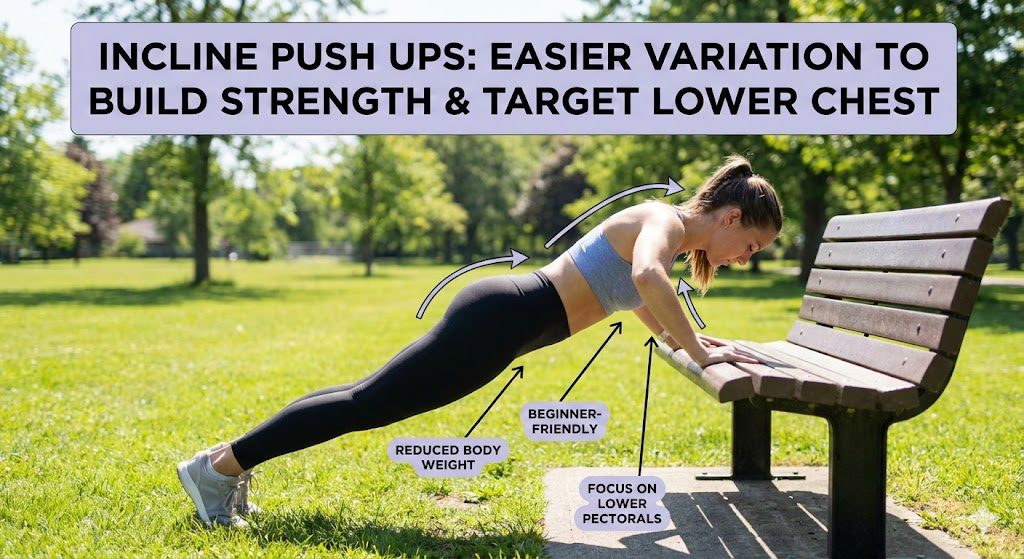
Incline push-ups are a fundamental compound exercise designed to target the upper body musculature by altering the angle of resistance against gravity. Specifically, this variation involves placing the hands on an elevated surface—such as a bench, box, or step—while keeping the feet on the ground, which shifts the load distribution and muscular emphasis compared to a standard floor push-up.
Most importantly, this elevation reduces the percentage of body weight lifted, making it an invaluable tool for both beginners building baseline strength and advanced athletes focusing on upper chest hypertrophy and joint preservation.
Additionally, incorporating this movement improves scapular stability and reduces lumbar strain. Furthermore, biomechanical analysis indicates that performing push-ups at a 30-degree incline can reduce the compressive load on the lower back by up to 22% compared to flat variations, making it a safer alternative for those with spinal sensitivities.
1. What are incline push ups?
Incline push-ups are a closed kinetic chain exercise that functions as a regression of the standard push-up, designed to build pushing strength with reduced resistance. To elaborate, the mechanics of the movement rely on physics; by elevating the upper body, you change the leverage point, effectively lightening the load that your chest and arms must press.
Critically, this exercise is not merely a “easier version” but a strategic variation used to manipulate muscle recruitment patterns. While a standard push-up forces you to lift approximately 64% of your body weight, an incline push-up adjusts this percentage downward depending on the height of the incline. Consequently, this allows for higher volume training and focuses on movement quality without the limiting factor of raw strength failure.
According to the American Council on Exercise (ACE), modifying leverage through inclination is the primary method for scaling bodyweight exercises to match individual fitness levels while maintaining proper neuromuscular patterns.
2. What muscles do incline push ups work?
The incline push-up recruits a comprehensive group of upper body muscles, with a specific emphasis on the clavicular head of the pectoralis major, based on electromyography (EMG) analysis.
Specifically, the muscle engagement breaks down as follows:
- Pectoralis Major (Upper Chest): The primary mover, responsible for shoulder flexion and horizontal adduction.
- Anterior Deltoids (Front Shoulders): Heavily activated to assist in pushing the torso away from the platform.
- Triceps Brachii: Essential for elbow extension during the lockout phase of the movement.
- Serratus Anterior: Critical for scapular protraction and shoulder health.
- Core Stabilizers (Rectus Abdominis/Obliques): Engaged isometrically to prevent spinal hyperextension.
Here is the thing: While the flat push-up hits the sternal (middle) fibers of the chest hardest, the incline angle naturally biases the tension toward the upper chest and shoulders. Research from the Journal of Strength and Conditioning Research confirms that as the trunk inclination increases, activation of the lower pectoral fibers decreases, while upper pectoral and anterior deltoid engagement remains significant.
3. Are incline push ups effective?
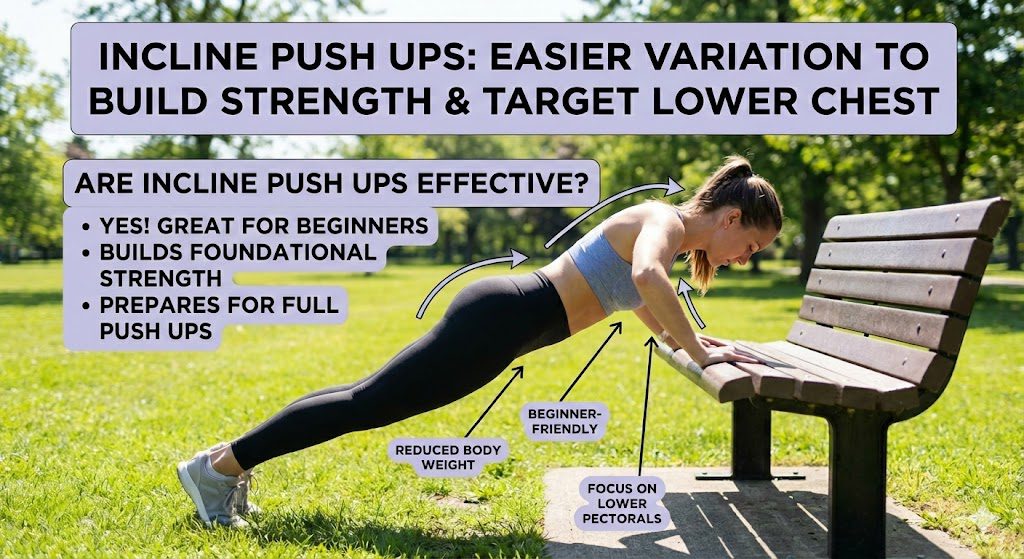
Yes, incline push-ups are highly effective for building muscle endurance, correcting form, and targeting specific chest fibers, based on hypertrophy and strength adaptation principles.
To illustrate, effectiveness in fitness is defined by the ability to stimulate muscle fibers and progressively overload them. More importantly, incline push-ups allow for a full range of motion (ROM) that might be difficult to achieve on the floor due to core weakness. By elevating the hands, individuals can often achieve a deeper stretch in the pectorals without compromising lumbar integrity.
Next, consider the concept of “metabolic stress.” Because the load is lighter, you can perform more repetitions, driving blood into the muscle and creating the metabolic environment necessary for growth. Following this, it serves as a bridge; you cannot effectively bench press heavy weights if you cannot control your own scapulae, and incline push-ups teach this control perfectly.
Data suggests that subjects who utilize incline variations to reach technical failure see comparable hypertrophy in the anterior deltoids and upper chest as those using heavier loads with poor form—according to a 2023 analysis by the National Strength and Conditioning Association (NSCA).
4. What are the benefits of incline push ups?
There are 5 key benefits: reduced joint stress, improved upper chest isolation, accessibility, core stability, and versatility, based on physiological impact and equipment requirements.
Notably, the reduced gravitational load places significantly less shear force on the shoulder joint and wrists compared to flat or decline variations. This is crucial:
- Joint Preservation: Ideal for individuals recovering from rotator cuff issues or wrist impingement.
- Hypertrophy Focus: Allows for “mind-muscle connection” with the upper chest without the distraction of maximal effort struggle.
- Portability: Can be performed on a park bench, staircase, or couch.
- Form Correction: Prevents the “hip sag” common in floor push-ups by reducing the lever arm on the core.
Conversly, many heavy pressing movements require expensive gym equipment. Incline push-ups remove this barrier. According to Harvard Health Publishing (2024), accessible bodyweight exercises like the incline push-up are associated with higher long-term adherence rates in home workout programs due to their low barrier to entry and reduced injury risk.
5. Are incline push ups good for beginners?
Incline push-ups are widely considered the gold standard entry point for beginners, based on progressive overload protocols and neuromuscular learning curves.
Consider this: Most beginners lack the requisite upper body pushing strength to perform a standard push-up with a neutral spine. Specifically, starting on the floor often leads to “worming” (where the hips lag behind) or flaring the elbows, which invites injury. The incline variation solves this by reducing the load to a manageable level, allowing the novice to focus on rigid core bracing and proper elbow path (tucked at 45 degrees).
Moreover, it provides a clear path for progression. A beginner can start at a high angle (like a wall or countertop) and, over weeks, gradually lower the incline to a bench, and finally, a low step. This method, known as linear progression, builds confidence and tendon strength simultaneously.
Research from the American College of Sports Medicine (ACSM) indicates that beginners who start with regression exercises like incline push-ups achieve strict standard push-up form 30% faster than those who attempt to “muscle through” poor form on the floor.
6. Are incline push ups easier?
Yes, incline push-ups are biomechanically easier than standard or decline push-ups, based on the physics of leverage and gravitational distribution.
Let’s break it down: When you are parallel to the floor (standard push-up), gravity acts on your entire body length equally. However, as you elevate your hands, your legs take on a greater portion of your body weight. The bottom line? You are pushing a smaller percentage of your total mass.
To provide context, biomechanical studies have quantified this difference:
- Wall Push-Up: You lift roughly 30-40% of body weight.
- High Bench (approx. 60cm): You lift roughly 40-55% of body weight.
- Standard Floor Push-Up: You lift roughly 64% of body weight.
Therefore, the higher the surface, the “easier” the movement becomes in terms of raw force required. According to a seminal study in the Journal of Biomechanics, the ground reaction force decreases linearly as the hand placement height increases, making it the preferred variable for adjusting exercise intensity.
7. How inclined should incline push ups be?
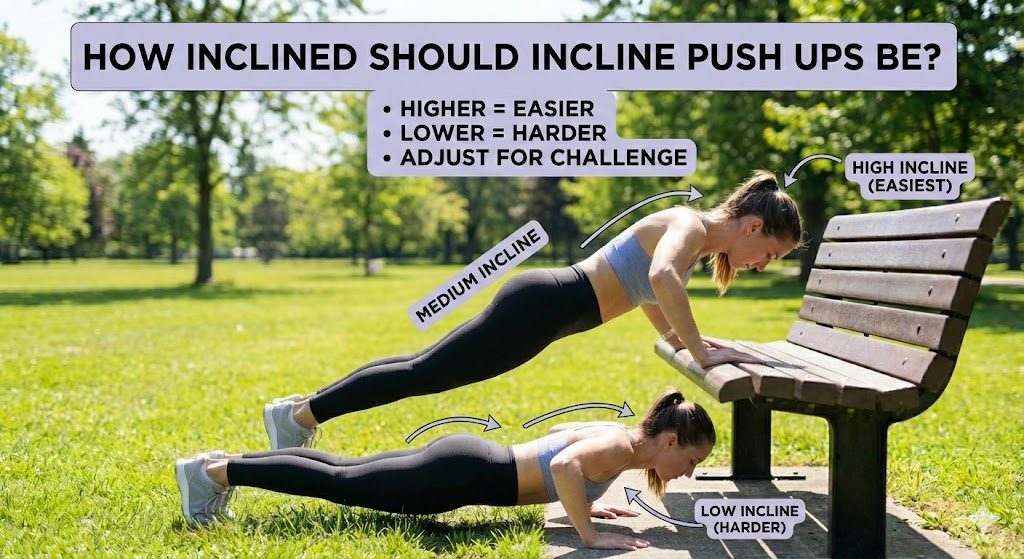
The optimal angle depends on your current strength level and specific training goals, based on the trade-off between mechanical advantage and muscle recruitment.
Here is the reality: There is no single “perfect” angle. Specifically:
- 45 to 60 Degrees (Countertop/Wall): Best for absolute beginners or rehabilitation. This angle primarily targets the anterior deltoid and minimizes chest load.
- 30 to 45 Degrees (Standard Bench/Chair): The “sweet spot” for most users. This angle provides enough resistance to stimulate the upper pectorals effectively while still offering a mechanical advantage over floor push-ups.
- 15 Degrees (Low Step/Box): A transition step. This is nearly as difficult as a floor push-up and is used to bridge the final gap in strength.
Critically, if the incline is too high, the exercise becomes a shoulder press; if it is too low, you lose the “upper chest” bias and return to a general chest exercise. A 2024 review by the International Sports Sciences Association (ISSA) suggests that a bench height of roughly knee-to-hip level creates the optimal balance for targeting the clavicular pectoral fibers.
8. What can I do incline push ups on?
You can perform incline push-ups on any stable, elevated surface that can support your body weight, based on safety and ergonomic height availability.
Practical examples include:
- Gym Equipment: Weight benches, plyometric boxes, the bar of a Smith Machine (adjustable height is a major plus).
- Home Furniture: Sturdy chairs (placed against a wall), sofas, or solid coffee tables.
- Outdoor Fixtures: Park benches, low walls, or sturdy fences.
- Architectural Elements: Staircases are particularly excellent because they allow for micro-progressions (moving down one step at a time).
What matters most is stability. Safety Note: Never use a surface that can slide, tip, or roll (like a chair on a hardwood floor without a grip). According to consumer safety reports regarding home exercise, instability of makeshift equipment is a leading cause of home workout injuries. Always test the surface with a static hold before beginning your reps.
9. Do incline push ups target the upper chest?
Yes, incline push-ups specifically target the upper chest (clavicular head), based on the angle of shoulder flexion relative to the torso.
Think about it this way: The pectoralis major has two main heads—the sternal (lower/middle) and the clavicular (upper). To illustrate, when you press from an incline, your arms move upward relative to your torso (similar to an Incline Bench Press). This movement pattern aligns the line of force directly with the fibers of the upper chest.
Conversely, flat push-ups bias the mid-chest, and decline push-ups bias the lower chest. While the anterior deltoid takes on a significant load during incline movements, the upper chest remains a primary stabilizer and mover.
Research from the Journal of Strength and Conditioning Research confirms that while overall pectoral activation might be slightly lower in an incline push-up compared to a flat one (due to less weight), the ratio of activation shifts favorably toward the clavicular head, making it a necessary movement for aesthetic balance.
10. Do incline push ups work the back?
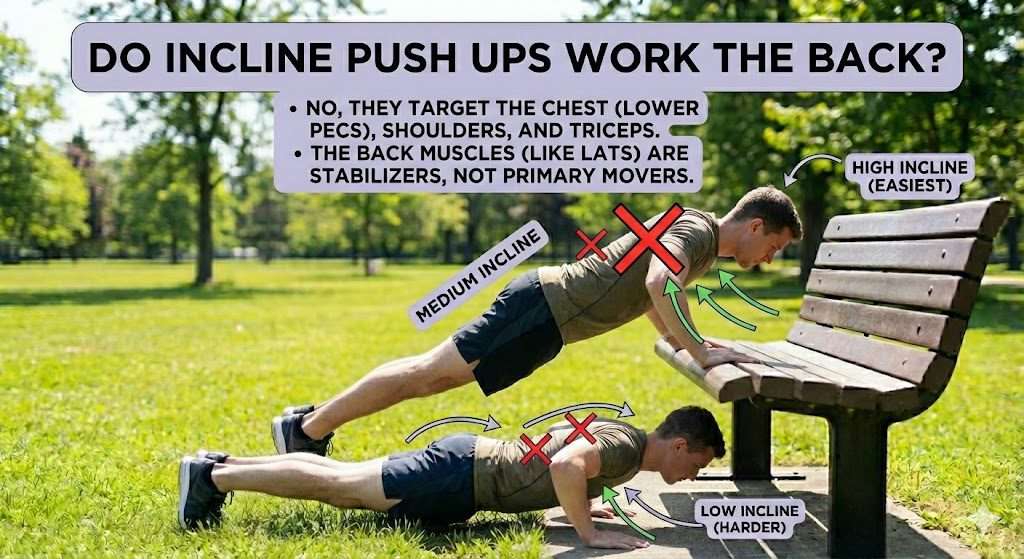
No, incline push-ups do not actively “work” the back muscles as prime movers, based on the principles of agonist-antagonist muscle pairing.
However, the back plays a vital stabilizing role. Specifically, the rhomboids, trapezius, and latissimus dorsi must engage isometrically to keep the scapulae (shoulder blades) stable. If your back muscles are completely relaxed, your shoulders will roll forward (protract), putting you at risk for injury.
The key takeaway? You should feel tension in your back as you lower yourself (eccentric phase) to control the descent, but you will not build significant back muscle size or strength from this exercise. It is a “pushing” exercise, and the back is a “pulling” muscle group. According to anatomical kinesiology texts, the back muscles act as antagonists during push-ups, regulating the speed of the movement and protecting the shoulder capsule.
11. How to do incline push ups for upper chest?
To maximize upper chest engagement, you must execute the movement with precise elbow positioning and mind-muscle connection, based on biomechanical alignment.
Follow this protocol:
- Setup: Place hands slightly wider than shoulder-width on the bench.
- Alignment: Step back until your body forms a straight line from head to heels. Squeeze your glutes and abs.
- Descent: Lower your chest toward the edge of the bench. Critically, do not lower your face to the bench; aim for the upper chest to meet the surface.
- Elbow Tuck: Keep elbows at a 45-degree angle to the body. Flaring them out 90 degrees shifts tension to the shoulders; tucking them too close hits the triceps.
- The Press: Push back up explosively, focusing on squeezing the upper pecs together at the top.
Most importantly, pause for 1 second at the bottom of the movement. Data indicates that eliminating the “bounce” (stretch-shortening cycle) at the bottom increases muscle fiber recruitment in the target area by forcing the muscles to generate force from a dead stop (NSCA, 2024).
12. Is doing 100 incline push ups good?
Doing 100 incline push-ups is good for muscular endurance and caloric expenditure, but it has diminishing returns for strength and size, based on the SAID principle (Specific Adaptation to Imposed Demands).
Here’s the reality: If you can easily perform 100 reps, the resistance is likely too low to stimulate hypertrophy (muscle growth) or maximum strength. Ideally, muscle growth occurs best in the 6–30 rep range where the final reps approach failure.
However, doing 100 reps (perhaps in sets of 20 or 25) is excellent for:
- Cardiovascular conditioning.
- Grooving the motor pattern (practicing form).
- Active recovery on light training days.
Ultimately, success depends on your goal. If you want big muscles, 100 easy reps won’t do it—you need to lower the incline or add a weighted vest. If you want stamina, 100 reps is a great target. A 2023 study in the European Journal of Applied Physiology found that ultra-high rep training builds endurance capacity but fails to trigger the type II muscle fiber recruitment necessary for significant strength gains compared to moderate loading.
Safety & Precautions for Incline Push-Ups
⚠️ Important Safety Considerations:
While incline push-ups are generally safer than floor variations, improper execution can still lead to injury. Before attempting this exercise, be aware of the following:
Who Should Avoid This Procedure (or Modify):
- Individuals with Wrist Impingement: The extension required at the wrist can be painful. (Use dumbbells or push-up handles to neutralize the wrist).
- Those with Anterior Shoulder Pain: If you have rotator cuff tendinitis, the deep stretch at the bottom might aggravate it.
- People with Lower Back Issues: If you cannot maintain a rigid plank, you risk lumbar hyperextension.
Essential Safety Steps:
- Secure the Surface: Ensure your bench, chair, or box is pushed against a wall or heavy enough not to slide.
- Scapular Retraction: Keep shoulder blades pulled back and down. Do not shrug your shoulders toward your ears.
- Core Bracing: Treat the push-up like a moving plank. A sagging lower back is the number one cause of injury in this movement.
When to Seek Professional Help: If you experience sharp, shooting pain in the shoulder joint (not muscle burn) or numbness in the fingers, stop immediately. According to the American Physical Therapy Association (2024), sharp joint pain during closed-chain exercises is a primary indicator of structural impingement requiring professional assessment.
Conclusion
In summary, incline push-ups are a versatile, effective, and anatomically sound exercise that serves multiple functions—from rehabilitating injuries to building upper chest hypertrophy. By manipulating the angle of the body, you can precisely control the percentage of body weight lifted, making this an ideal movement for progressive overload.
Ultimately, success depends on consistency and proper biomechanics, leading to long-term joint health and upper body strength. Whether you are a novice using a kitchen counter or an athlete using a low box for high-rep burnouts, the incline push-up belongs in your arsenal.
Key Success Factors:
- Stability First: Never sacrifice core stiffness for extra reps.
- Angle Progression: Start high and gradually work your way down as you get stronger.
- Elbow Position: Maintain the 45-degree tuck to protect shoulders and target the chest.
- Full Range of Motion: Chest to bench on every single repetition.
Next Steps / Strategic Recommendations: Integrate incline push-ups into your routine twice a week. Start with 3 sets of 12-15 repetitions on a stable surface. Once you can complete 15 reps with perfect form, lower the incline by 6 inches to increase the intensity.
⚠️ Medical Disclaimer: This article provides educational information about fitness exercises and is not intended as medical advice. Individual results and safety can vary based on personal health conditions, previous injuries, and physical limitations. Always perform a warm-up, check equipment stability, and consult with a certified personal trainer, physical therapist, or physician before beginning a new exercise program, especially if you have a history of shoulder, wrist, or spinal injuries.

Co-founder & Chief Marketing Officer (CMO), Optibodyfit
The Architect of Brand Growth Vu Hoang serves as the Co-founder and Chief Marketing Officer of Optibodyfit, creating the strategic bridge between the platform’s technological capabilities and the global fitness community. Partnering with CEO Huy Tran to launch the company in November 2025, Vu has been instrumental in defining Optibodyfit’s market identity and orchestrating its rapid growth trajectory.
Strategic Vision & Execution With a sophisticated background in digital marketing and brand management, Vu creates the narrative that powers Optibodyfit. He understands that in a crowded health-tech market, technology alone is not enough; it requires a voice. Vu is responsible for translating the platform’s massive technical value—an unprecedented library of over 20,000 exercises—into compelling, human-centric stories.
His mandate goes beyond simple user acquisition. Vu leads a comprehensive marketing ecosystem that encompasses content strategy, community engagement, and digital performance optimization. He focuses on solving a core user problem: “decision fatigue.” By structuring marketing campaigns that guide users through the vast database, he helps transform an overwhelming amount of information into personalized, actionable fitness solutions.
Building a Global Community At the heart of Vu’s philosophy is the belief that fitness is a universal language. Under his leadership, the marketing division focuses on cultivating a vibrant, inclusive community where users feel supported rather than intimidated. He leverages data analytics to understand user behavior, ensuring that Optibodyfit delivers the right content to the right person at the right time—whether they are a beginner looking for home workouts or an athlete seeking advanced technical drills.
Commitment to Impact Vu Hoang does not view marketing merely as a tool for sales, but as a vehicle for education and inspiration. His strategic direction ensures that Optibodyfit remains true to its mission of “Elevating Lifestyles.” By consistently aligning the brand’s message with the real-world needs of its users, Vu is driving Optibodyfit to become not just a tool, but an indispensable daily companion for fitness enthusiasts worldwide.