Seated Calf Raises: Productive or No? (vs. Standing Raises)
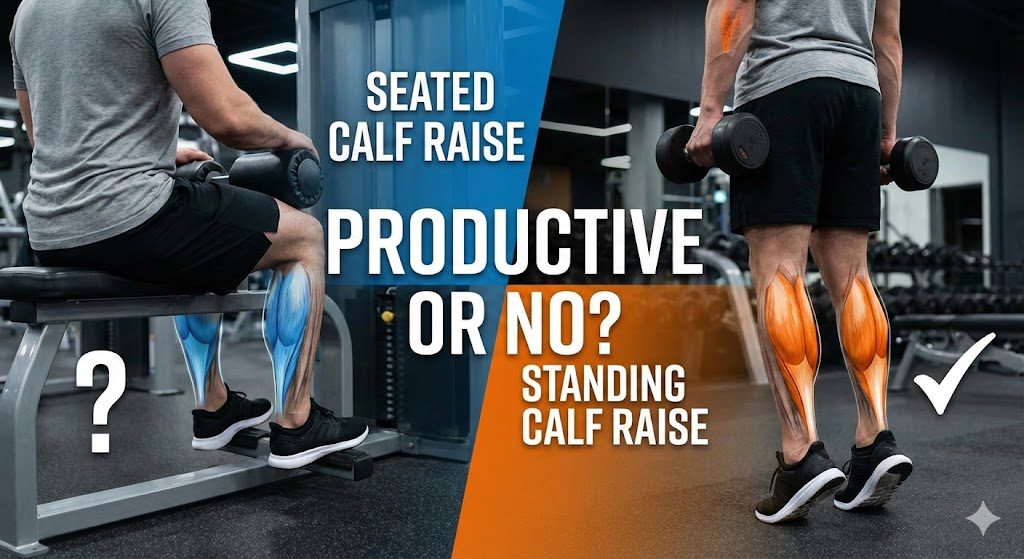
Seated Calf Raises are undoubtedly productive, serving as the primary exercise to target the Soleus muscle, essential for adding width and thickness to the lower leg, while standing variations focus on the Gastrocnemius. Specifically, neglecting this exercise results in incomplete calf development, as the seated position mechanically isolates the Soleus by placing the Gastrocnemius in a state of active insufficiency. Therefore, for a complete, 3D lower leg aesthetic and optimal functional strength, seated calf raises are not just productive but mandatory.
The difference between Seated and Standing Calf Raises lies in the knee angle and muscle recruitment; whereas standing raises target the larger, diamond-shaped Gastrocnemius for overall mass, seated raises isolate the underlying Soleus for lateral width. Furthermore, understanding this distinction is crucial because the Soleus makes up a significant portion of the calf volume but is often undertrained in standing-only routines.
You can unlock key benefits such as improved ankle stability, greater lower leg width, and reduced spinal loading by incorporating Seated Calf Raises, additionally, performing them correctly requires strict attention to range of motion and tempo to eliminate tendon elasticity. Moreover, mastering the technique ensures that the tension remains on the muscle fibers rather than the Achilles tendon, maximizing hypertrophy.
However, to fully realize these gains, you must navigate common variations and mistakes, such as performing seated raises at home without a machine, troubleshooting why your calves aren’t growing, understanding ankle mobility benefits, and knowing how to program seated vs. standing raises. Consequently, addressing these nuances allows you to build a comprehensive lower body routine that prevents injury and breaks through training plateaus.
Are Seated Calf Raises Productive or No?
Seated Calf Raises are highly productive because they are the single most effective movement for isolating the Soleus muscle, adding structural width to the lower leg, and correcting muscular imbalances. To clarify, many lifters mistakenly believe calf training is redundant if they squat or deadlift, yet the specific biomechanics of the seated raise offer unique benefits that compound movements cannot replicate.
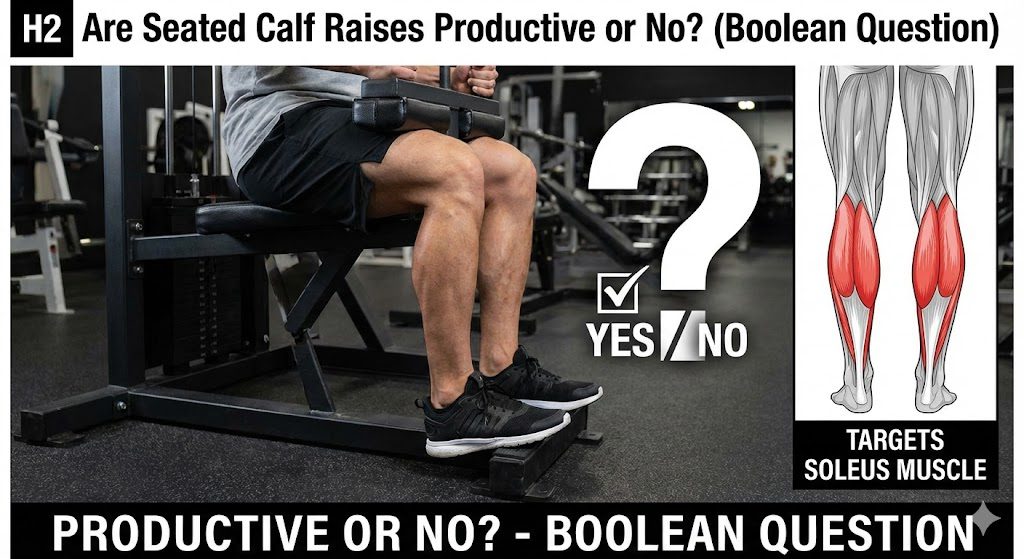
Seated Calf Raises act as a critical tool for hypertrophy and function due to the following reasons:
- Targeted Soleus Isolation: The Soleus comprises roughly 60-70% of the triceps surae (calf muscle group) volume.
- Correction of “Skinny Calves”: While the Gastrocnemius provides the “diamond” shape, the Soleus pushes that muscle out, creating a wider look from the front and back.
- Reduced Axial Loading: Unlike standing machine raises, seated versions place zero compressive load on the spine.
According to biomechanical analysis from the Journal of Strength and Conditioning Research, the Soleus muscle consists predominantly of slow-twitch fibers and requires direct, high-volume isolation in a flexed-knee position to maximize hypertrophy.
What Is the Difference Between Seated and Standing Calf Raises?
The difference between Seated and Standing Calf Raises is primarily defined by knee flexion angle, which dictates whether the Gastrocnemius or the Soleus bears the primary load. Specifically, Standing Calf Raises target the Gastrocnemius (the visible heart-shaped muscle) for overall size, while Seated Calf Raises target the Soleus (the deep muscle) for width and thickness. In other words, treating these two exercises as interchangeable is a fundamental error in leg training; they are complementary, not competitive.
To better understand this distinction, we must look at the unique mechanics of the lower leg muscles:
Active Insufficiency of the Gastrocnemius
- Mechanism: The Gastrocnemius crosses two joints: the knee and the ankle. When the knee is bent at 90 degrees (seated), the muscle is shortened at the knee joint.
- Result: This creates “active insufficiency,” meaning the Gastrocnemius becomes slack and cannot generate significant force.
- Outcome: The body is forced to rely almost entirely on the Soleus to perform the plantar flexion (pointing the toe), making the seated variation a pure isolation movement.
Structural Recruitment of the Soleus
- Mechanism: The Soleus only crosses the ankle joint, meaning its length and tension capabilities are unaffected by knee position.
- Result: In the standing position, both muscles work, but the Gastrocnemius often takes over. In the seated position, the Soleus has no choice but to do the work.
- Outcome: This creates the “width” of the calf, as a developed Soleus pushes the Gastrocnemius outward.
“According to standard anatomical texts, the Gastrocnemius acts as a dynamic mover for explosive power, while the Soleus acts as a postural stabilizer, requiring different training stimuli.”
What Are the Key Benefits of Performing Seated Calf Raises?
The key benefits of performing Seated Calf Raises include enhancing lower leg aesthetics (width), improving performance in running and jumping, and promoting joint health through minimized spinal compression. Beyond aesthetics, this exercise serves as a functional pillar for athletes and general fitness enthusiasts alike.
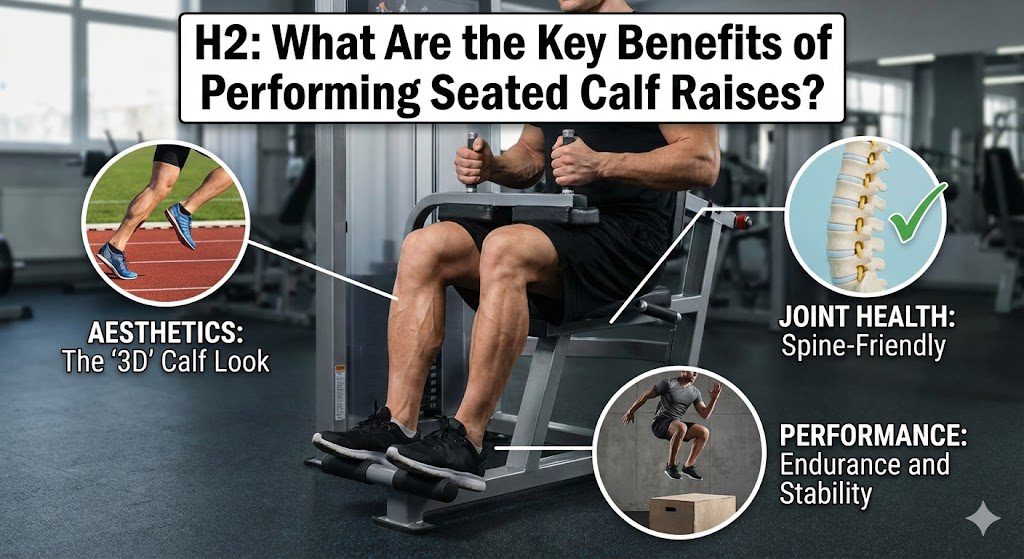
Here are the specific benefits detailed below:
Aesthetics: The “3D” Calf Look
- Visual Impact: Many lifters have high-inserting Gastrocnemius muscles, leading to a “high calves” look. You cannot change muscle insertion, but you can grow the Soleus.
- The “Push” Effect: A hypertrophied Soleus sits underneath the Gastrocnemius. As it grows, it pushes the outer muscles further away from the bone, making the legs look wider from the front view.
Performance: Endurance and Stability
- Runner’s Muscle: The Soleus is often called the “second heart” because of its role in pumping blood back up the leg and its incredible fatigue resistance.
- Vertical Stability: Strong Soleus muscles stabilize the tibia on the foot, preventing knee collapse during heavy squats or jump landings.
Joint Health: Spine-Friendly Hypertrophy
- No Axial Load: Standing calf machines often require heavy weight resting on the shoulders, compressing the spine.
- Isolation Focus: The seated variation places the load directly on the distal thigh (quadriceps), completely bypassing the spinal column, making it ideal for those with back pain.
“A study published in the Journal of Applied Physiology indicates that the Soleus is capable of withstanding extremely high loading and volume without fatigue, making it crucial for lower body endurance.”
How to Perform Seated Calf Raises Correctly?
To perform Seated Calf Raises correctly, you must adjust the pads to rest on the quadriceps (not the knees), execute a full range of motion by dropping the heels deep, and control the tempo to prevent bouncing. Crucially, the effectiveness of this exercise is often ruined by “ego lifting” and using momentum rather than muscle tension.
Follow these steps for optimal execution:
Setup: Pad Placement and Positioning
- Pad Position: Adjust the knee pad so it sits firmly on the lower quadriceps, just above the knee cap. Never place it directly on the knee joint.
- Foot Placement: Place the balls of your feet on the platform edge. Your toes should point straight forward or slightly out.
- Security: Grip the handles to keep your upper body stable and prevent sliding.
Range of Motion (ROM): The “Stretch and Squeeze”
- Deep Stretch: Lower your heels as far as flexible limits allow. The Soleus responds exceptionally well to loaded stretching.
- Peak Contraction: Press up onto the balls of your feet as high as possible. Imagine trying to stand on your big toes.
- Common Mistake: Doing partial reps in the middle range minimizes recruitment.
Tempo: Killing the Bounce
- The Achilles Trap: The Achilles tendon is like a rubber band. If you bounce out of the bottom, the tendon moves the weight, not the muscle.
- The Fix: Lower the weight over 2-3 seconds. Pause for 1 second at the bottom (dead stop). Explode up.
- Result: This removes the elastic energy and forces the Soleus to contract from a dead stop.
“According to hypertrophy experts, inserting a 1-second pause at the bottom of the movement increases muscle activation significantly by negating the stretch-shortening cycle of the Achilles tendon.”
What Are Common Variations and Mistakes in Seated Calf Training?
Common variations and mistakes in Seated Calf Training involve improvising without machines at home, troubleshooting non-responsive growth, leveraging the movement for mobility, and programming the correct ratio of seated to standing work. Furthermore, understanding these nuances transforms Seated Calf Raises from a simple accessory movement into a strategic tool for lower body mastery.
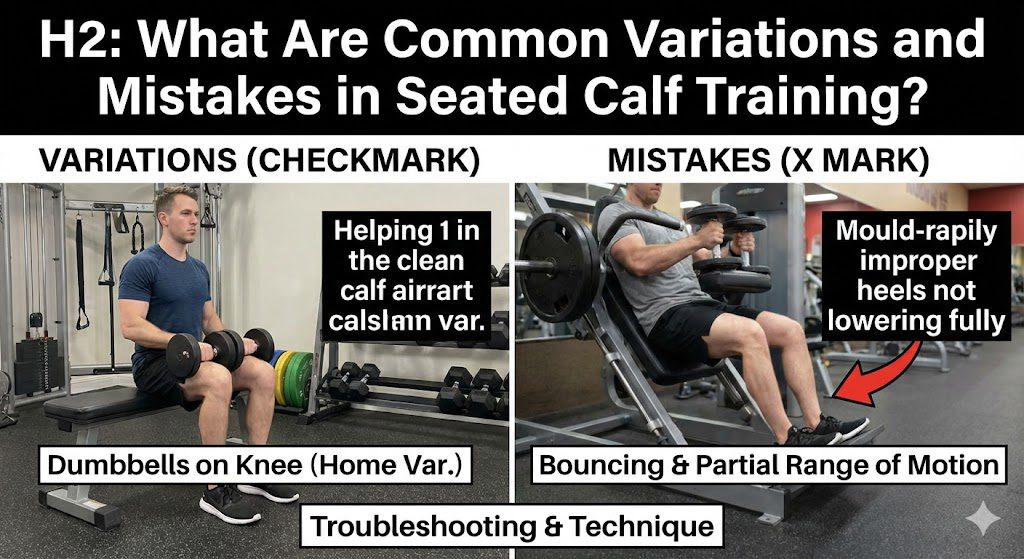
Let’s explore these supplementary aspects in detail:
Can You Do Seated Calf Raises At Home Without a Machine?
Yes, you can do Seated Calf Raises at home using dumbbells or resistance bands by placing the weight on your knees while seated on a bench or chair.
- The Setup: Sit on a sturdy chair. Place a block or step under your toes to allow for the heels to drop (creating a deficit).
- The Load: Place heavy dumbbells vertically on your lower thighs (use a towel or pad to protect the skin).
- Efficacy: While slightly harder to stabilize than a machine, this variation is equally effective if the range of motion is maintained.
Why Are Your Calves Not Growing Despite Seated Exercises?
Your calves are likely not growing because of insufficient volume, poor range of motion, or reliance on tendon elasticity (bouncing).
- Volume Issue: The Soleus is a slow-twitch dominant muscle. It often requires higher repetitions (15-25 reps) and shorter rest periods to fatigue fully.
- Intensity: Because the calf is used to carrying your body weight all day, it is stubborn. You must train it close to failure.
- The “Bounce”: As mentioned, bouncing destroys hypertrophy potential. Stop the bounce to start the growth.
Do Seated Calf Raises Help with Ankle Mobility and Injury Prevention?
Seated Calf Raises significantly help with ankle mobility and injury prevention by loading the ankle in deep dorsiflexion, stretching the tight structures of the lower calf.
- Dorsiflexion: Improving the ability of the knee to travel over the toe is crucial for squat depth. Seated raises stretch the Soleus, which is often the limiting factor in poor ankle mobility.
- Achilles Health: Controlled, slow eccentric loading is a gold-standard rehabilitation method for Achilles tendinopathy, helping to realign collagen fibers in the tendon.
How Should You Program Seated vs. Standing Raises in a Routine?
You should program Seated vs. Standing Raises in a ratio that reflects your weaknesses, typically a 1:1 ratio for general fitness or 2:1 favoring the weak point for bodybuilding.
- Standard Split: Perform one standing exercise (heavy, lower reps: 8-12) and one seated exercise (lighter, higher reps: 15-25) in the same session.
- Frequency: Calves recover quickly. Training them 2-3 times per week is often necessary for optimal results.
- Placement: If calves are a weak point, train them at the beginning of the workout when you are fresh, rather than treating them as an afterthought.
“Research suggests that a mix of high and low repetitions, targeting both the Soleus and Gastrocnemius, yields the best results for overall calf circumference.”
Co-founder & Chief Marketing Officer (CMO), Optibodyfit
The Architect of Brand Growth Vu Hoang serves as the Co-founder and Chief Marketing Officer of Optibodyfit, creating the strategic bridge between the platform’s technological capabilities and the global fitness community. Partnering with CEO Huy Tran to launch the company in November 2025, Vu has been instrumental in defining Optibodyfit’s market identity and orchestrating its rapid growth trajectory.
Strategic Vision & Execution With a sophisticated background in digital marketing and brand management, Vu creates the narrative that powers Optibodyfit. He understands that in a crowded health-tech market, technology alone is not enough; it requires a voice. Vu is responsible for translating the platform’s massive technical value—an unprecedented library of over 20,000 exercises—into compelling, human-centric stories.
His mandate goes beyond simple user acquisition. Vu leads a comprehensive marketing ecosystem that encompasses content strategy, community engagement, and digital performance optimization. He focuses on solving a core user problem: “decision fatigue.” By structuring marketing campaigns that guide users through the vast database, he helps transform an overwhelming amount of information into personalized, actionable fitness solutions.
Building a Global Community At the heart of Vu’s philosophy is the belief that fitness is a universal language. Under his leadership, the marketing division focuses on cultivating a vibrant, inclusive community where users feel supported rather than intimidated. He leverages data analytics to understand user behavior, ensuring that Optibodyfit delivers the right content to the right person at the right time—whether they are a beginner looking for home workouts or an athlete seeking advanced technical drills.
Commitment to Impact Vu Hoang does not view marketing merely as a tool for sales, but as a vehicle for education and inspiration. His strategic direction ensures that Optibodyfit remains true to its mission of “Elevating Lifestyles.” By consistently aligning the brand’s message with the real-world needs of its users, Vu is driving Optibodyfit to become not just a tool, but an indispensable daily companion for fitness enthusiasts worldwide.