Is There Any Benefit to Doing Calf Raises Barefoot? An In-Depth Analysis
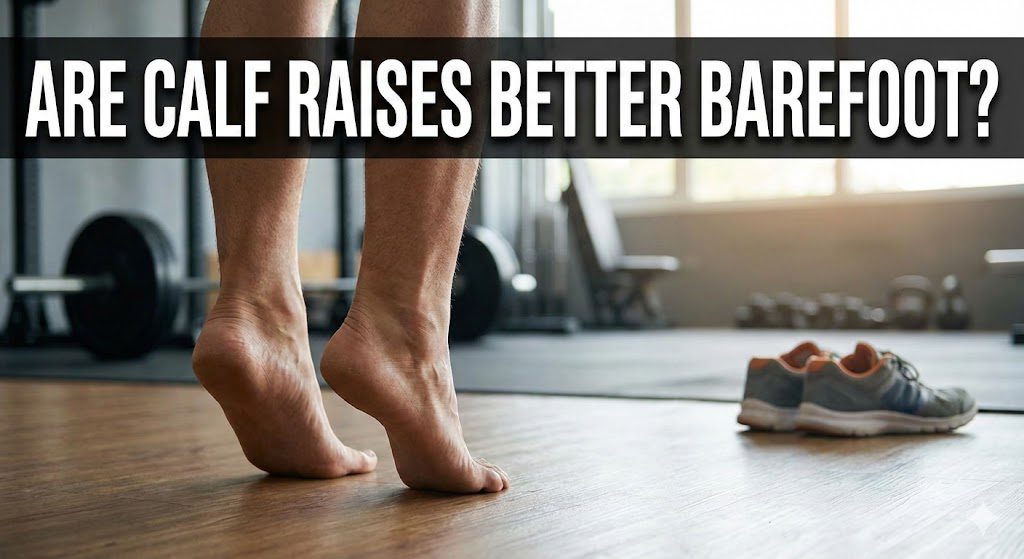
Yes, performing calf raises barefoot offers significant benefits, including maximized range of motion, enhanced activation of intrinsic foot muscles, and improved proprioception compared to training in shoes. Specifically, removing the artificial buffer of a shoe sole allows the ankle to move through its full natural degree of dorsiflexion and plantarflexion, leading to superior hypertrophy in the Gastrocnemius and Soleus muscles. Furthermore, this method strengthens the stabilizing muscles of the arch, potentially correcting minor balance issues over time.
The primary benefits of barefoot calf raises extend beyond simple muscle growth; they include increased ankle mobility, better ground connection, and strengthened plantar fascia. Moreover, training without shoes forces the body to rely on its natural mechanics for stability rather than the artificial support of a stiff sneaker, which translates to better functional strength in athletic movements.
When comparing barefoot calf raises to wearing lifting shoes, the barefoot approach allows for better muscle isolation and natural joint articulation, whereas shoes provide artificial stability that can mask muscle imbalances. However, while shoes allow for heavier absolute loads due to the rigid platform, barefoot training ensures that the load is managed by the actual musculature of the lower leg, providing a higher quality of contraction.
It is crucial to consider specific biomechanical risks, such as potential strain on the plantar fascia, reduced shock absorption, and considerations for individuals with flat feet or Achilles tendonitis. Consequently, understanding who should avoid this method and how to implement proper techniques—like toe gripping—is essential for safety. Below, we will analyze the effectiveness, benefits, comparisons, and safety considerations of barefoot calf training.
Is Barefoot Training Effective for Calf Muscle Development?
Yes, barefoot training is highly effective for calf muscle development because it increases the range of motion, forces greater recruitments of stabilizer muscles, and improves the neuromuscular connection with the lower leg. To understand this effectiveness, we must look at how the removal of footwear alters the mechanics of the calf raise.
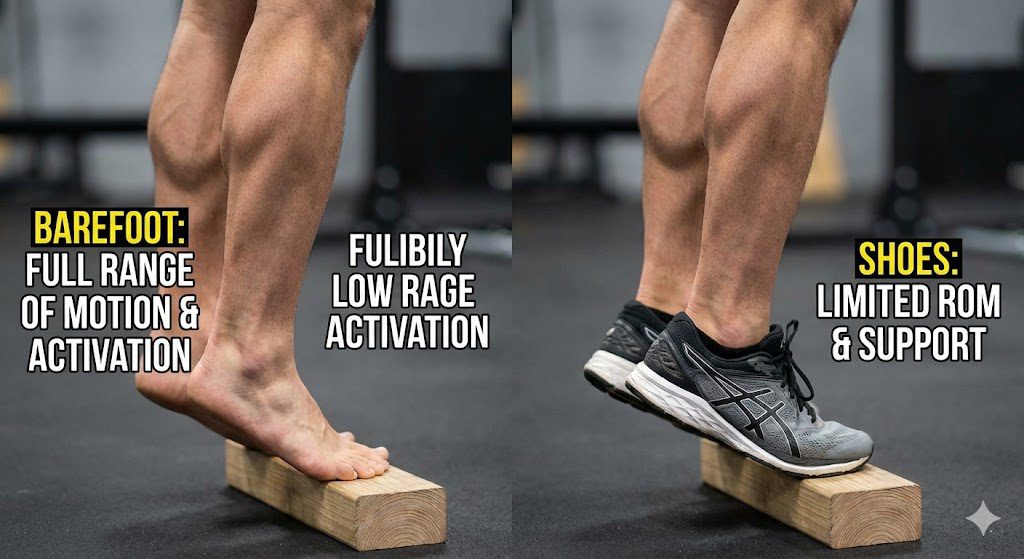
Specifically, when you remove shoes, you eliminate the heel elevation and the cushioning that typically shorten the muscle fiber’s operating length. This allows the calf muscles to stretch fully at the bottom of the movement (eccentric phase) and contract completely at the top (concentric phase) without mechanical hindrance. By engaging the feet directly with the ground, you create a kinetic chain that demands more work from the Gastrocnemius and Soleus, leading to a more potent hypertrophic stimulus.
According to a study published in the Journal of Strength and Conditioning Research, training through a full range of motion significantly increases muscle hypertrophy compared to partial range movements often caused by restrictive footwear.
What Are the Primary Benefits of Barefoot Calf Raises?
There are two primary benefits of barefoot calf raises: significantly increased Range of Motion (ROM) and the strengthening of intrinsic foot muscles. Let’s examine how these specific physiological advantages contribute to better overall leg development.
How Does Removing Shoes Increase Range of Motion (ROM)?
Removing shoes increases Range of Motion (ROM) by eliminating the heel drop and removing the rigid sole that often stops the foot from achieving maximum dorsiflexion. In other words, most athletic shoes have a heel-to-toe drop (often 4mm to 10mm) and a thick sole that physically blocks your heel from touching the floor or a block’s lowest point.
When you train barefoot, your heel can descend past the point where a shoe would normally stop it. This deep stretch places the calf muscles under tension for a longer duration and at a greater length. Since muscle growth is highly correlated with stretch-mediated hypertrophy, this extra inch of movement can lead to significantly better gains over time.
How Does Barefoot Training Strengthen the Intrinsic Foot Muscles?
Barefoot training strengthens the intrinsic foot muscles—the small muscles located within the foot itself—by forcing them to actively grip and stabilize the arch without external support. This means that instead of your shoe holding your foot in place, your body must do the work.
Specifically, inside a shoe, the small muscles responsible for maintaining the arch and gripping the floor often become dormant or “lazy.” By doing calf raises barefoot, these muscles (such as the abductor hallucis) must fire intensely to keep you balanced. This “foot core” strength translates to better stability in squats, deadlifts, and running, making your entire lower body foundation more robust.
How Do Barefoot Calf Raises Compare to Wearing Lifting Shoes?
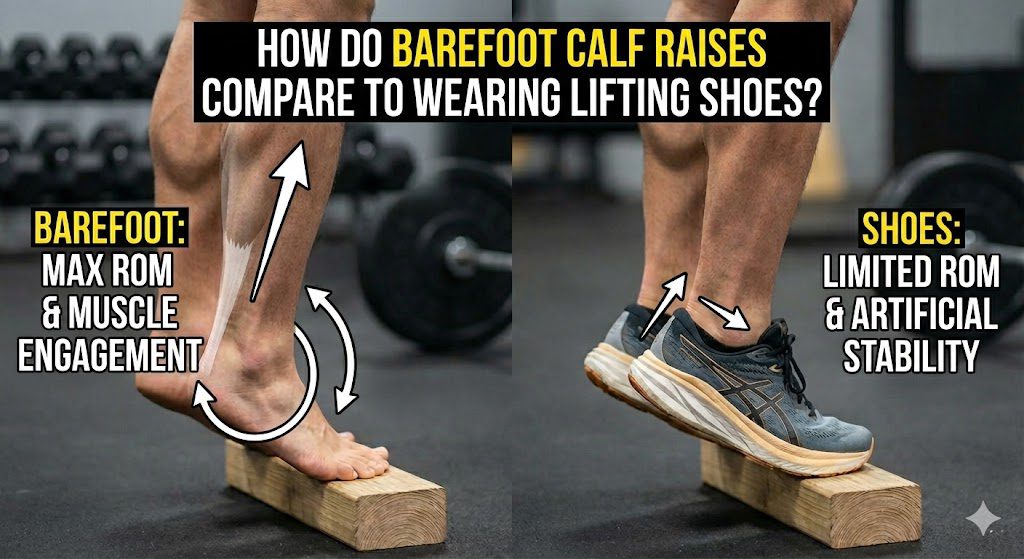
Barefoot calf raises generally win on muscle isolation and natural mechanics, while wearing lifting shoes is better for absolute load stability and foot protection. However, for the specific goal of hypertrophy and functional foot health, the barefoot approach offers distinct advantages that shoes cannot replicate.
Which Method Provides Better Gastrocnemius and Soleus Isolation?
The barefoot method provides better Gastrocnemius and Soleus isolation because it removes the “spring” effect of rubber soles and prevents momentum cheating derived from shoe stiffness. Consequently, the muscle fibers must generate 100% of the force required to lift the body.
In contrast, many running shoes have cushioned midsoles that compress and rebound, effectively doing some of the work for you. When barefoot, there is zero energy leak; the force transfer is direct from the metatarsals to the floor. This forces the calf muscles to work harder to stabilize the load, resulting in a purer isolation exercise that exposes and corrects left-to-right imbalances.
Do Shoes Limit the Natural Movement of the Ankle Joint?
Yes, shoes often limit the natural movement of the ankle joint, particularly high-tops or shoes with stiff heel counters, which restrict full plantarflexion and reduce proprioceptive feedback. Therefore, relying solely on shoes can lead to stiff ankles and reduced athletic agility over time.
Specifically, the ankle is designed to articulate through a complex range of motion. Rigid footwear acts as a cast, locking the ankle into a specific path. Barefoot calf raises allow the ankle to micro-adjust naturally, ensuring that the pressure is distributed evenly across the joint surfaces rather than being forced into an artificial track dictated by the shoe’s manufacturing last.
What Are the Specific Biomechanical Risks and Considerations?
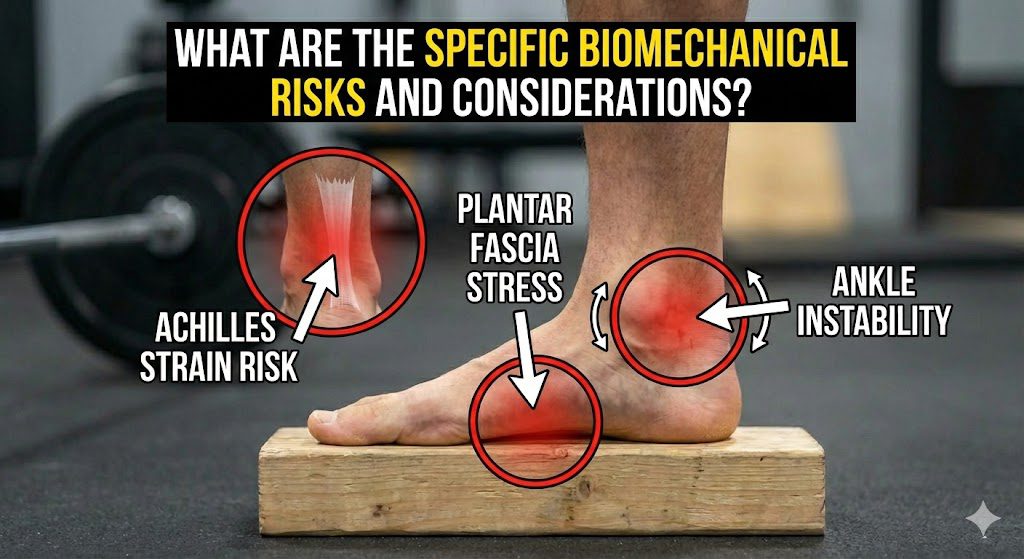
The specific biomechanical risks and considerations for barefoot calf raises include potential aggravation of Plantar Fasciitis, the need for enhanced proprioception, contraindications for specific foot conditions, and the importance of active toe grip. While the benefits are substantial, approaching this training method requires caution and an understanding of your own biomechanics to avoid injury.
Can Barefoot Calf Raises Help With Plantar Fasciitis and Flat Feet?
Yes, barefoot calf raises can help with Plantar Fasciitis and flat feet by strengthening the arch through the Windlass mechanism, provided they are introduced gradually. However, jumping straight into heavy barefoot volume can worsen these conditions if the tissues are not adapted.
For individuals with flat feet, barefoot raises force the arch to actively lift, which can help rebuild the natural curve of the foot over time. However, if you currently suffer from acute Plantar Fasciitis inflammation, the deep stretch at the bottom of a barefoot raise might place excessive tension on the fascia. It is best to start with bodyweight only to strengthen the tissue before adding external load.
How Does Proprioception Improve Without Shoe Cushioning?
Proprioception improves without shoe cushioning because sensory receptors in the soles make direct contact with the ground, sending immediate feedback to the brain regarding balance and position. This enhanced sensory loop allows for faster micro-corrections in posture and balance.
Cushioned shoes dampen this signal, creating a delay in neuromuscular response. By training barefoot, you heighten your body’s kinesthetic awareness. This improved proprioception helps you feel exactly how your weight is distributed across the ball of your foot, preventing you from rolling your ankles outward (supination) or inward (pronation) excessively during the lift.
Who Should Avoid Performing Heavy Calf Raises Barefoot?
Individuals who should avoid performing heavy calf raises barefoot include those with acute Achilles tendonitis, severe structural foot deformities, or diabetes-related neuropathy. For these groups, the lack of support and protection can lead to tissue rupture or unnoticed injuries.
Specifically, if you have a history of Achilles issues, the increased stretch afforded by going barefoot might place too much load on the tendon before it is ready. In such cases, a shoe with a higher heel drop can act as a safety crutch while the tendon heals. Additionally, in crowded gyms, training barefoot poses a safety risk from dropped weights, so awareness of your surroundings is paramount.
What Role Does Toe Grip Play in Peak Contraction?
Toe grip plays a critical role in peak contraction by activating the long toe flexor muscles, which assist the triceps surae in generating maximum force at the very top of the movement. Therefore, failing to engage the toes results in a weaker contraction and less stability.
To perform this correctly, as you rise onto the balls of your feet, you should actively press your toes into the floor. This action anchors the foot and engages the deep posterior compartment muscles. Without the stiffness of a shoe sole to “bridge” the toes, you must consciously engage them, which adds another layer of muscular development to the lower leg that is often missed in shod training.

Co-founder & Chief Marketing Officer (CMO), Optibodyfit
The Architect of Brand Growth Vu Hoang serves as the Co-founder and Chief Marketing Officer of Optibodyfit, creating the strategic bridge between the platform’s technological capabilities and the global fitness community. Partnering with CEO Huy Tran to launch the company in November 2025, Vu has been instrumental in defining Optibodyfit’s market identity and orchestrating its rapid growth trajectory.
Strategic Vision & Execution With a sophisticated background in digital marketing and brand management, Vu creates the narrative that powers Optibodyfit. He understands that in a crowded health-tech market, technology alone is not enough; it requires a voice. Vu is responsible for translating the platform’s massive technical value—an unprecedented library of over 20,000 exercises—into compelling, human-centric stories.
His mandate goes beyond simple user acquisition. Vu leads a comprehensive marketing ecosystem that encompasses content strategy, community engagement, and digital performance optimization. He focuses on solving a core user problem: “decision fatigue.” By structuring marketing campaigns that guide users through the vast database, he helps transform an overwhelming amount of information into personalized, actionable fitness solutions.
Building a Global Community At the heart of Vu’s philosophy is the belief that fitness is a universal language. Under his leadership, the marketing division focuses on cultivating a vibrant, inclusive community where users feel supported rather than intimidated. He leverages data analytics to understand user behavior, ensuring that Optibodyfit delivers the right content to the right person at the right time—whether they are a beginner looking for home workouts or an athlete seeking advanced technical drills.
Commitment to Impact Vu Hoang does not view marketing merely as a tool for sales, but as a vehicle for education and inspiration. His strategic direction ensures that Optibodyfit remains true to its mission of “Elevating Lifestyles.” By consistently aligning the brand’s message with the real-world needs of its users, Vu is driving Optibodyfit to become not just a tool, but an indispensable daily companion for fitness enthusiasts worldwide.