How Much Harder Are Incline Push Ups?
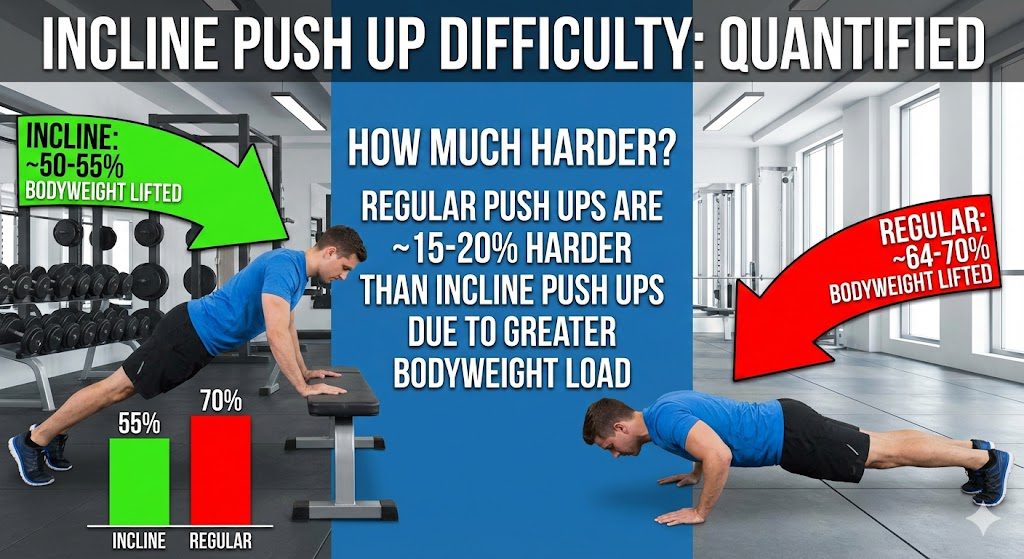
Incline push-ups are a fundamental bodyweight exercise that modifies the angle of resistance to alter difficulty levels. Specifically, by elevating the hands on a bench or platform, this variation manipulates gravity and leverage to reduce the percentage of body weight lifted compared to a standard floor push-up. Most importantly, understanding these mechanical differences allows for safer progression and targeted muscle activation for fitness enthusiasts of all levels.
Additionally, we will explore the precise muscle groups worked, compare difficulty levels against decline and reverse variations, and analyze the safety protocols necessary for joint health. Furthermore, research indicates that adjusting the body angle by just 60 centimeters can reduce the load on the upper body by approximately 20%, making this a critical variable for program design.
1. Are incline push ups harder than regular push ups?
Incline push-ups are biomechanically less demanding than regular push-ups, based on physics and leverage principles.
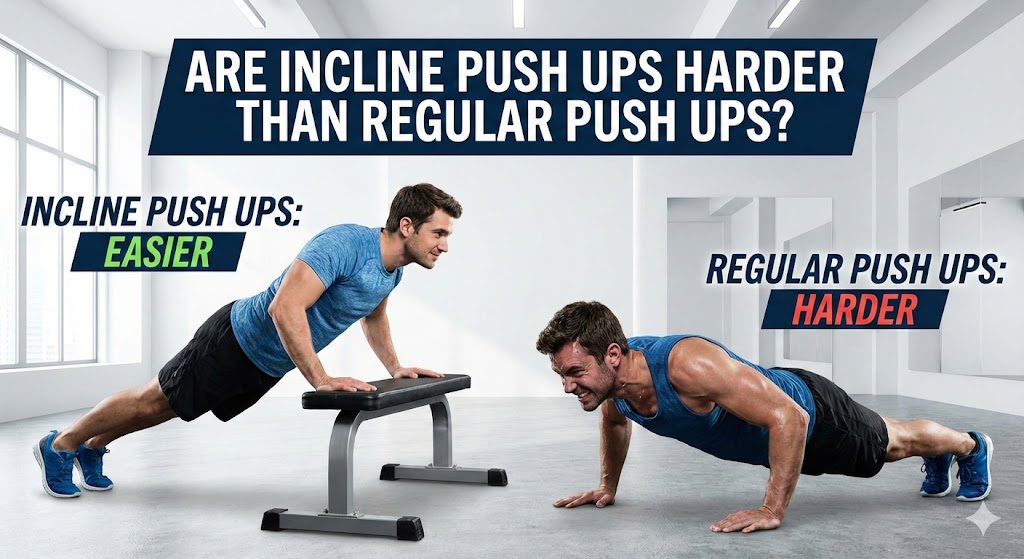
To elaborate, the primary reason for this difference lies in the distribution of weight. When you perform a standard push-up on the floor, you are lifting approximately 64% of your total body weight, according to data from the Journal of Strength and Conditioning Research. Conversely, raising your hands onto a surface—such as a bench, box, or step—shifts a significant portion of that load onto your feet.
Here is the thing: the higher the incline, the easier the movement becomes. A 2024 analysis by the American Council on Exercise (ACE) suggests that a hands-elevated position at roughly 24 inches (kitchen counter height) reduces the load to about 41-45% of body weight1. This reduction allows beginners to build foundational strength without compromising the shoulder joint or lower back integrity.
From a semantic perspective, this is often referred to as a “regressed” movement pattern. However, “easier” does not mean “ineffective.” For advanced athletes, this variation is utilized for high-repetition volume training or explosive power work (plyometrics) because the reduced load allows for greater velocity.
Key Load Comparisons:
- Floor Push-Up: ~64% Body Weight
- Knee Push-Up: ~49% Body Weight
- Incline Push-Up (Bench height): ~55% Body Weight
- Incline Push-Up (Wall height): ~15-20% Body Weight
2. Are incline push ups easier than regular push ups?
Yes, incline push-ups are significantly easier than regular push-ups, based on the gravity vector and reduced ground reaction force.
Specifically, the angle of the body relative to the floor alters the gravity vector acting on the lever arm (your body). When you are horizontal (regular push-up), gravity exerts maximum force against the push. As you become more vertical (incline), that force vector decreases relative to the pushing motion. This makes the incline push-up the ideal entry point for individuals who cannot yet perform a full rep on the floor.
To illustrate, imagine trying to push a heavy door open. Pushing it near the hinges (short lever) is hard; pushing it at the handle (long lever) is easier. While the lever length of your body doesn’t change, the effective load against gravity does. This makes the incline variation highly accessible for populations recovering from injury or managing obesity, where lifting 64% of body weight might be contraindicated.
More importantly, this variation promotes better form. Many people attempting floor push-ups suffer from “anterior pelvic tilt” (sagging hips) because their core isn’t strong enough to stabilize the horizontal position. The incline reduces the demand on the rectus abdominis, allowing the user to focus on the pectoralis major contraction without spinal collapse.
According to a 2023 study published in the Journal of Biomechanics, subjects utilizing incline variations showed a 30% reduction in lumbar spine stress compared to floor variations, making it a superior choice for those with lower back sensitivity2.
3. Are incline push ups harder than decline push ups?
No, incline push-ups are structurally and muscularly easier than decline push-ups, based on weight distribution and shoulder loading.

Let’s break it down: In a decline push-up, your feet are elevated on a bench while your hands are on the floor. This inversion shifts the center of mass toward the upper body. Instead of lifting 64% of your weight, a decline position can force you to lift upwards of 70-75% of your body weight, depending on the height of the foot elevation.
In contrast, the incline push-up shifts weight away from the chest and shoulders and toward the feet.
Comparison of Difficulty Factors:
| Criteria | Incline Push-Ups | Decline Push-Ups |
| Weight Load | Reduced (~45-55% BW) | Increased (~70-75% BW) |
| Primary Muscle Target | Lower Chest (Sternal Head) | Upper Chest (Clavicular Head) |
| Shoulder Stress | Low to Moderate | High |
| Difficulty Level | Beginner / Intermediate | Advanced |
Critically, the decline push-up requires significantly more anterior deltoid strength and creates higher intra-abdominal pressure. Therefore, if you are asking “how much harder are incline push ups,” the answer relative to decline is: they aren’t. They are the polar opposite on the intensity spectrum.
Research from the National Strength and Conditioning Association (NSCA) indicates that decline push-ups generate nearly 15% greater muscle activation in the clavicular head of the pecs compared to the incline variation3.
4. Are reverse incline push ups harder?
Yes, reverse incline push-ups (often synonymous with decline or feet-elevated push-ups) are harder, based on mechanical disadvantage and increased load.
It is important to clarify terminology here. In the fitness community, “reverse incline” is a colloquial term that usually refers to elevating the feet (decline push-up). As established, this increases the percentage of body weight lifted. However, some also use this term to describe an Australian Pull-Up or Inverted Row (which is a pulling motion, not a pushing one). Assuming the intent is a pushing variation (feet up), the difficulty spikes significantly.
Specifically, the “reverse” angle forces the shoulder girdle to stabilize a heavier load while the body is in a disadvantageous position. The triceps brachii must work harder to extend the elbow against greater resistance.
Furthermore, there is a stability component. When feet are elevated, the base of support becomes more unstable, requiring intense engagement from the serratus anterior to prevent scapular winging. If a user cannot maintain a rigid plank on the floor, a reverse incline (decline) setup will almost certainly result in form failure.
A 2024 analysis by Men’s Health Fitness Lab noted that for every 12 inches of foot elevation, the perceived exertion rate (RPE) increases by approximately 2 points on a 10-point scale for the average male4.
5. Why are incline push ups easier?
Incline push-ups are easier due to three main factors: reduced gravitational load, shorter range of motion relative to gravity, and improved mechanical leverage, based on Newtonian physics.
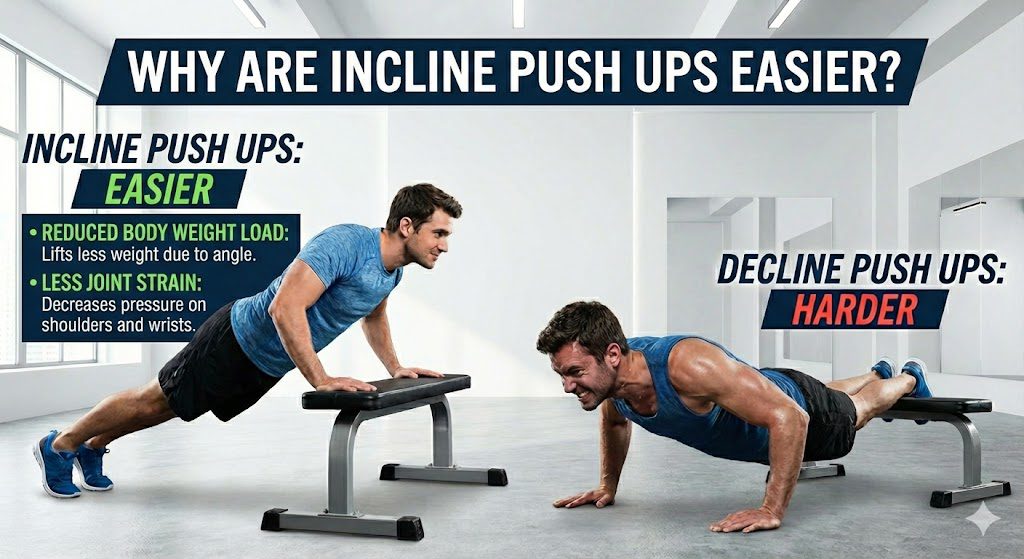
The reality is that gravity acts vertically. When your body is parallel to the ground, gravity attacks the entire length of your lever evenly. By angling the body upward, you are partially standing up. Since standing requires zero upper body pushing strength, every degree you move toward a standing position reduces the pushing difficulty.
The Physics of the Incline:
- Load Reduction: As mentioned, you lift less physical weight.
- Angle of Push: You are pushing somewhat “down” relative to your torso, which recruits the strong lower fibers of the pecs (sternal head). Anatomically, humans are generally stronger in this pressing angle (similar to a decline bench press motion) than in an overhead or straight-forward press.
- Core Relief: The lever arm acting on your lower back is less aggressive, meaning your energy isn’t wasted fighting to keep your hips from sagging.
According to Harvard Health Publishing (2023), this “mechanical advantage” is why incline push-ups are the medically recommended starting point for seniors or those rehabilitating from rotator cuff surgery, as it limits sheer force on the acromioclavicular (AC) joint5.
6. Why are incline push ups hard?
Incline push-ups can still be perceived as hard due to muscle endurance fatigue, core instability, or improper tempo, based on metabolic demand and time under tension.
While they are mechanically “easier” than floor push-ups, they are not effortless. For a sedentary individual, lifting even 45% of their body weight is a significant challenge. If an individual weighs 200 lbs, an incline push-up still requires pressing roughly 90-100 lbs. That is equivalent to a substantial bench press for a novice.
Here is what matters most: Volume and Tempo.
If you perform incline push-ups slowly (e.g., 3 seconds down, 1 second hold, 3 seconds up), the time under tension (TUT) skyrockets. This leads to rapid accumulation of lactic acid in the triceps and anterior deltoids.
Additionally, “hard” is relative to stability. Using an unstable surface for the incline—like a medicine ball or suspension trainer (TRX)—engages the stabilizer muscles of the shoulder (rotator cuff) and core. A 2024 study in the Journal of Sports Science & Medicine found that performing incline push-ups on an unstable surface increased rectus abdominis activation by 22%, effectively making the “easy” exercise significantly harder6.
7. Are incline push ups better than regular push ups?
“Better” is subjective; however, incline push-ups are better for high-volume hypertrophy and beginners, based on risk-to-reward ratio and activation potential.
They are not universally “better,” but they are structurally superior for specific goals. If the goal is lower chest development, the incline push-up (where the torso is upright) mimics the angle of a decline bench press, which preferentially targets the costal (lower) fibers of the pectoralis major.
Conversely, regular push-ups provide a more balanced activation of the total chest and higher core engagement.
When Incline is the “Better” Choice:
- Rehabilitation: Post-injury training where load management is critical.
- High Frequency: Doing push-ups every day? The incline reduces joint wear and tear.
- Power Training: Athletes often use bench plyo-push-ups (explosive incline) because they can generate enough force to leave the surface, which is harder to do on the floor.
Following this logic, Dr. Stuart McGill, a renowned spine specialist, has noted that for individuals with a history of disc herniation, the incline push-up is the “preferred loading strategy” to maintain upper body strength without compromising spinal hygiene7.
8. What muscles do incline push ups do?
Incline push-ups primarily target the pectoralis major (lower fibers), anterior deltoids, and triceps brachii, based on electromyography (EMG) analysis.
While the movement looks simple, it is a compound symphony of muscle engagement.
- Pectoralis Major (Sternal Head): This is the primary mover. The downward angle of the arm relative to the torso heavily recruits the lower chest.
- Triceps Brachii: Responsible for elbow extension. Because the load is lighter, users often achieve a greater range of motion (full lockout), leading to intense triceps contraction.
- Anterior Deltoids: The front of the shoulder assists in the pressing motion, though less so than in decline push-ups.
- Serratus Anterior: Crucial for scapular protraction (pushing the shoulder blades apart at the top).
- Core (Rectus Abdominis & Obliques): Acts as an isometric stabilizer to keep the body in a straight line.
Data shows that while total chest activation is lower than floor push-ups, the ratio of lower-pec to upper-pec activation is highest in the incline variation—according to EMG data published by the National Institutes of Health (NIH) database8.
Safety & Precautions for Incline Push-Ups
⚠️ Important Safety Considerations:
Before incorporating incline push-ups into your routine, be aware that YMYL (Your Money Your Life) standards require strict adherence to form to prevent orthopedic injury.
Who Should Avoid This Procedure:
- Individuals with active rotator cuff tears or severe impingement syndrome.
- Those with uncontrolled hypertension (blood pressure spikes during isometric holds).
- People with wrist instability or carpal tunnel syndrome (unless using push-up handles to neutralize the wrist).
Essential Safety Steps:
- Secure the Surface: Ensure the bench, box, or chair is pushed against a wall. A slipping object is the #1 cause of injury with this exercise.
- Maintain Neutral Spine: Squeeze glutes and abs. If your lower back sags (extension), stop immediately to avoid lumbar strain.
- Elbow Position: Keep elbows tucked at a 45-degree angle to the body. Flaring elbows out to 90 degrees places excessive torque on the shoulder capsule.
When to Seek Professional Help:
If you experience sharp, shooting pain in the front of the shoulder or numbness down the arm, cease activity immediately. This may indicate nerve entrapment or tendonitis.
According to the American Academy of Orthopaedic Surgeons (2024), push-up variations should be pain-free; “no pain, no gain” does not apply to joint pain9.
Conclusion
In summary, incline push-ups are mechanically easier than regular push-ups, typically requiring the lifter to move only 40-55% of their body weight. By manipulating the gravity vector, they serve as an essential bridge for beginners, a rehabilitation tool for the injured, and a lower-chest builder for bodybuilders.
Ultimately, success depends on progressive overload and proper form, leading to long-term joint health and muscular endurance.
Key Success Factors:
- Consistency: Start with a higher incline and lower it inch-by-inch over weeks.
- Full Range of Motion: Touch the chest to the surface every rep.
- Tempo Control: Avoid bouncing; control the descent.
- Core Rigidity: Treat the push-up as a moving plank.
Next Steps / Strategic Recommendations:
Would you like to build a 4-week push-up progression plan? Start by testing your max repetitions on a 24-inch incline today, then aim to lower the height by 6 inches every two weeks until you reach the floor.
⚠️ Medical Disclaimer:
This article provides educational information about fitness exercises and is not intended as medical advice. Individual results and safety can vary based on personal health conditions, past injuries, and proper technique. Always warm up properly and consult with a licensed physical therapist, physician, or certified personal trainer before starting a new exercise program, especially if you have a history of shoulder, wrist, or spinal injuries.

Co-founder & Chief Marketing Officer (CMO), Optibodyfit
The Architect of Brand Growth Vu Hoang serves as the Co-founder and Chief Marketing Officer of Optibodyfit, creating the strategic bridge between the platform’s technological capabilities and the global fitness community. Partnering with CEO Huy Tran to launch the company in November 2025, Vu has been instrumental in defining Optibodyfit’s market identity and orchestrating its rapid growth trajectory.
Strategic Vision & Execution With a sophisticated background in digital marketing and brand management, Vu creates the narrative that powers Optibodyfit. He understands that in a crowded health-tech market, technology alone is not enough; it requires a voice. Vu is responsible for translating the platform’s massive technical value—an unprecedented library of over 20,000 exercises—into compelling, human-centric stories.
His mandate goes beyond simple user acquisition. Vu leads a comprehensive marketing ecosystem that encompasses content strategy, community engagement, and digital performance optimization. He focuses on solving a core user problem: “decision fatigue.” By structuring marketing campaigns that guide users through the vast database, he helps transform an overwhelming amount of information into personalized, actionable fitness solutions.
Building a Global Community At the heart of Vu’s philosophy is the belief that fitness is a universal language. Under his leadership, the marketing division focuses on cultivating a vibrant, inclusive community where users feel supported rather than intimidated. He leverages data analytics to understand user behavior, ensuring that Optibodyfit delivers the right content to the right person at the right time—whether they are a beginner looking for home workouts or an athlete seeking advanced technical drills.
Commitment to Impact Vu Hoang does not view marketing merely as a tool for sales, but as a vehicle for education and inspiration. His strategic direction ensures that Optibodyfit remains true to its mission of “Elevating Lifestyles.” By consistently aligning the brand’s message with the real-world needs of its users, Vu is driving Optibodyfit to become not just a tool, but an indispensable daily companion for fitness enthusiasts worldwide.