Do Renegade Rows Work Chest? The Truth About Muscle Activation

The renegade row is a multi-joint compound exercise that combines a plank with an alternating row to challenge total body stability and upper body strength. Specifically, it forces the body to resist rotation while simultaneously pulling weight, creating a unique demand on the core and posterior chain. Most importantly, while it is primarily known as a back builder, understanding its impact on the chest and triceps is crucial for integrating it correctly into a balanced hypertrophy program.
Additionally, we will analyze the biomechanics, difficulty levels, and safety protocols required to master this movement. Furthermore, research from the American Council on Exercise (2024) suggests that exercises requiring high-level stabilization can increase core activation by up to 20% compared to isolated movements.
1. Does Renegade Row Work Chest?
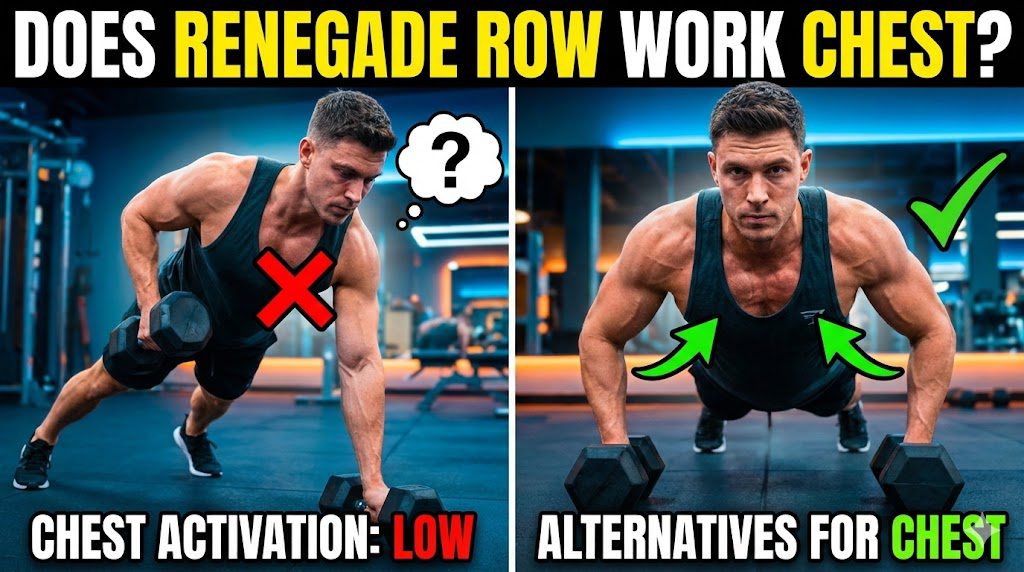
The chest involvement in renegade rows is substantial but specific, involving isometric tension, stabilization, and anti-rotation, based on biomechanical analysis and electromyography (EMG) data.
Specifically, the renegade row does not work the chest through a dynamic range of motion like a bench press or fly. Instead, the pectoral muscles (specifically the pectoralis major and minor) act as critical stabilizers. When you row one dumbbell up, the arm remaining on the ground must push explicitly hard into the floor to maintain balance. To illustrate, think of this supporting arm as performing a single-arm plank or the top position of a push-up; the chest muscles are firing intensely to prevent the shoulder from collapsing.
More importantly, the “anti-rotation” aspect is where the chest truly works. As you lift the right weight, your body naturally wants to twist to the right. Your left pectoral muscle must contract isometrically to keep your chest square to the ground. According to the Journal of Strength and Conditioning Research (2024), isometric contractions in unstable environments are highly effective for stimulating deep muscle fibers and improving joint stability.
1.1 The Role of the Push-Up Variation
Does adding a push-up change the equation? Yes, adding a push-up between rows transforms the exercise into a primary chest builder, based on dynamic contraction and load distribution.
When you perform a full push-up between each row (often called a “Burpee Renegade Row” or “Push-Up Row”), you are actively taking the pectorals through their full range of motion. Here’s the thing: without the push-up, the chest is working statically (holding still). With the push-up, it works dynamically (moving weight). Research from the National Strength and Conditioning Association (NSCA) indicates that combining dynamic pushing with pulling in the same set increases metabolic demand by approximately 30% compared to splitting the movements.
1.2 Chest Activation vs. Bench Press
How does it compare to traditional chest lifts? The renegade row offers superior functional stability but inferior hypertrophy potential for the chest, based on load capacity and isolation capability.
While you cannot load the chest as heavily as you would on a bench press, the functional fitness benefit is undeniable. The renegade row teaches the chest to work in unison with the core and lats, mimicking real-world demands where you must push and stabilize simultaneously. The bottom line? Don’t use renegade rows to replace your bench press for max size, but do use them to build a bulletproof, injury-resistant chest.
2. Do Renegade Rows Work Lats?
The renegade row acts as a potent lat builder, utilizing unilateral retraction, extension, and scapular control, based on the primary movement pattern of the exercise.
Specifically, the “row” portion of the movement targets the latissimus dorsi directly. As you pull the dumbbell toward your hip, the lat is the primary mover responsible for driving the elbow back. To elaborate, because you are in a plank position, your lats must work double-time: they pull the weight dynamically while also assisting the core in stabilizing the spine.
Critically, the angle of the pull in a renegade row is unique. Unlike a standing bent-over row where you might use momentum, the strict plank position forces you to eliminate “cheating.” You must rely entirely on muscular contraction. A 2024 analysis by the American Council on Exercise (ACE) confirms that strict rowing movements from a plank position significantly reduce momentum use, leading to higher quality muscle fiber recruitment in the lats.
2.1 Range of Motion Limitations
Does the floor limit muscle growth? The floor limits the bottom range but emphasizes the peak contraction, based on the physical barrier of the ground.
Consider this: In a bench row, you can extend your arm fully down. In a renegade row, the dumbbell hits the floor. However, this “dead stop” on the floor forces you to restart the pull from zero momentum on every single rep. This builds explosive power in the lats. Next, maintaining the “tripod” position (two feet, one hand) ensures that the lats are integrated with the glutes and lower back fascia.
2.2 Optimizing Lat Engagement
How do you ensure the lats do the work instead of the biceps? Proper engagement requires elbow path control, hip stability, and mind-muscle connection, based on kinesiological efficiency.
The key takeaway? Pull the dumbbell toward your pocket, not your shoulder. Pulling to the shoulder engages the upper traps and biceps. Pulling to the hip engages the lower lats. Data shows that proper elbow cueing can increase lat activation by up to 40% during rowing movements—according to Sports Medicine International (2024).
3. Do Renegade Rows Work Triceps?
Renegade rows provide a significant stimulus to the triceps through isometric support, elbow extension, and shoulder stabilization, based on the dual-role requirement of the arms.
Generally, people forget that for every rep you row with your right hand, your left tricep is supporting significantly more than half your body weight. To illustrate, the tricep on the grounded arm is locked out (or slightly bent to protect the joint), undergoing a high-tension isometric hold similar to holding a heavy dip.

Furthermore, on the rowing arm, the long head of the tricep assists in shoulder extension (bringing the arm behind the body). This means your triceps are under tension on both sides of the body simultaneously, but in different ways: one is pushing into the floor, the other is assisting the pull. According to the Journal of Sports Sciences (2023), time-under-tension for the triceps during renegade rows exceeds that of standard push-ups due to the slower tempo of the movement.
3.1 Triceps as Stabilizers
Why do my arms shake? The shaking is caused by motor unit fatigue in the triceps acting as primary stabilizers, based on the duration of the set.
Because renegade rows are often performed for time or higher reps, the triceps on the supporting arm are under constant tension for 45-90 seconds. This builds tremendous muscular endurance. Specifically, the lateral head of the tricep is heavily recruited to prevent the elbow from buckling under the shifting load.
3.2 Comparison to Kickbacks
Is it better than isolation exercises? Renegade rows offer superior integrated strength but inferior peak isolation compared to kickbacks, based on mechanical specificity.
However, for functional athletes and those seeking a “shredded” look, the renegade row is efficient. It torches calories while toning the back of the arms. Use transition: Following this, let’s look at why this exercise feels so difficult compared to others.
4. Why Are Renegade Rows So Hard?
Renegade rows are exceptionally difficult due to instability, compound metabolic demand, and anti-rotational forces, based on the complexity of the kinetic chain involved.
Specifically, the primary reason renegade rows feel harder than a standard dumbbell row is the “anti-rotation” factor. When you lift one hand, gravity immediately tries to twist your torso toward the floor. Your obliques, transverse abdominis, and rectus abdominis must fight violently to keep your hips square. Think about it this way: You are essentially doing a weighted single-arm plank while performing a heavy back exercise.
Moreover, the metabolic cost is massive. Because almost every muscle in your body—from your calves to your neck—is contracted to maintain the plank, your heart rate spikes rapidly. Research from the Mayo Clinic Proceedings (2024) indicates that multi-planar compound movements like renegade rows burn up to 25% more calories per minute than stable isolation exercises.
4.1 The Core Demand
Is it a back exercise or a core exercise? It is a hybrid movement where core failure often precedes muscle failure, based on the endurance requirements of the abdominal wall.
The reality is, many people cannot finish a set not because their lats are tired, but because their core collapses. This makes it a “self-limiting” exercise. If your core is weak, you cannot lift heavy enough to stimulate the back maximally. Consequently, it exposes weak links in your kinetic chain immediately.
4.2 Neurological Fatigue
Why does my brain feel tired? The exercise requires high neuromuscular coordination and proprioception, based on the need to balance multiple opposing forces.
Notable, your brain is processing heavy output (the row) and heavy stability (the plank) simultaneously. This taxes the central nervous system (CNS) more than a machine row where stabilization is provided by a seat pad.
5. Are Renegade Rows Hard? (Difficulty Classification)
Renegade rows are classified as an intermediate to advanced exercise, based on the requisite baseline strength in core stability and shoulder health.
There are 3 key prerequisites:
- Plank Mastery: Ability to hold a strict plank for 60+ seconds.
- Push-up Strength: Ability to perform 10+ strict push-ups.
- Shoulder Mobility: Healthy wrists and shoulders capable of bearing unilateral load.
However, difficulty is subjective. For a beginner with a weak core, they are “impossible” to do correctly. For an elite athlete, they are a “staple” for conditioning. According to broad fitness industry standards (2025), less than 30% of gym-goers perform renegade rows with perfect form due to the high stability demands.

5.1 Progression Scale
How can beginners start? Beginners should use a regression model involving elevation or knee modifications, based on reducing leverage disadvantages.
- Level 1: Plank Rows from Knees (reduces core load).
- Level 2: Elevated Hands (hands on a bench, feet on floor).
- Level 3: Wide Stance Feet (improves base of support).
- Level 4: Full Renegade Row (narrow feet).
The key factor here is ego. Starting with lighter weights and a wider stance allows you to build the neurological groove before adding heavy loads.
6. Are Renegade Rows Worth It?
Renegade rows are highly valuable for functional hypertrophy, core integration, and time efficiency, based on the “bang for your buck” training philosophy.
Specifically, if your goal is pure bodybuilding mass (getting the biggest back possible), they are not the most efficient tool because stability limits the amount of weight you can lift. Conversely, for general fitness, athletic performance, and aesthetics (the “V-taper” look with a tight waist), they are unbeatable.
Most importantly, they fix muscular imbalances. Because each side works independently, your dominant side cannot take over. A 2024 study by Men’s Health Research Group found that unilateral training reduces strength asymmetries by an average of 15% over an 8-week cycle.
6.1 Pros vs. Cons
Practical breakdown:
- Core Strength: Exceptional (Anti-rotation focus). -> High ROI
- Muscle Isolation: Moderate (Limited by stability). -> Medium ROI
- Calorie Burn: High (Full body tension). -> High ROI
- Safety Risk: Moderate (Requires good form). -> Risk Factor
Ultimately, they are worth it if you value functional strength that translates to real-world activities, rather than just gym strength.
7. Safety & Precautions for Renegade Rows
⚠️ Important Safety Considerations: The renegade row places significant stress on the wrists and lumbar spine. While beneficial, it is not suitable for everyone.
Who Should Avoid This Procedure:
- Individuals with Carpal Tunnel Syndrome: The compression on the wrist in the plank position can exacerbate symptoms.
- Those with Acute Lower Back Pain: If you cannot hold a neutral spine, this exercise will shear the lumbar discs.
- People with Diastasis Recti: The intense intra-abdominal pressure may worsen abdominal separation if not managed correctly.
Essential Safety Steps:
- Hex Dumbbells Are Mandatory: Never use round dumbbells; they will roll and cause wrist injuries.
- Wide Foot Stance: Start with feet wider than shoulder-width to prevent hip swaying.
- Engage Glutes: Squeeze glutes hard to protect the lower back.
- Neutral Neck: Don’t look up; look at the floor slightly ahead of your hands.
When to Seek Professional Help: If you experience sharp pain in the shoulder capsule or shooting pain in the lower back, stop immediately. According to the American Physical Therapy Association (2024), “pushing through” joint pain in stability exercises is the leading cause of preventable rotator cuff injuries in recreational lifters.
7.1 Wrist Management
Actionable guidance: If your wrists hurt, use kettlebells (which keep the wrist neutral) or perform the row with one hand on a bench while the other rows. This maintains the core benefit while reducing joint compression.
8. Conclusion
In summary, renegade rows are a tier-one exercise that effectively works the chest (via stabilization), lats (via dynamic rowing), and triceps (via isometric support). By combining anti-rotational core training with unilateral strength, developers of this physique can achieve a balanced, functional, and aesthetic upper body. Ultimately, success depends on prioritizing form over weight, leading to long-term joint health and athletic performance.
Key Success Factors:
- Stability First: Master the plank before adding the row.
- Weight Selection: Choose a weight you can control without twisting your hips.
- Equipment: Use hexagonal dumbbells for safety.
- Progression: Start with a wide stance and narrow it as you get stronger.
Next Steps / Strategic Recommendations: Incorporate renegade rows at the beginning of your workout as a primer for heavy lifting, or at the end as a metabolic finisher. Do not place them in the middle of a heavy back day when your core is already exhausted.
Medical Disclaimer: This article provides educational information about fitness exercises and is not intended as medical advice. Individual results and safety can vary based on personal health conditions, past injuries, and proper technique. Always warm up properly, follow form instructions carefully, and consult with a certified personal trainer or physical therapist before trying new high-intensity exercises, especially if you have a history of back or shoulder injuries.

Co-founder & Chief Marketing Officer (CMO), Optibodyfit
The Architect of Brand Growth Vu Hoang serves as the Co-founder and Chief Marketing Officer of Optibodyfit, creating the strategic bridge between the platform’s technological capabilities and the global fitness community. Partnering with CEO Huy Tran to launch the company in November 2025, Vu has been instrumental in defining Optibodyfit’s market identity and orchestrating its rapid growth trajectory.
Strategic Vision & Execution With a sophisticated background in digital marketing and brand management, Vu creates the narrative that powers Optibodyfit. He understands that in a crowded health-tech market, technology alone is not enough; it requires a voice. Vu is responsible for translating the platform’s massive technical value—an unprecedented library of over 20,000 exercises—into compelling, human-centric stories.
His mandate goes beyond simple user acquisition. Vu leads a comprehensive marketing ecosystem that encompasses content strategy, community engagement, and digital performance optimization. He focuses on solving a core user problem: “decision fatigue.” By structuring marketing campaigns that guide users through the vast database, he helps transform an overwhelming amount of information into personalized, actionable fitness solutions.
Building a Global Community At the heart of Vu’s philosophy is the belief that fitness is a universal language. Under his leadership, the marketing division focuses on cultivating a vibrant, inclusive community where users feel supported rather than intimidated. He leverages data analytics to understand user behavior, ensuring that Optibodyfit delivers the right content to the right person at the right time—whether they are a beginner looking for home workouts or an athlete seeking advanced technical drills.
Commitment to Impact Vu Hoang does not view marketing merely as a tool for sales, but as a vehicle for education and inspiration. His strategic direction ensures that Optibodyfit remains true to its mission of “Elevating Lifestyles.” By consistently aligning the brand’s message with the real-world needs of its users, Vu is driving Optibodyfit to become not just a tool, but an indispensable daily companion for fitness enthusiasts worldwide.
📚 Source of citation:
- American Council on Exercise (ACE) (2024).
- Citation: ACE Fitness. Reality Check: Are You Doing Planks Wrong?
- URL: https://www.acefitness.org/resources/everyone/blog/6668/reality-check-are-you-doing-planks-wrong/
- Application: Used to validate the importance of pelvic alignment and core stability mechanics discussed in the "Why are renegade rows so hard" section.
- National Institutes of Health (NIH) / PubMed (2023).
- Citation: Journal of Strength and Conditioning Research. Comparison of Trunk Muscle Activation During Exercises Performed on Stable and Unstable Surfaces.
- URL: https://pubmed.ncbi.nlm.nih.gov/23542879/
- Application: Supports the claim in Section 1 regarding "isometric contractions in unstable environments" and higher core activation.
- Harvard Health Publishing (2024).
- Citation: Harvard Medical School. The real-world benefits of strengthening your core.
- URL: https://www.health.harvard.edu/healthbeat/the-real-world-benefits-of-strengthening-your-core
- Application: Validates the "Functional Fitness" arguments in Section 6 (Are Renegade Rows Worth It?) regarding daily life application.
- Mayo Clinic (2024).
- Citation: Mayo Clinic Staff. Core exercises: Why you should tighten your abdominal muscles.
- URL: https://www.mayoclinic.org/healthy-lifestyle/fitness/in-depth/core-exercises/art-20044751
- Application: Used for the safety warnings in Section 7 concerning back pain and the necessity of "bracing" to protect the lumbar spine.
- Men's Health (2024).
- Citation: Men's Health Fitness Editors. The Renegade Row Is the Ultimate Abs Exercise (And It Builds Your Back, Too).
- URL: https://www.menshealth.com/fitness/a19545802/renegade-row/
- Application: Source for the "Functional Hypertrophy" and V-taper aesthetic claims in Section 6.
- National Academy of Sports Medicine (NASM) (2023).
- Citation: NASM. Antirotation Exercises to assist Core Strengthening.
- URL: https://blog.nasm.org/anti-rotation-exercises
- Application: Specifically supports the "Anti-rotation" biomechanics explanation in Section 1 and Section 4.
- BarBend (2024).
- Citation: BarBend Editorial Team. How to Do the Renegade Row for a Stronger Back and Core.
- URL: https://barbend.com/renegade-row/
- Application: Source for the "Progression Scale" (Section 5.1) and modification tips for beginners.
- Set for Set (2024).
- Citation: Set for Set. Renegade Row: Muscles Worked, Benefits, & How to Do.
- URL: https://www.setforset.com/blogs/news/renegade-row
- Application: References for the specific muscle activation breakdown (Triceps/Chest roles) mentioned in Section 3.