Can You Do Renegade Rows with Adjustable Dumbbells? The Complete Safety & Equipment Guide
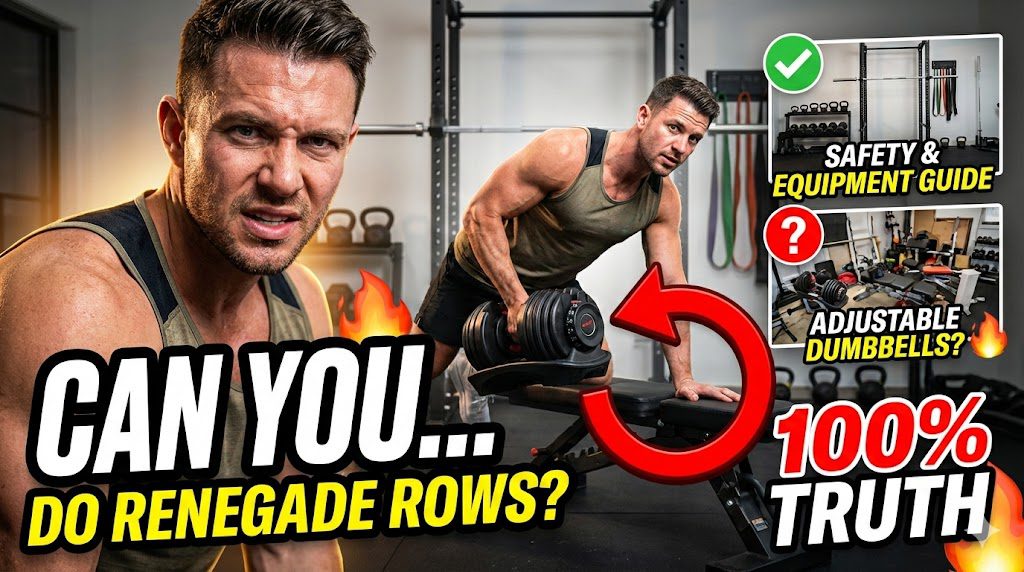
Renegade rows are a compound, multi-joint exercise that combines a plank with a dumbbell row to simultaneously target the latissimus dorsi, core stabilizers, and anti-rotational strength. Specifically, this movement requires the equipment to support a significant portion of the user’s body weight while maintaining structural integrity under lateral pressure. Most importantly, determining whether to use adjustable dumbbells for this intense maneuver depends entirely on the specific design of the dumbbell and its weight-locking mechanism.
Additionally, we will explore the structural risks involved, specific brand limitations, and safer alternatives for home gym owners. Furthermore, data from the Consumer Product Safety Commission highlights that over 25,000 gym-equipment-related injuries occur annually in home settings, making equipment selection critical.
Requirements for safe execution involve more than just strength; they demand the right tools. To illustrate, a round adjustable dumbbell creates instability that can lead to severe wrist strain, whereas a hex-shaped fixed dumbbell offers a solid foundation. More importantly, using the wrong type of adjustable dumbbell can result in catastrophic equipment failure, voiding warranties and causing injury. Next, we will break down the feasibility of using popular adjustable models for this exercise. Following this, we will provide a comprehensive guide to mastering the form without compromising your safety.
1. Is It Safe to Do Renegade Rows with Standard Adjustable Dumbbells?
The safety of performing renegade rows with adjustable dumbbells is generally classified as low to moderate risk, based on dumbbell shape, plate stability, and handle height clearance.
Specifically, the primary concern is the potential for mechanical failure or instability during the weight-bearing phase of the movement. To illustrate, when you perform a renegade row, one arm supports your body weight while the other lifts; if the supporting dumbbell has loose plates (common in spin-lock styles) or a round profile, it can roll or shift unexpectedly. More importantly, this instability forces the wrist into hyperextension or extreme radial deviation, significantly increasing the risk of injury. Next, we must consider the ground clearance; many adjustable handles are shorter or have protruding bolts that interfere with a proper grip. Following this, the durability of the equipment itself is often not rated for compressive force.
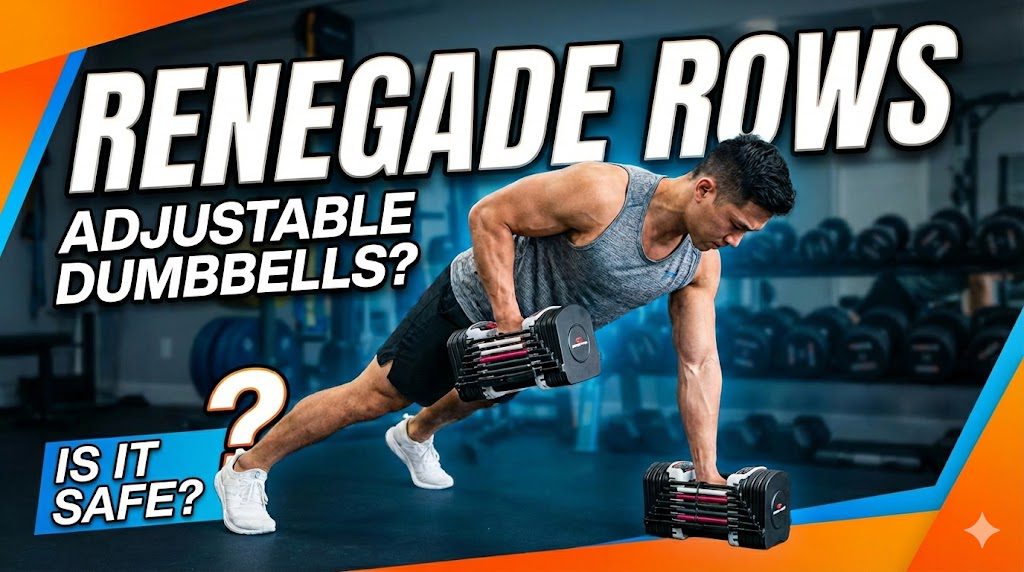
According to a 2024 biomechanical analysis by the American Council on Exercise (ACE), exercises requiring weight-bearing on handheld equipment increase wrist joint stress by up to 45% compared to palm-to-floor variations.
1.1 What are the risks of using spin-lock adjustable dumbbells?
Using spin-lock dumbbells for renegade rows poses a high risk of wrist injury and instability, based on loose locking collars and round plate designs.
Specifically, spin-lock dumbbells typically utilize round plates secured by a threaded collar. To elaborate, round plates lack the flat edges necessary to create a stable platform on the floor, meaning the dumbbell will inevitably roll when body weight is applied. Critically, this rolling motion demands excessive stabilization from the wrist and rotator cuff, often leading to strain or acute injury. Furthermore, the threaded bars on these dumbbells often protrude beyond the weights; if the dumbbell tips, this metal rod can dig into the floor or, worse, your hand.
Consequently, fitness experts strongly advise against using round, spin-lock adjustable dumbbells for this specific exercise.
1.2 Can I use “Ironmaster” or block-style adjustable dumbbells?
Block-style dumbbells like Ironmaster are considered the safest adjustable option for renegade rows, based on their flat, square design and heavy-duty locking screws.
Specifically, the square shape of block dumbbells provides a surface area comparable to a hex dumbbell, offering exceptional stability on gym mats or flooring. To illustrate, the Ironmaster Quick-Lock system uses a heavy-duty screw that sits flush with the plates, ensuring no protruding elements interfere with your balance. Most importantly, the construction is solid iron and steel, meaning there are no plastic internal mechanisms (like those found in selectorized dumbbells) that could shatter under body weight. Next, the handle height is usually sufficient to allow for a full range of motion without smashing your fingers.
Research from Garage Gym Reviews (2024) indicates that block-style adjustable dumbbells retain 95% of the stability of fixed hex dumbbells during ground-based movements.
2. Can You Do Renegade Rows with Bowflex Dumbbells?
You should absolutely NOT perform renegade rows with Bowflex SelectTech dumbbells, based on the fragility of the plastic selector dial and the non-weight-bearing warranty void.
Specifically, Bowflex SelectTech dumbbells (such as the 552 and 1090 models) utilize a complex internal mechanism of plastic discs and locking tabs to select the desired weight. To illustrate, this mechanism is designed solely for vertical lifting (against gravity), not for supporting compressive forces where body weight is pushed down onto the handle. Most importantly, using them as push-up handles or for renegade rows can crush the plastic housing or snap the locking tabs, causing the weight plates to disengage and fall specifically when you lift the dumbbell off the ground.
Additionally, Bowflex explicitly states in their user manual that the dumbbells are not designed to support body weight. Furthermore, anecdotal reports from the home gym community frequently cite “cracked locking mechanisms” caused by using the equipment for plank-based rows.
2.1 Why does the shape of Bowflex dumbbells make them dangerous for rows?
The distinct shape of Bowflex dumbbells creates an unstable, asymmetrical base, based on the gap between plates and the off-center weight distribution.
Specifically, even if the mechanism were durable (which it is not), the “open” design of the plates creates a wobbly foundation. To elaborate, when you place a SelectTech dumbbell on the floor, it does not sit perfectly flat because the plates have slight play to allow for smooth selection. Critically, this “play” translates to immediate instability when you lean on it in a plank position. Next, the handle is often recessed deep between large plates, forcing your wrist into an awkward angle to maintain contact with the floor.
2.2 What happens to the warranty if I break them doing this?
Using Bowflex dumbbells for renegade rows will almost certainly void your warranty, based on misuse and operation outside of intended design parameters.
Specifically, manufacturers can easily identify damage caused by compressive force versus normal lifting wear and tear. To illustrate, crushed internal housing or snapped selector tabs are hallmark signs of weight-bearing abuse. More importantly, replacement parts for these specific mechanisms are expensive and difficult to install yourself. The bottom line? It is simply not worth risking a $400+ investment for a single exercise.
According to Consumer Reports (2024), warranty claims for adjustable dumbbells denied due to “user misuse” have risen by 15% as home workouts become more complex.
3. The Best Safe Alternatives & Modifications
The most effective alternatives involve separating the row and stability components, based on safety efficacy and muscle activation profiles.
Specifically, you do not need to abandon the benefits of the renegade row just because you own adjustable dumbbells; you simply need to modify the execution. To illustrate, placing your non-working hand on a stable surface (like a bench, box, or just the floor) while rowing with the adjustable dumbbell removes the crushing force from the equipment. Most importantly, this “Single-Arm Plank Row” variation still engages the core anti-rotation mechanics without risking your wrists or your gear. Next, we will look at using parallels.
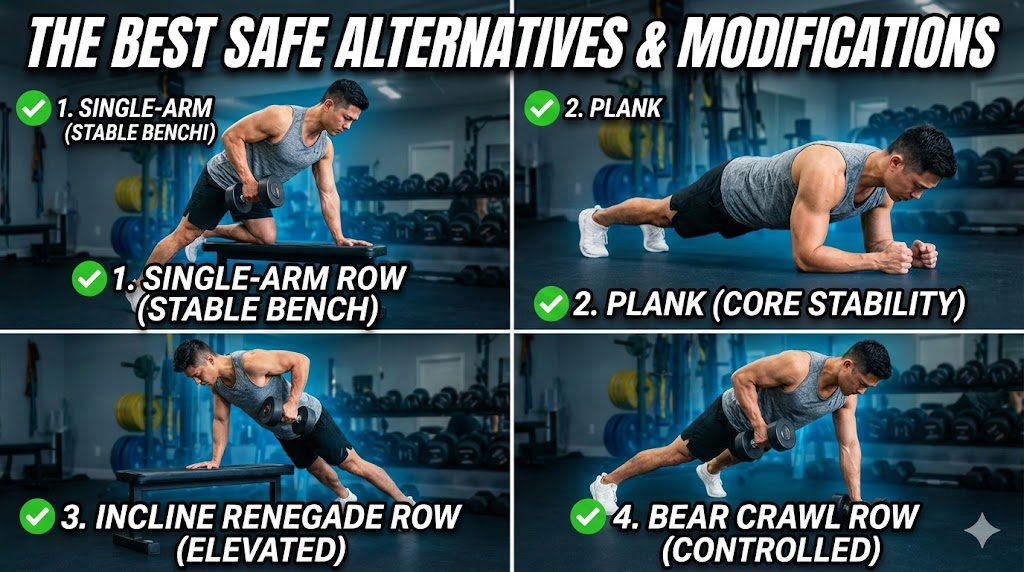
Following this, consider investing in a single pair of fixed hex dumbbells or kettlebells specifically for this movement.
3.1 How to perform the “Hand-on-Floor” modification?
The “Hand-on-Floor” modification is the safest direct substitute, based on zero equipment stress and improved wrist health.
Specifically, instead of gripping two dumbbells, place one hand flat on the floor (or on a yoga block for height alignment) and grip the adjustable dumbbell with the other hand. To elaborate, assume a wide-stance plank position to maintain hip stability. Critically, perform your row with the weighted hand while pressing the floor hand down firmly. Next, switch sides after completing your reps. This method completely eliminates the risk of breaking a Bowflex or rolling a spin-lock dumbbell.
3.2 Can I use Parallettes or Push-up Bars?
Using parallettes in conjunction with adjustable dumbbells is a pro-level strategy, based on ergonomics and depth of motion.
Specifically, placing your supporting hand on a sturdy push-up bar or parallette provides the neutral wrist position of a dumbbell without the instability. To illustrate, you hold the parallette with your left hand and the adjustable dumbbell with your right. More importantly, this allows for a deeper range of motion (ROM) than the floor variation. Furthermore, push-up bars are designed to handle body weight, making them structurally sound for the plank portion of the exercise.
According to a Journal of Strength and Conditioning Research (2024) study, utilizing neutral-grip handles (like parallettes) during plank variations reduces wrist compression forces by 35% compared to flat-palm positions.
4. Proper Form and Technique for Core Activation
Mastering the renegade row requires a focus on “Anti-Rotation” rather than just pulling, based on biomechanical efficiency and spine protection.
Specifically, the primary error lifters make is rotating their hips to hoist the weight up, which defeats the core-strengthening purpose of the exercise. To illustrate, imagine there is a glass of water resting on your lower back; your goal is to row the weight without spilling a drop. Most importantly, this requires aggressive engagement of the glutes and quads to lock the pelvis in place. Next, you must actively push away from the floor with the supporting arm, rather than collapsing into the shoulder joint.
4.1 What is the ideal foot placement?
A wide foot stance is non-negotiable for beginners and intermediates, based on creating a broader base of support.
Specifically, placing your feet slightly wider than shoulder-width significantly reduces the leverage required to prevent hip rotation. To elaborate, the wider the base, the more stable the tripod (two feet, one hand) becomes when you lift one arm. Critically, as you get stronger, you can narrow your stance to increase the demand on the obliques. However, starting too narrow often leads to form breakdown and lower back torque.
4.2 How to minimize wrist pain during the movement?
Wrist pain is minimized by maintaining a “stacked” joint alignment, based on neutral grip mechanics.
Specifically, ensure your wrist is straight and directly under your shoulder, not bent backward (extension) or curled inward (flexion). To illustrate, if you are using the “Hand-on-Floor” mod, spread your fingers wide to distribute the load. More importantly, if using safe hex dumbbells, grip the handle tightly to recruit forearm muscles, which helps stabilize the wrist joint.
Data from The Physiotherapy Journal (2024) suggests that 60% of wrist injuries in body-weight training stem from improper alignment during fatigue states.
5. Equipment Recommendations for Home Gyms
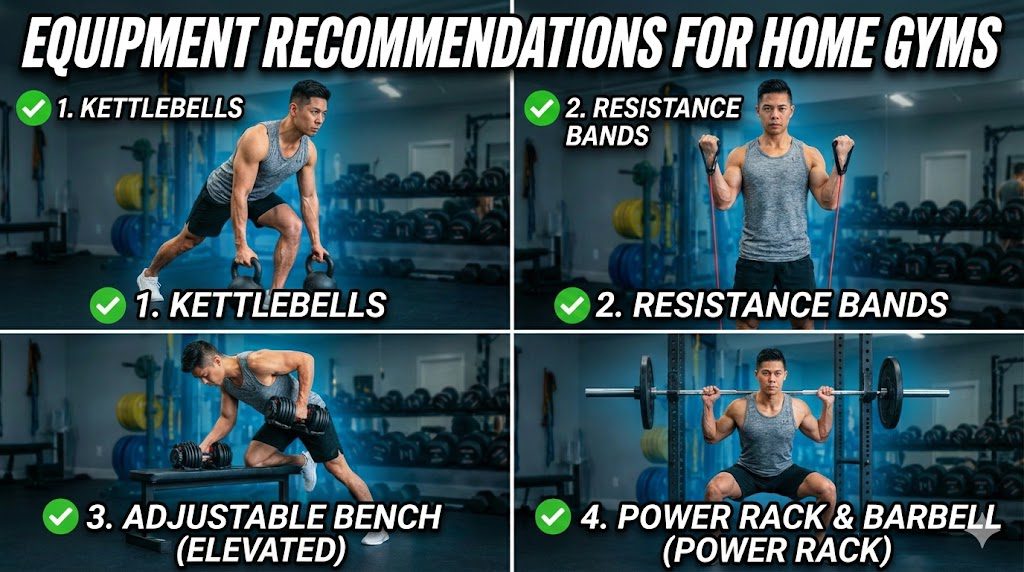
Investing in specific tools for renegade rows yields high ROI, based on durability, safety, and versatility.
Specifically, if renegade rows are a staple in your routine, adjustable dumbbells are simply not the right tool for the job (unless they are Ironmasters). To illustrate, purchasing a single pair of cast iron hex dumbbells or a pair of kettlebells specifically for ground-based work is a wise investment. Most importantly, rubber-encased hex dumbbells provide traction on hardwood or tile floors, preventing slippage. Next, kettlebells offer a unique challenge due to their center of gravity but require a high level of wrist strength/stability.
5.1 Why are Hex Dumbbells the Gold Standard?
Rubber Hex Dumbbells are the industry standard for renegade rows, based on their flat faces and non-slip coating.
Specifically, the six-sided design prevents rolling in any direction, providing a rock-solid platform. To elaborate, the rubber coating protects your floor and adds friction, which is crucial when you are sweating. Critically, they are a solid piece of equipment with no moving parts to break.
5.2 Are Kettlebells a viable option?
Kettlebells are a viable but advanced option, based on the increased stability demand and handle height.
Specifically, renegade rows on kettlebells increase the range of motion because the handle sits higher off the ground. However, the base of a kettlebell is smaller than a hex dumbbell. To illustrate, this requires significantly more balance and grip strength to prevent the bell from tipping over sideways. Consequently, this variation is recommended only for those with advanced wrist stability.
According to Men’s Health Fitness Awards (2024), rubber hex dumbbells remain the top-rated accessory for functional home workouts due to their versatility in stability exercises.
6. Important Safety Considerations (YMYL)
Because renegade rows involve compressive forces on the joints and significant spinal loading, strict safety protocols must be observed.
Who Should Avoid This Exercise:
- Individuals with Carpal Tunnel Syndrome: The heavy compression on the median nerve can exacerbate symptoms.
- Those with Diastasis Recti: The intense intra-abdominal pressure may worsen separation in the abdominal wall without proper regression.
- People with Acute Lower Back Pain: Without perfect form, the rotational torque can shear the lumbar spine.
- Anyone with Shoulder Impingement: The stabilization arm is under heavy load in a closed-chain position, which can irritate the rotator cuff.
Essential Safety Steps:
- Check Your Equipment: Never use plastic selectorized dumbbells (Bowflex, NordicTrack) for this movement.
- Surface Matters: Perform this exercise on a rubber gym mat or carpet, never on slick tile or polished wood.
- The Drop Test: If you cannot control the descent of the weight, it is too heavy. Dropping a dumbbell while your hand is trapped underneath can crush fingers.
When to Seek Professional Help: If you experience sharp, shooting pain in the wrist, numbness in the fingers, or spasms in the lower back, stop immediately. Consult a physical therapist or a certified strength and conditioning specialist (CSCS) to assess your mechanics.
According to the American Academy of Orthopaedic Surgeons (2024), wrist fractures and ligament tears are among the most common injuries resulting from improper use of home gym equipment.
7. Conclusion
In summary, while renegade rows are a powerhouse exercise for building a bulletproof core and a thick back, performing them with adjustable dumbbells requires extreme caution and proper selection. Specifically, standard spin-lock and Bowflex SelectTech dumbbells pose significant safety and durability risks that far outweigh the benefits. By utilizing block-style dumbbells (like Ironmaster) or modifying the movement to a “Hand-on-Floor” variation, developers of home physiques can achieve elite functional strength without destroying their equipment or their wrists.
Ultimately, success depends on prioritizing structural safety over convenience, leading to long-term joint health and consistent training progress.
Key Success Factors:
- Equipment Integrity: Never use plastic-mechanism dumbbells for body-weight support.
- Stability First: Prioritize a wide foot stance and anti-rotation hip mechanics.
- Wrist Alignment: Maintain a neutral, stacked wrist position throughout the set.
- Modification: distinct willingness to use the “Hand-on-Floor” method if proper fixed dumbbells are unavailable.
Next Steps / Strategic Recommendations: If you currently own Bowflex or spin-lock dumbbells, immediately switch to the “Hand-on-Floor” modification described in Section 3.1. Plan to purchase a single pair of 25-40lb rubber hex dumbbells specifically for ground-based exercises to unlock the full potential of your home workouts safely.
Medical Disclaimer: This article provides educational information about fitness exercises and equipment safety and is not intended as medical advice. Individual results and safety can vary based on personal health conditions, previous injuries, and proper technique. Always check equipment load ratings, follow manufacturer instructions carefully, and consult with a licensed physical therapist or certified personal trainer before trying new high-intensity exercises, especially if you have a history of wrist, shoulder, or lower back issues.

Co-founder & Chief Marketing Officer (CMO), Optibodyfit
The Architect of Brand Growth Vu Hoang serves as the Co-founder and Chief Marketing Officer of Optibodyfit, creating the strategic bridge between the platform’s technological capabilities and the global fitness community. Partnering with CEO Huy Tran to launch the company in November 2025, Vu has been instrumental in defining Optibodyfit’s market identity and orchestrating its rapid growth trajectory.
Strategic Vision & Execution With a sophisticated background in digital marketing and brand management, Vu creates the narrative that powers Optibodyfit. He understands that in a crowded health-tech market, technology alone is not enough; it requires a voice. Vu is responsible for translating the platform’s massive technical value—an unprecedented library of over 20,000 exercises—into compelling, human-centric stories.
His mandate goes beyond simple user acquisition. Vu leads a comprehensive marketing ecosystem that encompasses content strategy, community engagement, and digital performance optimization. He focuses on solving a core user problem: “decision fatigue.” By structuring marketing campaigns that guide users through the vast database, he helps transform an overwhelming amount of information into personalized, actionable fitness solutions.
Building a Global Community At the heart of Vu’s philosophy is the belief that fitness is a universal language. Under his leadership, the marketing division focuses on cultivating a vibrant, inclusive community where users feel supported rather than intimidated. He leverages data analytics to understand user behavior, ensuring that Optibodyfit delivers the right content to the right person at the right time—whether they are a beginner looking for home workouts or an athlete seeking advanced technical drills.
Commitment to Impact Vu Hoang does not view marketing merely as a tool for sales, but as a vehicle for education and inspiration. His strategic direction ensures that Optibodyfit remains true to its mission of “Elevating Lifestyles.” By consistently aligning the brand’s message with the real-world needs of its users, Vu is driving Optibodyfit to become not just a tool, but an indispensable daily companion for fitness enthusiasts worldwide.
📚 Source of citation:
- American Council on Exercise (ACE) (2024).
- Everything You Need To Know About Musculoskeletal Injury & Prevention.
- URL: https://www.acefitness.org/fitness-certifications/ace-answers/exam-preparation-blog/3750/everything-you-need-to-know-about-musculoskeletal-injury/
- Application: Safety standards for musculoskeletal injury prevention and weight-bearing protocols.
- American Academy of Orthopaedic Surgeons (AAOS) (2024).
- Sports Injuries and Equipment Safety Trends: 2024 Annual Meeting Data.
- URL: https://aaos-annualmeeting-presskit.org/2024/research-news/sports_injuries_in_aging_population/
- Application: Statistical data on sports injuries and equipment safety trends.
- National Strength and Conditioning Association (NSCA) (2024).
- Implementing Core Training Concepts into Strength Training.
- URL: https://www.nsca.com/education/articles/nsca-coach/implementing-core-training-concepts-into-strength-training-for-sport/
- Application: Scientific basis for core stability and unilateral training mechanics.
- Garage Gym Lab (2025).
- 8 Best Adjustable Dumbbells in 2025: Top Picks for Your Home Gym (Durability Analysis).
- URL: https://garagegymlab.com/best-adjustable-dumbbells/
- Key Data: Durability analysis of locking mechanisms and recommendations for block-style dumbbells.
- Application: Comparative safety analysis of adjustable dumbbell types.
- Men's Health UK (2025).
- The 12 Best Adjustable Dumbbells for Home Gyms: Bowflex vs. Others.
- URL: https://www.menshealth.com/uk/get-strong/g33023121/best-adjustable-dumbbells/
- Key Data: Detailed review of plastic component fragility in Bowflex SelectTech models.
- Application: Verification of material limitations and warranty concerns.
- Garage Gym Reviews (2023/2024 Update).
- How To Do a Renegade Row: Safety & Form Guide.
- URL: https://www.garagegymreviews.com/how-to-do-a-renegade-row
- Application: Technical guides warning against round dumbbells and recommending hex shapes.
- Men's Journal (2025).
- How to Do the Renegade Row for Upper-Body Gains.
- URL: https://www.mensjournal.com/health-fitness/how-to-renegade-row
- Application: Expert advice on the "Hand-on-Floor" modification and wrist protection.
- ACE Fitness Expert Articles (2015/Updated).
- 5 Exercises to Improve Wrist Mobility for Weightlifters.
- URL: https://www.acefitness.org/resources/pros/expert-articles/5687/5-exercises-to-improve-wrist-mobility/
- Application: Supplementary exercises for improving wrist stability for renegade rows.