Can Barely Walk After Calf Raises? Treat Severe DOMS & Restore Mobility for Lifters
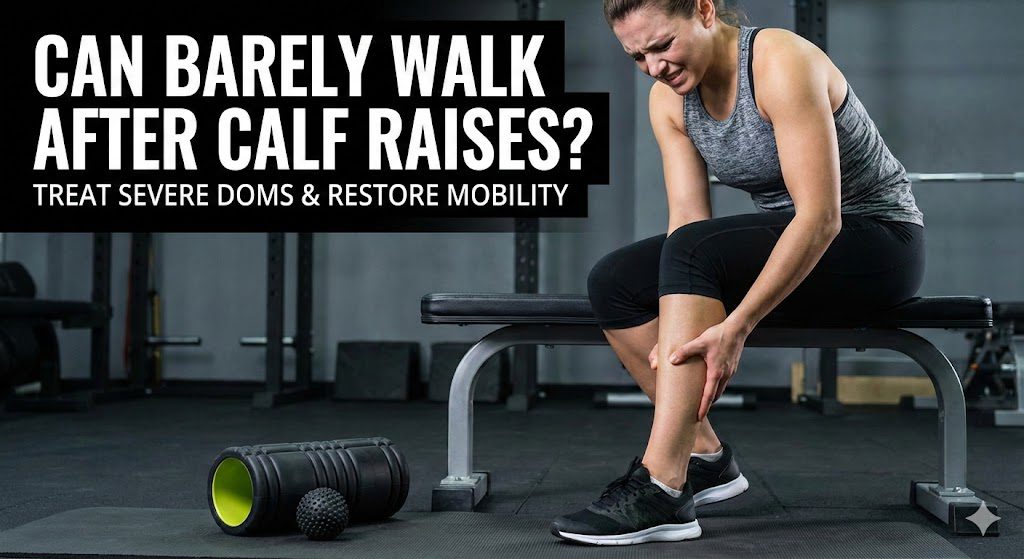
Severe Delayed Onset Muscle Soreness (DOMS) is the primary reason you can barely walk after calf raises, especially if you have recently increased training volume or returned to the gym after a break; however, this condition is generally temporary and treatable with active recovery and mobility techniques. Specifically, the calf muscles (Gastrocnemius and Soleus) are incredibly dense and used constantly for walking, making them hypersensitive to the micro-trauma caused by the eccentric (lowering) portion of calf raises. Consequently, the resulting inflammation causes stiffness so severe that it alters your gait, often referred to as the “penguin walk,” but with proper care, mobility can be restored within days.
You need to distinguish between normal severe DOMS and an actual muscle strain or tear to ensure you apply the correct treatment, as treating an injury like simple soreness can worsen the damage. While DOMS presents as a dull, symmetrical ache across both calves, a strain usually manifests as a sharp, localized pain often accompanied by bruising or swelling. Therefore, understanding these differences is the critical first step in your recovery plan.
To treat sore calves and regain mobility, you should prioritize heat therapy over ice to encourage blood flow, engage in low-impact active recovery like walking or cycling, and perform gentle static stretching rather than aggressive bouncing. Furthermore, hydration and electrolyte balance—specifically magnesium and potassium—play a vital role in flushing out metabolic waste products that contribute to stiffness. By implementing these protocols immediately, you can significantly reduce the duration of the pain.
Below, we will explore the detailed causes of this debilitating soreness, how to differentiate it from serious injury, and the most effective, science-backed protocols to get you walking normally again. Let’s examine the physiological reasons behind why your calves lock up and how to prevent it in the future.
Is It Normal to Be Unable to Walk After Calf Raises?
Yes, it is entirely normal to be unable to walk properly after calf raises, especially if you are a beginner, returning from a hiatus, or have drastically increased your training intensity. Specifically, this phenomenon occurs due to three main factors: the high density of slow-twitch muscle fibers in the calves, the eccentric loading mechanism of the exercise, and the accumulation of metabolic waste. However, while the inability to lower your heels to the ground can be alarming, it is rarely a sign of permanent damage if the pain is bilateral (in both legs).
Understanding why this happens helps reduce the panic associated with the “crippled” feeling. The calves are unique because they support your body weight all day. When you isolate them with heavy loads and deep stretches (calf raises), you create micro-tears in fibers that are not used to that specific range of motion. The body’s inflammatory response to repair these tears causes swelling within the tight fascia compartments of the lower leg, mechanically restricting movement.
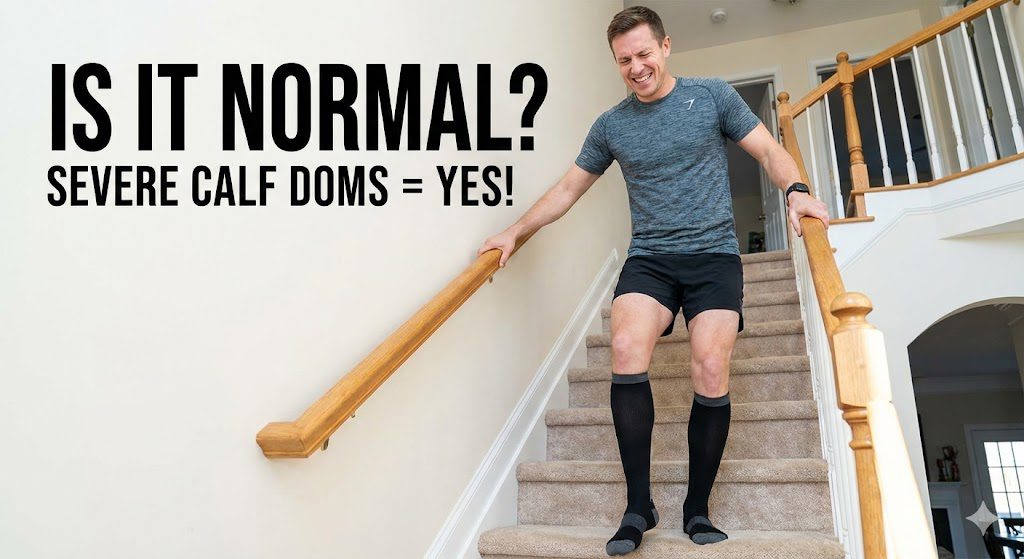
Furthermore, the “inability to walk” is technically a loss of dorsiflexion range of motion. Your brain inhibits the muscle from stretching to protect it from further damage. This creates a feedback loop: the muscle tightens to protect itself, walking becomes difficult, and the lack of movement makes the muscle tighter. Breaking this cycle requires a calculated approach rather than complete rest.
According to a study published in the Journal of Strength and Conditioning Research, the calf muscles experience significantly higher degrees of delayed onset muscle soreness compared to other muscle groups due to their unique fiber composition and daily loading demands.
What Causes Such Severe Delayed Onset Muscle Soreness (DOMS) in Calves?
Severe Delayed Onset Muscle Soreness (DOMS) in calves is primarily caused by eccentric muscle contractions, mechanical tension overload, and metabolic stress accumulation. Specifically, the eccentric phase of a calf raise—where you lower the heel towards the floor—lengthens the muscle fibers under load, causing microscopic structural damage to the sarcomeres (the basic unit of muscle tissue). Consequently, this damage triggers an inflammatory signaling cascade that sensitizes nerve endings, leading to the extreme pain and stiffness you feel 24 to 48 hours later.
To understand this deeper, we must look at the mechanics of the exercise. Unlike walking, which is mostly concentric (shortening) and isometric (holding), calf raises force the muscle to lengthen while resisting weight. This “braking” force causes significantly more structural disruption than the lifting phase.
Moreover, the “pump” or cellular swelling contributes to the pain. During intense calf training, blood and fluid rush into the muscle. Because the calves are wrapped in a tough sheath of connective tissue called fascia, this fluid retention increases internal pressure. This pressure presses against nerves, causing the throbbing sensation and the physical inability to stretch the muscle (walk with a flat foot).
How Long Does Severe Calf DOMS Typically Last?
Severe calf DOMS typically lasts between 3 to 5 days, with the pain peaking around the 48-hour mark post-workout. Typically, the timeline follows a predictable pattern: mild soreness begins 12-24 hours after training, intensity spikes and mobility is most restricted at 24-48 hours, and symptoms gradually subside by day 4 or 5. However, in cases of extreme volume shock, residual stiffness can linger for up to a week.
It is crucial to note that the duration depends heavily on your recovery actions. Total sedation (staying in bed) can actually prolong the stiffness, while active recovery (gentle movement) helps flush out inflammatory byproducts. If pain persists sharply beyond 7 days, it may indicate a strain rather than simple DOMS.
DOMS vs. Calf Strain: What Is the Difference?
DOMS is characterized by a dull, aching pain that is usually symmetrical in both legs, whereas a Calf Strain presents as a sharp, stabbing pain, often localized to a specific point on one leg. Specifically, recognizing the difference is vital because treating a tear like DOMS (e.g., stretching it) can worsen the injury. In contrast, DOMS generally improves slightly as you warm up and move, while a strain causes increased pain with activity and may be accompanied by bruising or a visible dent in the muscle.
To differentiate effectively, perform a quick self-check. If the pain started during the workout with a “pop” or “snapping” sensation, it is likely a strain. If the pain appeared gradually the next day and affects both legs equally, it is almost certainly severe DOMS.
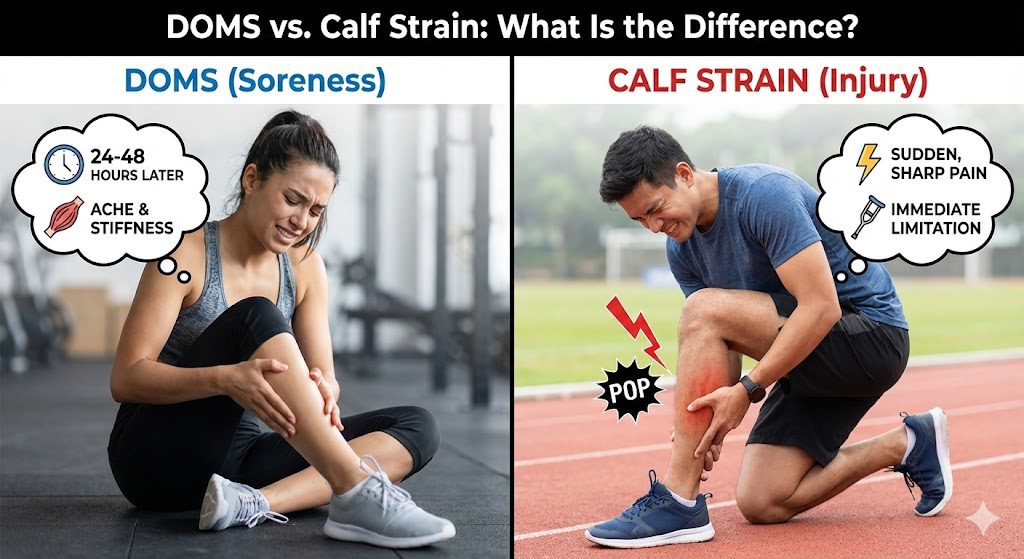
Additionally, function is a key indicator. With DOMS, you can technically push through the pain to stand flat-footed, even if it hurts. With a Grade 2 or 3 strain, the muscle physically cannot support the weight, and the ankle may give way. If you suspect a strain, the R.I.C.E protocol (Rest, Ice, Compression, Elevation) is immediate; however, for DOMS, we want to encourage movement and heat.
According to the Mayo Clinic, distinguishing between muscle soreness and muscle injury is critical for determining return-to-sport timelines, with DOMS requiring 2-5 days and strains requiring weeks to months of rehabilitation.
What Are the Best Ways to Treat Sore Calves and Regain Mobility?
The best ways to treat sore calves and regain mobility are applying heat therapy, engaging in active recovery, utilizing percussive therapy, and optimizing electrolyte intake. Specifically, these methods aim to increase blood flow (vasodilation) to clear out metabolic waste and mechanically loosen the tightened fascia. Therefore, a combination of these approaches yields faster results than relying on just one method.
Below are the most effective strategies broken down by modality to help you walk normally as soon as possible:
Heat vs. Ice: Which Is Better for Tight Calves?
Heat is significantly better than ice for treating tightness and stiffness associated with delayed onset muscle soreness after the initial 24 hours. Specifically, heat promotes vasodilation (widening of blood vessels), which brings oxygen and nutrients to the damaged tissue and helps flush out the inflammatory fluid causing the pressure. Conversely, ice causes vasoconstriction, which reduces blood flow; while this numbs pain temporarily, it can make the muscle stiffer and delay the healing process in the context of DOMS.
You should use ice only if you suspect an acute injury or severe swelling immediately after the workout. For the “I can’t walk” stiffness 2 days later, soaking your calves in a hot bath with Epsom salts or using a heating pad for 15-20 minutes is superior. The heat relaxes the muscle fibers, allowing you to gently mobilize the ankle joint.
What Stretches Are Safe to Perform When Calves Are Locked Up?
Safe stretches to perform when calves are locked up include gentle wall stretches, seated towel pulls, and ankle pumps, provided they are done statically without bouncing. Critically, aggressive stretching can trigger the “myotatic reflex” (stretch reflex), causing the muscle to contract harder to protect itself, which worsens the pain. Instead, the goal is to gently coax the muscle into lengthening.
Here is how to perform the safest movements:
- The Wall Lean: Stand facing a wall, place hands on it. Step one foot back slightly. Keep the heel down only as far as comfortable. Do not force it. Hold for 30 seconds.
- Seated Towel Pull: Sit with legs extended. Loop a towel around the ball of your foot. Gently pull the towel toward you to stretch the calf.
- Ankle Pumps: While lying down or sitting, simply point your toes up and down rhythmically. This pumps blood through the muscle without loading it with body weight.
According to physical therapy guidelines, dynamic stretching is preferred before activity, but for severe DOMS recovery, low-intensity static holding helps reset the muscle’s resting length.
What Are Advanced Strategies to Prevent Future Calf Lock-Ups?
Advanced strategies to prevent future calf lock-ups include implementing progressive overload, managing training frequency, correcting foot positioning, and monitoring for signs of Rhabdomyolysis. Specifically, the most common cause of crippling soreness is doing too much volume too soon; thus, regulating intensity is the primary preventative measure. Additionally, understanding the anatomy of the calf and how recovery mechanisms work allows lifters to train consistently without being sidelined.

By mastering these strategies, you move from a reactive state (treating pain) to a proactive state (optimizing growth). Let’s explore the crucial details that separate an experienced lifter from a perpetual sufferer of DOMS.
What Is Rhabdomyolysis and When Should You See a Doctor?
Rhabdomyolysis is a serious medical condition where damaged muscle tissue breaks down rapidly, releasing a protein called myoglobin into the bloodstream, which can damage the kidneys. Crucially, while severe DOMS is painful, Rhabdomyolysis is life-threatening and requires immediate medical attention. Therefore, distinguishing between “extreme soreness” and “Rhabdo” is a vital safety skill for any lifter pushing their limits.
You should see a doctor immediately if you experience the following symptoms alongside muscle pain:
- Dark urine: Often described as looking like tea or cola.
- Extreme swelling: The muscle looks visibly larger than normal.
- Systemic symptoms: Fever, nausea, confusion, or loss of consciousness. If your urine is clear or pale yellow, you likely just have severe DOMS. However, if hydration doesn’t clear the urine color, seek emergency care.
How Does Foot Positioning Affect Calf Activation and Soreness?
Foot positioning affects calf activation by shifting the emphasis between the medial (inner) and lateral (outer) heads of the Gastrocnemius muscle. Specifically, pointing the toes inward tends to bias the outer calf, while pointing the toes outward biases the inner calf. However, extreme deviations in foot angle can place uneven torque on the knee and ankle joints, potentially leading to asymmetrical soreness or strain.
For the purpose of preventing excessive soreness, it is recommended to keep feet neutral (shoulder-width apart, toes pointing forward) during the majority of your heavy sets. This ensures balanced recruitment of both heads of the Gastrocnemius and the underlying Soleus. Only use angled foot positions for lighter, shaping work once you have established a baseline of recovery capacity.
Why Is Active Recovery Superior to Total Rest for Calf Stiffness?
Active recovery is superior to total rest because it utilizes the muscle pump mechanism to mechanically flush out fluid and metabolic waste, whereas total rest allows fluids to stagnate and fascia to tighten. Specifically, low-intensity movement acts as a “lotion” for the joints and muscles, signaling the body to prioritize repair in that area. Conversely, lying in bed essentially allows the muscle to “dry” in a shortened position, making the first steps out of bed significantly more painful.
Effective active recovery for calves includes:
- Walking: Even if it’s a shuffle, keep moving.
- Stationary Cycling: With low resistance, this moves the ankle through a full range of motion without the heavy impact of running.
- Swimming: The water pressure compresses the muscles (like a sleeve) while the kicking motion activates blood flow with zero impact.
Ultimately, the phrase “motion is lotion” is scientifically accurate. By keeping the blood moving, you supply the raw materials (amino acids, oxygen) needed to repair the damage caused by those heavy calf raises.

Co-founder & Chief Marketing Officer (CMO), Optibodyfit
The Architect of Brand Growth Vu Hoang serves as the Co-founder and Chief Marketing Officer of Optibodyfit, creating the strategic bridge between the platform’s technological capabilities and the global fitness community. Partnering with CEO Huy Tran to launch the company in November 2025, Vu has been instrumental in defining Optibodyfit’s market identity and orchestrating its rapid growth trajectory.
Strategic Vision & Execution With a sophisticated background in digital marketing and brand management, Vu creates the narrative that powers Optibodyfit. He understands that in a crowded health-tech market, technology alone is not enough; it requires a voice. Vu is responsible for translating the platform’s massive technical value—an unprecedented library of over 20,000 exercises—into compelling, human-centric stories.
His mandate goes beyond simple user acquisition. Vu leads a comprehensive marketing ecosystem that encompasses content strategy, community engagement, and digital performance optimization. He focuses on solving a core user problem: “decision fatigue.” By structuring marketing campaigns that guide users through the vast database, he helps transform an overwhelming amount of information into personalized, actionable fitness solutions.
Building a Global Community At the heart of Vu’s philosophy is the belief that fitness is a universal language. Under his leadership, the marketing division focuses on cultivating a vibrant, inclusive community where users feel supported rather than intimidated. He leverages data analytics to understand user behavior, ensuring that Optibodyfit delivers the right content to the right person at the right time—whether they are a beginner looking for home workouts or an athlete seeking advanced technical drills.
Commitment to Impact Vu Hoang does not view marketing merely as a tool for sales, but as a vehicle for education and inspiration. His strategic direction ensures that Optibodyfit remains true to its mission of “Elevating Lifestyles.” By consistently aligning the brand’s message with the real-world needs of its users, Vu is driving Optibodyfit to become not just a tool, but an indispensable daily companion for fitness enthusiasts worldwide.