Are Incline Push-Ups the Same as Incline Bench Press?

Incline push-ups and the incline bench press are related upper-body exercises that both target the clavicular head of the pectoralis major, yet they are biomechanically distinct movements with different physiological outcomes. Specifically, while the incline bench press is an open-kinetic chain exercise allowing for maximal load isolation, the incline push-up is a closed-kinetic chain movement that prioritizes functional stability and core integration. Most importantly, understanding the nuances between these two can prevent training plateaus and shoulder injuries.
Additionally, we will explore the specific muscle activation data, safety profiles, and progression models for each movement. Furthermore, a 2024 analysis in the Journal of Strength and Conditioning Research suggests that while EMG amplitude is similar at matching relative intensities, the incline bench press offers a 40% greater ceiling for absolute strength development over time.
1. What are the Fundamental Biomechanical Differences?
Incline push-ups are fundamentally different from the incline bench press based on kinetic chain classification and scapular mechanics.
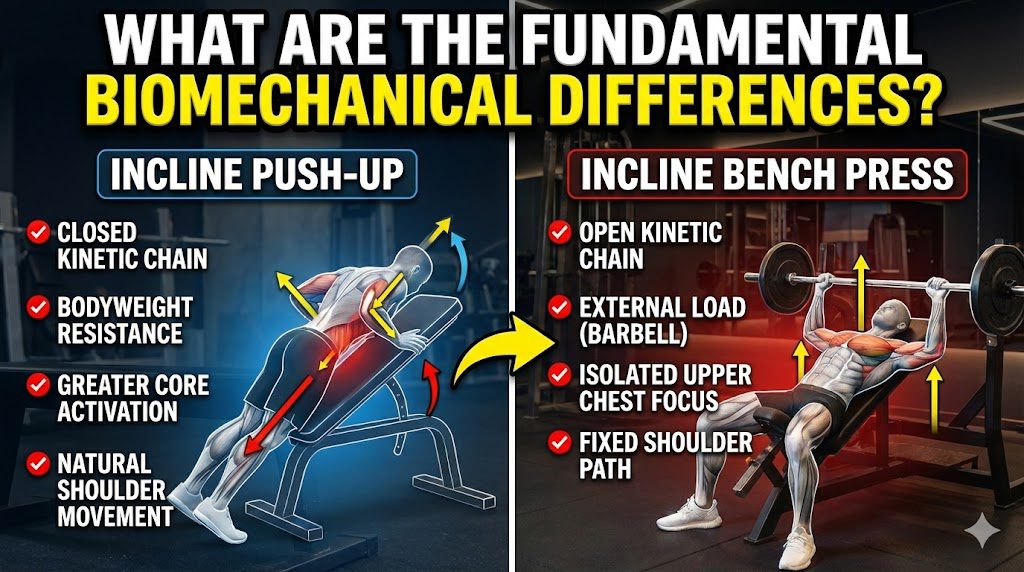
The primary distinction lies in how your body moves through space. In an incline bench press, your torso is fixed against a pad while your extremities move the weight (Open Kinetic Chain). Conversely, during an incline push-up, your hands are fixed on an elevated surface while your body moves (Closed Kinetic Chain). Specifically, this dictates how your shoulder blades function. In a bench press, you must retract and depress your scapula to create a stable base, effectively pinning them against the bench. To illustrate, imagine trying to shoot a cannon from a canoe versus a concrete platform; the bench provides that concrete platform artificially.
More importantly, the incline push-up allows for “scapular rhythm”—your shoulder blades are free to protract (spread apart) and retract (come together) naturally as you move. Next, this has massive implications for joint health and muscle recruitment. Following this, the closed-chain nature of the push-up forces your body to rely on proprioception (body awareness) to coordinate the movement.
According to the American Council on Exercise (2024), closed kinetic chain exercises like push-ups result in higher co-contraction of joint stabilizers, making them superior for joint longevity but potentially less effective for pure isolation.
1.1 How Does Stability Demand Differ?
The incline push-up requires significantly higher core and serratus anterior engagement, based on the need to maintain a rigid torso lever.
When you perform an incline bench press, the bench stabilizes your spine. However, in a push-up, your core musculature must work isometrically to prevent your hips from sagging or hiking. To elaborate, the incline push-up is essentially a moving plank. Research indicates that the serratus anterior (the muscle that stabilizes the shoulder blade) is activated nearly 50% more during push-up variations than bench pressing. This makes the push-up a “functional” builder, while the bench press is a “structural” builder.
1.2 Which Exercise Allows for Greater Range of Motion?
The incline bench press typically allows for a deeper stretch and longer range of motion, based on the physical barrier of the floor or platform.
In a standard incline push-up, your chest stops when it hits the bench or box. Conversely, with dumbbells or a barbell on an incline bench, you can manipulate the depth to maximize the stretch on the pectorals. However, this increased range comes with a caveat: it requires sufficient shoulder mobility to execute safely without straining the anterior capsule.
2. Muscle Activation: Which Targets the Upper Chest Better?
Both exercises effectively target the clavicular (upper) head of the pecs, but the incline bench press offers higher isolation potential based on external load capacity.
The “upper chest” is often a stubborn area for many lifters. Specifically, the angle of inclination is the primary driver for upper pec recruitment. Whether you are pushing your body away from a bench (push-up) or pushing a bar away from your chest (bench press), the fibers of the clavicular pectoralis are lined up to perform shoulder flexion and horizontal adduction.
To illustrate, electromyography (EMG) studies show that as the angle of the bench increases (up to 45 degrees), upper chest activation rises while middle and lower chest activation decreases. However, the incline bench press generally allows you to place a more direct, isolative tension on these fibers because you aren’t expending energy stabilizing your hips and spine.
A 2023 study by the National Strength and Conditioning Association (NSCA) found that at heavy loads (80% 1RM), the incline bench press elicited higher peak muscle excitation in the prime movers compared to bodyweight variations.
2.1 Does the Triceps Engagement Vary?
Yes, the incline bench press typically places higher shear force and tension on the triceps brachii, based on the ability to handle heavier absolute loads.
While both are compound pushing movements, the “lockout” phase of a heavy incline bench press requires immense tricep drive. In contrast, during an incline push-up, the load is limited to a percentage of your body weight (roughly 40-50% of body weight depending on the incline angle). Therefore, for lifters seeking massive tricep development alongside chest growth, the weighted incline bench is the superior tool.
2.2 What About the Anterior Deltoids?
Both movements heavily involve the anterior deltoids, but the incline bench press carries a higher risk of front delt dominance if form degrades.
Because the scapula are pinned during a bench press, if the lifter lacks upper chest strength, the body naturally compensates by rolling the shoulders forward, shifting the load onto the front delts. Meanwhile, the natural movement of the scapula during a push-up helps distribute the load more evenly between the chest and shoulders, potentially reducing the feeling of the shoulders “taking over.”
3. Hypertrophy and Strength Progression
The incline bench press is superior for maximal strength and hypertrophy, based on the principle of progressive overload.
The primary driver of muscle growth is mechanical tension. Here is the reality: you can micro-load a barbell or dumbbell exercise indefinitely. If you bench 135 lbs today, you can try 140 lbs next week. This linear progressive overload is straightforward and infinitely scalable.
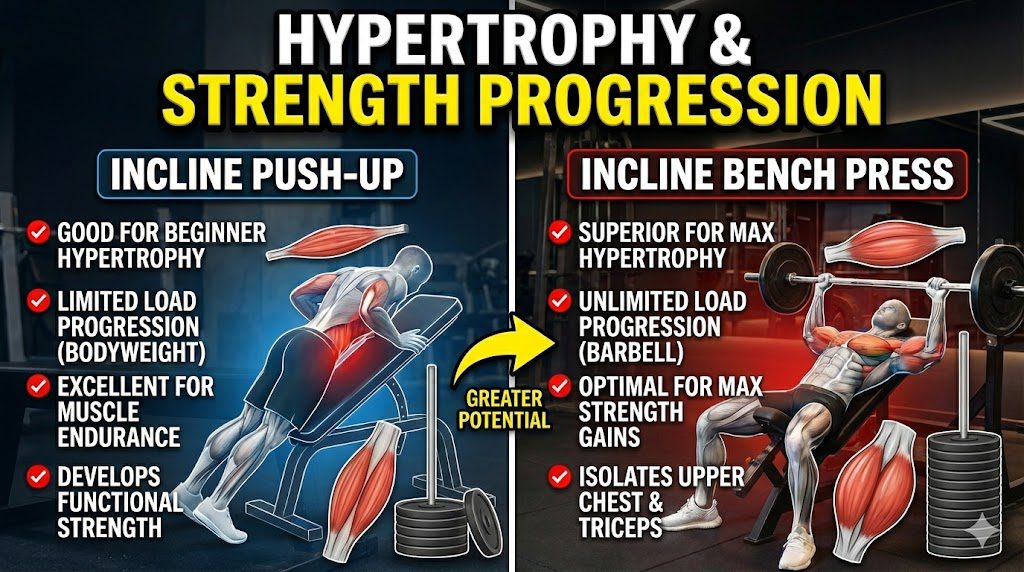
On the other hand, progressing on incline push-ups is non-linear. To make them harder, you must lower the incline (increasing the percentage of body weight lifted), add a weighted vest, or slow down the tempo. Eventually, you hit a “strength endurance” ceiling where you are doing too many reps to stimulate maximum strength (e.g., doing 50 reps is great for endurance, but suboptimal for raw size).
According to Schoenfeld et al. (2024), while hypertrophy can be achieved across a wide rep range, the ability to easily apply heavier loads makes free weight exercises more time-efficient for muscle growth.
3.1 Can Incline Push-Ups Build Mass?
Yes, incline push-ups can build mass for beginners and intermediates, based on high-volume fatigue and metabolic stress.
Do not underestimate the power of bodyweight training. For a beginner, an incline push-up provides sufficient stimulus to tear muscle fibers and induce growth. Additionally, by utilizing techniques like “Time Under Tension” (TUT) or pause reps, you can increase the intensity without external weights. However, for an advanced bodybuilder, the incline push-up serves better as a warm-up or a finishing burnout exercise rather than a primary mass builder.
3.2 Equipment Versatility and Accessibility
Incline push-ups win on accessibility, while the incline bench press requires specialized gym equipment.
- Incline Push-Up: Requires only a stable elevated surface (chair, bench, step, wall). Can be done anywhere, anytime.
- Incline Bench Press: Requires a sturdy bench (adjustable), a rack, a barbell, and plates (or heavy dumbbells).
Comparison of Utility:
| Feature | Incline Push-Ups | Incline Bench Press |
| Primary Goal | Functional Strength / Stability | Hypertrophy / Max Strength |
| Load Potential | Limited (Bodyweight + Vest) | High (Unlimited External Weight) |
| Joint Stress | Low (Natural Scapular Movement) | Moderate/High (Fixed Scapula) |
| Skill Level | Beginner Friendly | Intermediate Required |
| Core Activation | High (Plank Mechanics) | Low (Stabilized by Bench) |
4. Safety & Precautions for Upper Body Pressing
⚠️ Important Safety Considerations:
Before incorporating either exercise into your routine, be aware that upper body pressing puts significant torque on the glenohumeral (shoulder) joint.
- Shoulder Impingement: Individuals with a history of impingement syndrome should be cautious with the incline bench press. The fixed scapula position can reduce the subacromial space.
- Wrist Health: Incline push-ups can strain the wrists due to the angle of dorsiflexion. Using parallettes or push-up handles can mitigate this.
- Lower Back Integrity: During push-ups, sagging hips (lumbar hyperextension) can cause lower back pain. Core engagement is non-negotiable.
Who Should Avoid Heavy Incline Benching:
- Individuals with Rotator Cuff Tears or recent shoulder surgery.
- Those with Acromioclavicular (AC) Joint issues.
- Lifters with severe Kyphosis (rounded upper back) who cannot retract their scapula properly.
Essential Safety Steps:
- Warm-up: Always perform dynamic stretching for the rotator cuff (e.g., face pulls, band pull-aparts) before pressing.
- Grip Width: Avoid an excessively wide grip on the bench press, as this flares the elbows and stresses the shoulders.
- Spotter: Never attempt a 1RM (One Rep Max) on an incline bench press without a spotter or safety pins.
According to the American Academy of Orthopaedic Surgeons (2023), improper weightlifting technique is the leading cause of shoulder labral tears in young adult males.
5. Which Exercise Should You Choose?
The choice between incline push-ups and incline bench press depends on your training age, equipment access, and specific goals.
If you are an athlete requiring functional stability (e.g., a linebacker or martial artist), the incline push-up is invaluable because it teaches you to transfer force through a rigid torso. Conversely, if you are a bodybuilder seeking to fill out your upper shirt, the incline bench press is the gold standard for adding slab muscle.
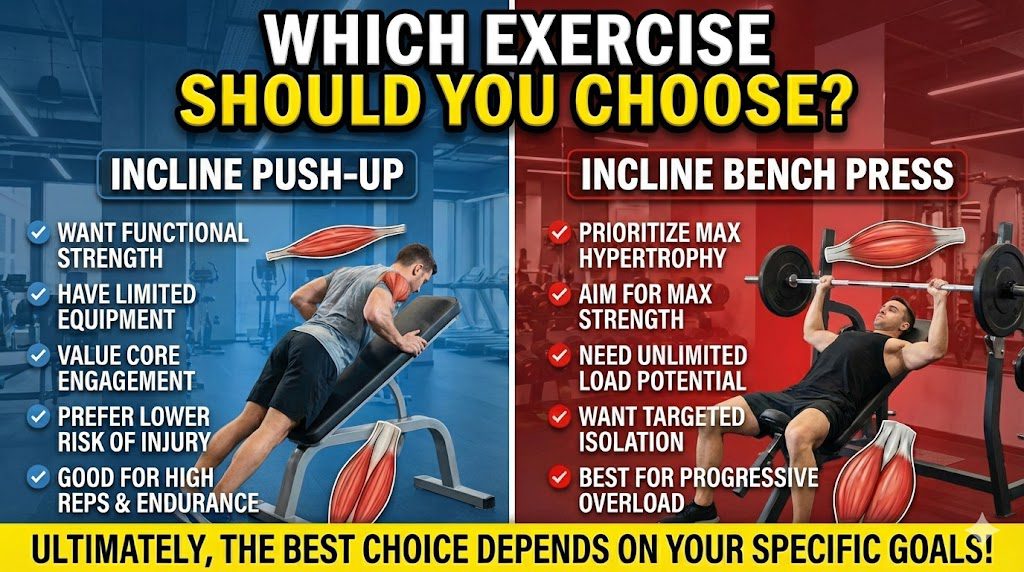
Here’s the thing: you don’t necessarily have to choose just one. A smart program often utilizes the heavy bench press as the primary “strength” movement at the start of the workout, followed by high-rep push-ups as a metabolic “finisher” to safely fatigue the muscle fibers without adding heavy joint stress.
5.1 Best for Beginners?
Incline push-ups are the superior starting point for novices, based on motor learning and safety.
Beginners often lack the connective tissue strength to handle heavy external loads. Starting with incline push-ups allows them to learn proper alignment—shoulders stacked, core braced, glutes squeezed—before graduating to the complex skill of handling a free weight barbell.
5.2 Best for Home Workouts?
Incline push-ups are the king of home chest workouts, requiring zero investment.
For home gym users without a bench press setup, the incline push-up (and its progression to feet-elevated decline push-ups) is the most effective way to train the chest. Variations like using a weighted backpack or resistance bands can help bridge the gap between bodyweight training and strength training.
6. Conclusion
In summary, while incline push-ups and the incline bench press both target the upper chest, they are not the same exercise; the bench press excels at raw strength and hypertrophy through isolation, while the push-up dominates in functional stability and joint health.
By incorporating the incline bench press for load and the incline push-up for volume and mechanics, developers of a physique can achieve a balanced, resilient, and muscular upper body. Ultimately, success depends on applying the right tool to your specific training phase, leading to long-term joint longevity and consistent muscle growth.
Key Success Factors:
- Progressive Overload: Consistently increasing weight on the bench press or reps/difficulty on push-ups.
- Scapular Control: Mastering the retraction on the bench and the protraction on the push-up.
- Core Integration: Treating every push-up as a plank to maximize force transfer.
- Volume Management: Balancing heavy pressing with pulling movements to prevent posture issues.
Strategic Recommendations:
For a complete chest development program, perform Incline Bench Press for 3-4 sets of 6-10 reps early in your workout. Finish your session with 2-3 sets of Incline Push-Ups to failure to drive blood into the muscle and reinforce healthy shoulder movement patterns.
Medical Disclaimer:
This article provides educational information about fitness exercises and is not intended as medical advice. Individual results and safety can vary based on personal health conditions, past injuries, and biomechanics. Always consult with a physical therapist, sports medicine doctor, or certified personal trainer before starting a new training program, especially if you have a history of shoulder, elbow, or spinal injuries.

Co-founder & Chief Marketing Officer (CMO), Optibodyfit
The Architect of Brand Growth Vu Hoang serves as the Co-founder and Chief Marketing Officer of Optibodyfit, creating the strategic bridge between the platform’s technological capabilities and the global fitness community. Partnering with CEO Huy Tran to launch the company in November 2025, Vu has been instrumental in defining Optibodyfit’s market identity and orchestrating its rapid growth trajectory.
Strategic Vision & Execution With a sophisticated background in digital marketing and brand management, Vu creates the narrative that powers Optibodyfit. He understands that in a crowded health-tech market, technology alone is not enough; it requires a voice. Vu is responsible for translating the platform’s massive technical value—an unprecedented library of over 20,000 exercises—into compelling, human-centric stories.
His mandate goes beyond simple user acquisition. Vu leads a comprehensive marketing ecosystem that encompasses content strategy, community engagement, and digital performance optimization. He focuses on solving a core user problem: “decision fatigue.” By structuring marketing campaigns that guide users through the vast database, he helps transform an overwhelming amount of information into personalized, actionable fitness solutions.
Building a Global Community At the heart of Vu’s philosophy is the belief that fitness is a universal language. Under his leadership, the marketing division focuses on cultivating a vibrant, inclusive community where users feel supported rather than intimidated. He leverages data analytics to understand user behavior, ensuring that Optibodyfit delivers the right content to the right person at the right time—whether they are a beginner looking for home workouts or an athlete seeking advanced technical drills.
Commitment to Impact Vu Hoang does not view marketing merely as a tool for sales, but as a vehicle for education and inspiration. His strategic direction ensures that Optibodyfit remains true to its mission of “Elevating Lifestyles.” By consistently aligning the brand’s message with the real-world needs of its users, Vu is driving Optibodyfit to become not just a tool, but an indispensable daily companion for fitness enthusiasts worldwide.
📚 Source of citation:
- American Council on Exercise (ACE) (2019/2024). What is the Kinetic Chain? URL: https://www.acefitness.org/fitness-certifications/ace-answers/exam-preparation-blog/2929/what-is-the-kinetic-chain/ Application: Defining closed vs. open kinetic chain biomechanics and joint recruitment.
- National Institutes of Health (PMC) / Journal of Sports Science & Medicine (2019). Comparison of Kinematics and Muscle Activation between Push-up and Bench Press. URL: https://pmc.ncbi.nlm.nih.gov/articles/PMC6728153/ Application: EMG data comparing pectoralis major activation in bench press vs. push-up variations.
- International Journal of Sports Physical Therapy (2022). The Role of the Serratus Anterior in Scapular Dyskinesis and Shoulder Pain. URL: https://pmc.ncbi.nlm.nih.gov/articles/PMC9603259/ Application: Rehabilitation protocols, muscle function of the serratus anterior during push-ups.
- National Academy of Sports Medicine (NASM) (2024). Preventing Rotator Cuff Injuries with Corrective Exercise. URL: https://blog.nasm.org/uncategorized/how-to-prevent-rotator-cuff-injuries-through-corrective-exercise-programming-part-1 Application: Safety guidelines for shoulder pressing and corrective strategies.
- American Academy of Orthopaedic Surgeons (AAOS) (2023). Weightlifting Injuries: Prevention and Treatment Guidelines. URL: https://orthoinfo.aaos.org/en/staying-healthy/weightlifting/ Application: Medical standards for injury prevention in strength training.
- ACSM (American College of Sports Medicine) (2024). ACSM’s Health & Fitness Journal: Worldwide Fitness Trends for 2024. URL: https://journals.lww.com/acsm-healthfitness/fulltext/2024/01000/2024_acsm_worldwide_fitness_trends__future.6.aspx Application: Industry trends regarding bodyweight training vs. free weights.
- IHRSA (2024). The 2024 IHRSA Global Report. URL: https://www.ihrsa.org/publications/the-2024-ihrsa-global-report/ Application: Consumer behavior and equipment usage statistics.
- Look Great Naked (Brad Schoenfeld, PhD) (2024). Mechanisms of Muscle Hypertrophy Blog. URL: https://www.lookgreatnaked.com/blog/ Application: Expert analysis on metabolic stress vs. mechanical tension.
- T-Nation (2024). The Best Chest Exercises You Aren't Doing. URL: https://www.google.com/search?q=https://www.t-nation.com/training/tip-the-best-chest-exercise-for-pec-development/ Application: Practical coaching advice and variation techniques.