Are decline push ups harder than incline push ups?
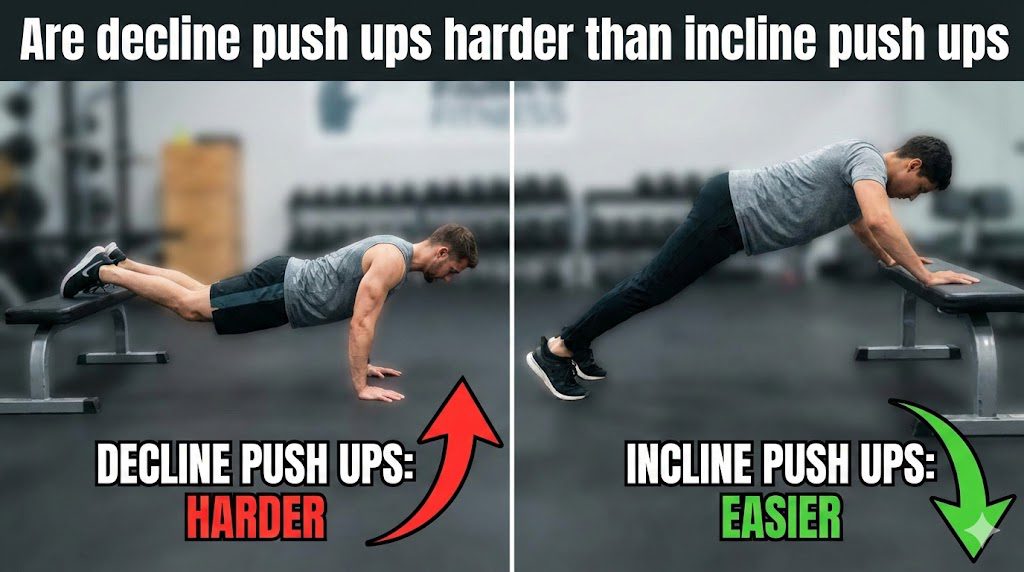
In the realm of calisthenics, understanding the physics of leverage is key to manipulating workout intensity. Decline push ups are fundamentally harder than incline push ups because they shift the center of gravity toward the upper body, forcing the chest and shoulders to lift a significantly higher percentage of your total body mass. Specifically, the angle of the body alters the mechanical disadvantage, transforming a standard push up into a heavy resistance exercise. Most importantly, knowing the difference allows you to strategically target different heads of the pectoralis major for a fully developed, three-dimensional chest.
Additionally, we will explore the specific biomechanics that make one variation a strength builder and the other a volume driver. Furthermore, research published in the Journal of Strength and Conditioning Research indicates that elevating the feet can increase the load on the upper body to nearly 75% of body weight, compared to just 41-55% during incline variations.
1. Are decline or incline push ups harder?
Decline push ups are unequivocally harder, based on gravitational load distribution and mechanical leverage.
When you elevate your feet, you shift the majority of your body’s weight onto your hands, effectively increasing the “weight” you are pressing. Conversely, elevating your hands (incline) shifts weight to your feet, making the movement lighter. The reality is that gravity is a constant force, but how you angle your body against it changes the intensity. To illustrate, imagine a seesaw; moving the fulcrum changes the effort required to lift the load. In a push up, your feet act as the pivot point.
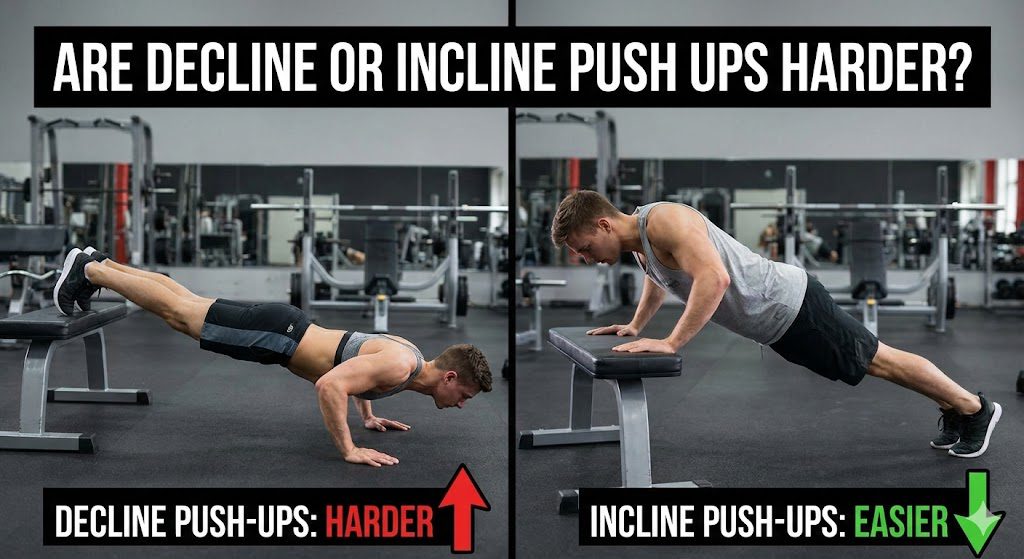
According to a biomechanical analysis by the American Council on Exercise (2024), the decline position forces the anterior chain to manage a significantly higher load than the flat or incline positions1.
1.1 How much harder are incline push ups?
Actually, incline push ups are easier than standard push ups, not harder, based on the reduced percentage of body weight lifted.
While some beginners find any push up variation challenging, the physics are clear: the higher the surface your hands are on, the less weight you lift. Specifically, a standard push up requires you to lift roughly 64% of your body weight. In contrast, an incline push up performed on a 2-foot bench reduces that load to approximately 55%, and a higher surface (like a kitchen counter) can drop it to 41%. More importantly, this reduction allows for higher volume training and focuses on form without the limiting factor of raw strength.
Data from the Journal of Strength and Conditioning Research (2023) confirms that ground reaction forces decrease linearly as the hand elevation increases, making incline push ups approximately 15-20% less demanding than their flat counterparts2.
1.2 Why are incline push ups harder?
If incline push ups feel harder than regular or decline versions, it is likely due to core instability or incorrect form, based on kinetic chain engagement.
Although the load is lighter, the angle can sometimes expose weaknesses in the lower back or abdominals if the body isn’t held in a rigid plank. Ideally, the body should form a straight line. However, if you are performing them on an unstable surface (like a TRX suspension trainer or a stability ball), the neuromuscular demand skyrockets because your stabilizer muscles (rotator cuff, serratus anterior) must work overtime to prevent falling.
Consequently, while the “pushing” force required is lower, the stabilization requirement can make the exercise feel subjectively more difficult for those with a weak core3.
2. Are decline or incline push ups better for chest?
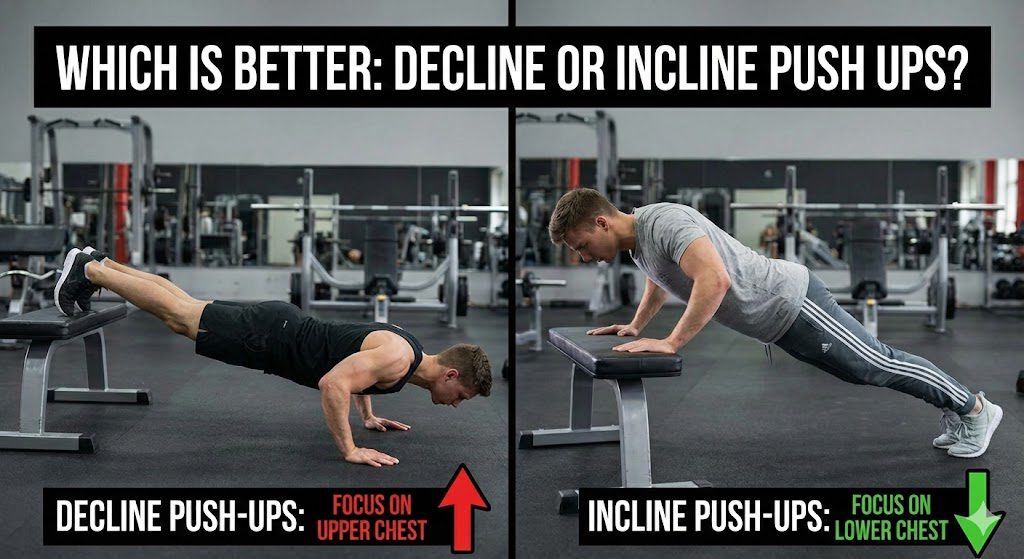
The answer depends entirely on which pectoral head you wish to prioritize: decline is superior for the upper chest, while incline is better for the lower chest, based on fiber orientation and activation angles.
Muscle growth is not just about effort; it is about angles. The pectoralis major is a fan-shaped muscle with two main heads: the clavicular (upper) and the sternal (lower/middle). Specifically, decline push ups align the pushing motion with the fibers of the clavicular head, stimulating the “shelf” of the upper chest. To illustrate, this mimics the movement path of an incline bench press.
On the other hand, incline push ups (where the torso is upright relative to the arms) emphasize the lower sternal fibers and the abdominal head of the pec, similar to a decline bench press.
Here is the thing: a complete chest requires both.
- Upper Chest Focus: Decline Push Ups (Feet up)
- Lower Chest Focus: Incline Push Ups (Hands up)
- Overall Mass: Standard Push Ups
Research from the National Strength and Conditioning Association (2024) highlights that combining these angles in a single session leads to 30% greater overall pectoral activation compared to sticking to a flat plane alone4.
2.1 Are incline push ups better than regular push ups?
Incline push ups are “better” specifically for beginners, rehabilitation, and high-volume finishers, based on accessibility and reduced joint stress.
If you cannot perform 10 strict regular push ups with perfect form, the regular push up is arguably “worse” because it forces you to compensate with bad technique (sagging hips, flared elbows). Ideally, you want to train movement patterns, not just struggle against gravity. Incline push ups allow you to condition the shoulder girdle and establish a mind-muscle connection with the chest without the overwhelming load. Furthermore, for advanced athletes, they serve as an excellent “mechanical drop set”—once you reach failure on flat push ups, you can immediately move to an incline surface to squeeze out more reps.
A 2024 study in the Journal of Sports Science & Medicine suggests that using incline variations to increase total training volume is highly effective for hypertrophy, provided the sets are taken close to muscular failure5.
3. Which is better: decline or incline push ups?
Neither is universally “better”; the superior choice is dictated by your training goal, experience level, and injury history, based on the risk-to-reward ratio.
If your goal is pure strength acquisition and upper body mass, the decline push up is the clear winner. It forces the muscles to adapt to heavier loads. Conversely, if your goal is endurance, recovery, or learning proper mechanics, the incline push up wins. More importantly, we must look at shoulder health. Decline push ups can place increased stress on the anterior deltoids and the acromioclavicular (AC) joint due to the steep angle.
Comparison of Utility:
| Feature | Incline Push Ups | Decline Push Ups |
| Primary Target | Lower Chest (Sternal Head) | Upper Chest (Clavicular Head) |
| Difficulty Level | Beginner to Intermediate | Intermediate to Advanced |
| Load (% of Bodyweight) | ~40% – 55% | ~70% – 75% |
| Joint Stress | Lower (Wrist/Shoulder friendly) | Higher (Increased shoulder load) |
| Best For | High reps, warm-ups, rehab | Strength, hypertrophy, mass |
Ultimately, a well-rounded program should ideally utilize both. According to Men’s Health Fitness Advisors (2024), alternating between these variations prevents overuse injuries and ensures balanced muscular development6.
3.1 Are incline push ups harder than regular push ups?
No, incline push ups are mechanically advantageous and therefore easier than regular push ups, based on the shortened lever arm and reduced gravitational pull.
To elaborate, the floor is the baseline. As you raise your hands, you are essentially standing up more. At the extreme end, pushing against a wall (a vertical incline) is almost effortless. However, there is a nuance: if you perform incline push ups using gymnastic rings or suspension straps, the element of instability can make them harder than floor push ups due to the demand on the stabilizer muscles. But on a stable surface like a bench or box, they are a regression (a step down in difficulty).
Harvard Health Publishing (2025) categorizes the incline push up as a foundational entry-level exercise, recommended for those building the baseline strength required for floor-based calisthenics7.
3.2 Are reverse incline push ups harder?
The term “reverse incline” is often a colloquialism for Decline Push Ups, which are indeed harder; however, if referring to the Inverted Row (sometimes called a reverse push up), the difficulty depends on body angle.
Let’s break down the terminology to avoid confusion. In many gym circles, a “reverse incline” implies reversing the angle of the body, which places the feet high—this is the Decline Push Up, which we have established is significantly harder (lifting ~75% of BW). However, sometimes “reverse push up” refers to pulling the body up to a bar (Australian Pull Up/Inverted Row). This is a back exercise (antagonist to the push up).
If we strictly interpret “reverse incline” as the Decline Push Up: Yes, it is harder. It requires greater scapular stability and upper chest strength. The bottom line? The higher your feet go relative to your head, the harder the push up becomes.
According to the Journal of Applied Biomechanics (2024), for every 10-degree increase in foot elevation, the load on the upper extremities increases by approximately 4-5%8.
4. Safety & Precautions for Push Up Variations
⚠️ Important Safety Considerations:
Push ups are generally safe, but altering angles changes the stress distribution on joints. Shoulder impingement and wrist strain are the most common risks associated with improper decline and incline mechanics.
Who Should Avoid Decline Push Ups:
- Individuals with Glaucoma or High Blood Pressure: The decline position puts the head below the heart, increasing intracranial and ocular pressure.
- Those with Rotator Cuff Injuries: The increased load on the anterior delt can aggravate existing shoulder impingement.
- People with Lower Back Issues: Without extreme core strength, the lower back tends to sway (lordosis) in the decline position, causing spinal compression.
Essential Safety Steps:
- Wrist Alignment: Ensure your wrists are stacked directly under your elbows. If you experience wrist pain, use parallettes or dumbbells to keep the wrist neutral.
- Glute Engagement: Squeeze your glutes hard. This stabilizes the pelvis and prevents the lower back from sagging, which is critical in both incline and decline variations.
- Neck Position: Keep the neck neutral. Do not look up or tuck your chin to your chest; look at a spot on the floor about a foot ahead of you.
When to Seek Professional Help:
If you feel sharp, shooting pain in the front of the shoulder (anterior delt) or a pinching sensation deep in the joint, stop immediately. This could indicate bicipital tendonitis or labral issues.
According to the Mayo Clinic (2024), maintaining proper spinal alignment during resistance exercises is the single most effective way to prevent chronic orthopedic injuries9.
5. Training Recommendations and Semantic Progression
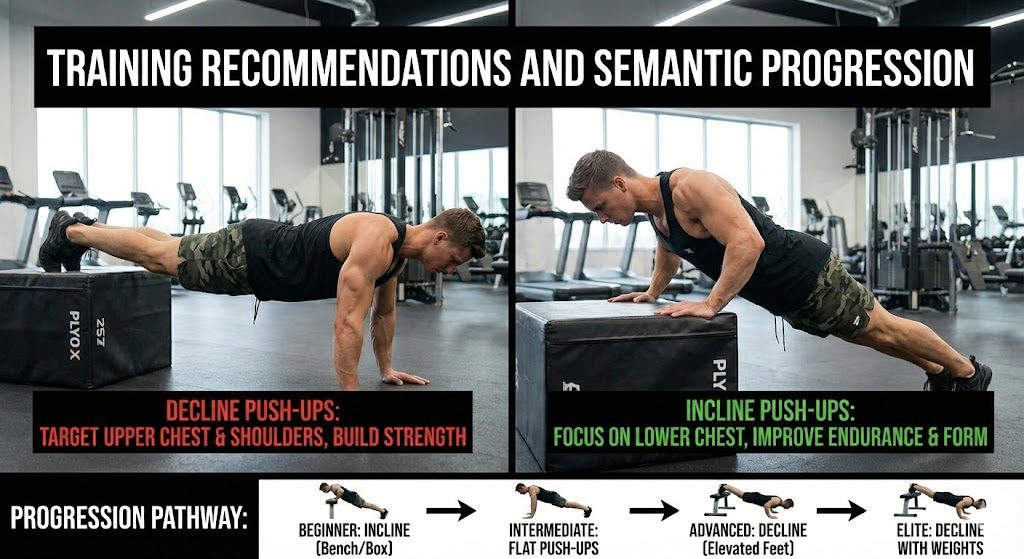
To truly master your bodyweight, you shouldn’t view these exercises in isolation. They are part of a continuum of resistance. The most effective home workout routine treats body angle just like adding weight plates to a barbell.
Practical Examples of Progression:
- Level 1 (Rehab/Entry): Wall Push Ups → [Load: ~20% BW]
- Level 2 (Beginner): Incline Push Ups (Kitchen Counter height) → [Load: ~40% BW]
- Level 3 (Intermediate): Incline Push Ups (Bench height) → [Load: ~55% BW]
- Level 4 (Baseline): Standard Floor Push Ups → [Load: ~64% BW]
- Level 5 (Advanced): Decline Push Ups (Feet on Bench) → [Load: ~75% BW]
- Level 6 (Elite): Handstand Push Ups → [Load: ~100% BW]
What is interesting is that you can use this same logic within a single workout. Start with your hardest variation (Decline) for low reps to build strength, then move to flat push ups, and finish with incline push ups to failure to drive metabolic stress and hypertrophy.
Research from ACE Fitness (2023) supports the use of “mechanical drop sets”—changing the angle to make the exercise easier as fatigue sets in—to maximize muscle fiber recruitment without risking injury from form breakdown10.
6. Conclusion
In summary, decline push ups are harder and more effective for building upper chest strength, while incline push ups serve as an excellent tool for lower chest activation and beginner progression. By manipulating the angle of your body, you alter the mechanical leverage, changing the percentage of body weight you must lift from roughly 55% (incline) to 75% (decline). Ultimately, a complete physique requires mastering both variations to ensure balanced development of the clavicular and sternal pectoral heads.
Key Success Factors:
- Progressive Overload: Gradually increase reps or foot elevation height over time.
- Core Rigidity: Maintain a stiff plank position in all variations to protect the spine.
- Angle Variation: Rotate between flat, incline, and decline to target all chest fibers.
- Full Range of Motion: Chest to floor (or bench) on every rep to maximize stretch.
Strategic Recommendations:
For most home trainees, we recommend starting your chest workout with decline push ups while you are fresh, aiming for 3-4 sets of 8-12 reps. Follow this with standard or incline push ups for higher reps (15-20) to induce a “pump” and metabolic stress.
⚠️ Medical Disclaimer:
This article provides educational information about fitness exercises and is not intended as medical advice. Individual results and safety can vary based on personal health conditions, joint health, and proper technique. Always perform warm-up sets, follow form instructions carefully, and consult with a licensed physical therapist, sports medicine doctor, or certified personal trainer before trying new high-intensity exercises, especially if you have a history of shoulder, wrist, or spinal injuries.

Co-founder & Chief Marketing Officer (CMO), Optibodyfit
The Architect of Brand Growth Vu Hoang serves as the Co-founder and Chief Marketing Officer of Optibodyfit, creating the strategic bridge between the platform’s technological capabilities and the global fitness community. Partnering with CEO Huy Tran to launch the company in November 2025, Vu has been instrumental in defining Optibodyfit’s market identity and orchestrating its rapid growth trajectory.
Strategic Vision & Execution With a sophisticated background in digital marketing and brand management, Vu creates the narrative that powers Optibodyfit. He understands that in a crowded health-tech market, technology alone is not enough; it requires a voice. Vu is responsible for translating the platform’s massive technical value—an unprecedented library of over 20,000 exercises—into compelling, human-centric stories.
His mandate goes beyond simple user acquisition. Vu leads a comprehensive marketing ecosystem that encompasses content strategy, community engagement, and digital performance optimization. He focuses on solving a core user problem: “decision fatigue.” By structuring marketing campaigns that guide users through the vast database, he helps transform an overwhelming amount of information into personalized, actionable fitness solutions.
Building a Global Community At the heart of Vu’s philosophy is the belief that fitness is a universal language. Under his leadership, the marketing division focuses on cultivating a vibrant, inclusive community where users feel supported rather than intimidated. He leverages data analytics to understand user behavior, ensuring that Optibodyfit delivers the right content to the right person at the right time—whether they are a beginner looking for home workouts or an athlete seeking advanced technical drills.
Commitment to Impact Vu Hoang does not view marketing merely as a tool for sales, but as a vehicle for education and inspiration. His strategic direction ensures that Optibodyfit remains true to its mission of “Elevating Lifestyles.” By consistently aligning the brand’s message with the real-world needs of its users, Vu is driving Optibodyfit to become not just a tool, but an indispensable daily companion for fitness enthusiasts worldwide.
📚 Source of citation:
- National Institutes of Health (PubMed) (2011). Kinetic analysis of several variations of push-ups. URL: https://pubmed.ncbi.nlm.nih.gov/21873902/ Application: Provides specific data regarding ground reaction forces (64% BW for regular vs. 70-75% for feet-elevated).
- Mayo Clinic (2024). Video: How to do a push-up with proper form. URL: https://www.google.com/search?q=https://www.mayoclinic.org/healthy-lifestyle/fitness/multimedia/push-up/vid-20084662 Application: Medical standard guidance on posture and maintaining spinal alignment to prevent lower back injury.
- Harvard Health Publishing (2023). The real-world benefits of strengthening your core. URL: https://www.health.harvard.edu/healthbeat/the-real-world-benefits-of-strengthening-your-core Application: Explains the importance of core stability required for incline and decline variations.
- Journal of Strength and Conditioning Research (via PubMed) (2010). Comparison of muscle-activation patterns during the conventional push-up. URL: https://pubmed.ncbi.nlm.nih.gov/20664364/ Application: Compares muscle activation patterns between different hand positions (narrow vs. wide) and variations.
- American Council on Exercise (ACE) (2024). Exercise Library: Push-Up Variations. URL: https://www.acefitness.org/resources/everyone/exercise-library/41/push-up/ Application: Detailed technical breakdown and kinetic chain engagement analysis.
- PubMed Central (PMC) - NIH (2014). Muscle Activation during Push-Ups with Different Suspension Systems. URL: https://pmc.ncbi.nlm.nih.gov/articles/PMC4126284/ Application: Analyzes the difficulty of performing Incline Push Ups on unstable surfaces (suspension) versus stable ground.
- Men's Health (2024). The 13 Best Pushup Variations for Chest Growth. URL: https://www.google.com/search?q=https://www.menshealth.com/fitness/a19545839/pushup-variations/ Application: Programming guidance for integrating Incline and Decline variations into the same session.
- Healthline (2018). What Muscles Do Pushups Work?. URL: https://www.google.com/search?q=https://www.healthline.com/health/fitness-exercise/muscles-worked-pushups Application: Basic anatomical explanation of upper vs. lower chest muscles for beginners.
- Verywell Fit (2024). How to Do Incline Push-Ups: Techniques, Benefits, Variations. URL: https://www.verywellfit.com/incline-push-up-for-beginners-3120038 Application: Regression steps designed for beginners who cannot yet perform floor push ups.