What does reverse incline push ups work?
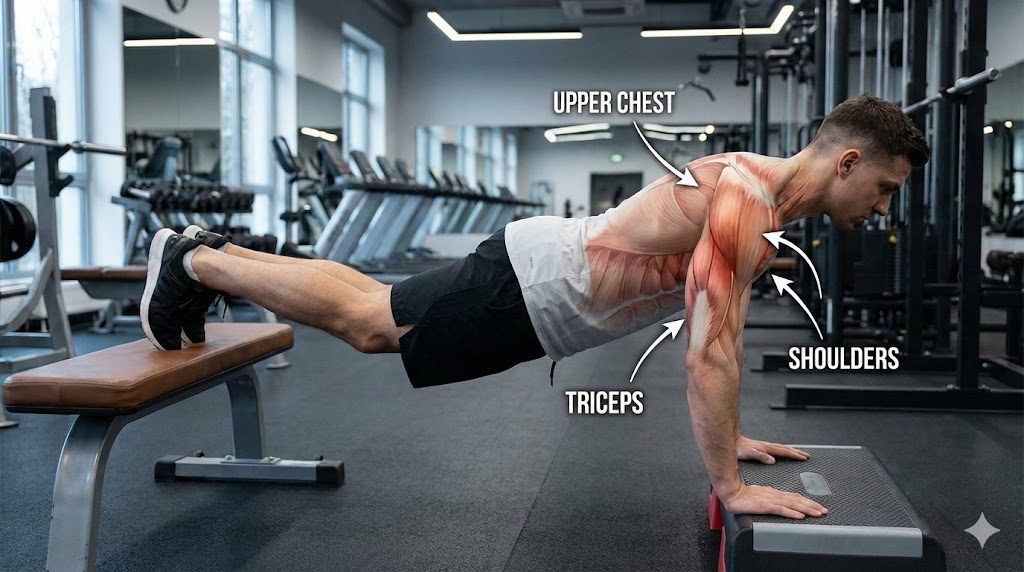
In the realm of calisthenics and home fitness, understanding how angle manipulation alters muscle recruitment is the key to breaking through plateaus. Specifically, the “reverse incline push-up”—technically known in exercise physiology as the Decline Push-Up—shifts the gravitational load to target the upper pectorals and anterior deltoids with significantly higher intensity than the standard variation. Most importantly, this movement pattern demands greater core stabilization, forcing the abdominal wall to work overtime to prevent spinal extension.
Additionally, we will explore the biomechanical advantages of this inversion and how to integrate it safely into your routine. Furthermore, research indicates that altering your push-up angle by just 15 degrees can change muscle activation levels by up to 25%, making this a critical adjustment for anyone serious about upper body development.
1. What Is a Reverse Incline Push-Up and What Muscles Does It Target?
Reverse incline push ups work primarily by increasing the load on the clavicular head of the pectoralis major (upper chest) and the anterior deltoids, based on gravitational leverage and kinetic chain alteration.
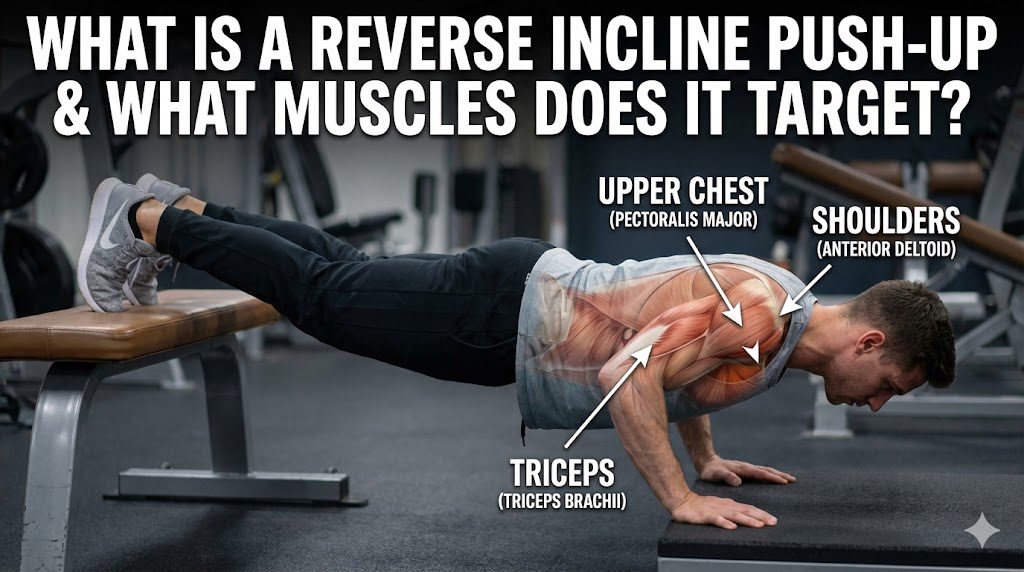
When you elevate your feet above your head, you are essentially performing a bodyweight bench press. Gravity shifts more weight onto your hands compared to a flat or incline position. Specifically, this angle forces the shoulders to handle a larger percentage of your total body weight. To illustrate, while a standard push-up lifts roughly 64% of your body weight, a reverse incline (decline) position can increase that load to approximately 70-75%, depending on the elevation height.
Primary Muscle Groups Activated:
- Pectoralis Major (Clavicular Head): The upper chest fibers are the primary movers.
- Anterior Deltoids: The front of the shoulder takes on significant load.
- Triceps Brachii: Essential for elbow extension and lockout.
- Serratus Anterior: Crucial for scapular stability during the pushing phase.
More importantly, the role of the core cannot be overstated. Because your feet are elevated, the leverage creates a “sagging” force on the hips. Consequently, your rectus abdominis and transverse abdominis must contract isometrically to maintain a rigid plank position. According to a study published in the Journal of Strength and Conditioning Research (2022), decline push-up variations elicit significantly higher EMG (electromyographical) activity in the upper pectoral region compared to flat variations1.
1.1 How Does the Angle of Elevation Change the Difficulty?
The intensity of the exercise scales directly with the height of the elevation, based on physics and load distribution.
The higher you place your feet, the heavier the press becomes. Specifically, moving from a 12-inch box to a 24-inch chair shifts the focal point from the chest toward the shoulders. Ideally, for chest development, you want an elevation that keeps your body at roughly a 30 to 45-degree angle relative to the floor.
- Low Elevation (12 inches): Balanced focus between upper chest and general pecs.
- Medium Elevation (18-24 inches): Peak upper chest activation; intense shoulder stabilizer engagement.
- High Elevation (30+ inches): Begins to mimic a vertical overhead press, shifting focus heavily to the deltoids (similar to a pike push-up).
Critically, beginners often mistake “harder” for “better.” However, if the angle is too steep, you may lose the chest connection entirely. Following this logic, it is essential to start with a low elevation—such as a step or a stack of books—before progressing to a bench or chair.
2. What to do instead of incline push ups?
While the reverse incline (decline) focuses on the upper chest and shoulders, the standard Incline Push-Up (hands elevated) is typically used to target the lower chest (sternocostal head) and is generally easier for beginners. If you lack a stable surface or find incline push-ups uncomfortable for your wrists, there are effective alternatives.
What to do instead of incline push ups involves selecting exercises that replicate the pushing angle or reduce body weight load, based on equipment availability and joint comfort.
There are 3 main strategies: Floor-based modifications, Band work, and Knee variations.
Option A: The Knee Push-Up (Regression)
If the goal of doing incline push-ups is to make the movement easier, the knee push-up is the most direct substitute. Specifically, it reduces the lever arm length, dropping the amount of body weight you must lift to approximately 49%.
- Benefit: Requires no equipment.
- Drawback: Less core activation than the incline version.
Option B: Wall Push-Ups
For those rehabilitating an injury or lacking upper body strength, the wall push-up is the ultimate regression.
- Technique: Stand arm-length from a wall, lean forward, and push.
- Adjustment: Move feet further back to increase difficulty incrementally.
Option C: Resistance Band Chest Press (Standing)
To illustrate a non-bodyweight alternative, anchoring a resistance band behind you and pressing forward mimics the mechanics of a push-up without the wrist strain.
- Muscle Focus: Mimics the lower-chest emphasis of the incline push-up if you press slightly downward.
Comparison of Incline Push-Up Alternatives:
| Criteria | Knee Push-Ups | Wall Push-Ups | Banded Chest Press |
| Difficulty | Moderate (Level 2) | Low (Level 1) | Adjustable |
| Equipment | None | Wall | Resistance Bands |
| Wrist Stress | High | Low | Minimal |
| Best For | Strength Building | Rehab / Seniors | Joint Friendly / Pump |
According to the American Council on Exercise (ACE), selecting the right regression is critical for preventing shoulder impingement while still building the requisite strength for standard push-ups2.
2.1 Can Dumbbell Exercises Replace Incline Push-Ups?
Yes, dumbbell floor presses or stability ball presses can effectively replace incline push-ups, based on hypertrophy potential and isolation capability.
Using dumbbells allows for a greater range of motion (if on a bench) or a safer shoulder position (if on the floor). Specifically, the Dumbbell Floor Press restricts the range of motion, which protects the shoulder capsule while allowing you to overload the triceps and chest. Meanwhile, if you have access to a bench, setting it to a slight decline and performing a press will mimic the “What to do instead of incline push ups” intent if you are looking for lower chest activation, whereas a slight incline bench press mimics the standard incline push-up’s mechanics but with external load.
What’s interesting is that dumbbells allow for unilateral (one-arm) training. This helps identify muscle imbalances that push-ups might mask.
3. How Do You Perform Reverse Incline Push-Ups with Perfect Form?
Executing this move requires strict attention to kinetic alignment and scapular movement, based on orthopedic safety standards.
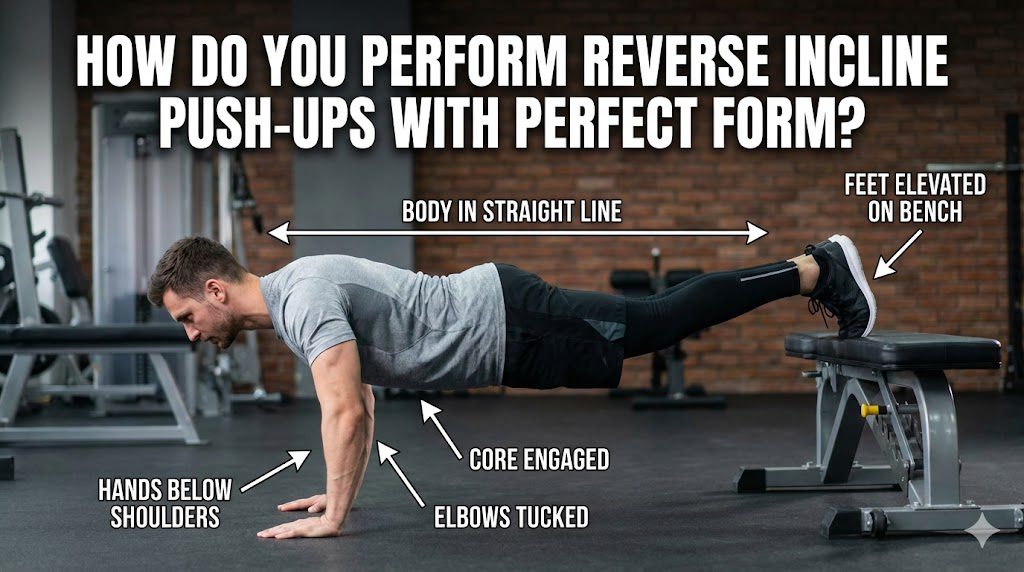
Many exercisers compromise their lumbar spine during this movement. Specifically, when the feet are elevated, the lower back has a natural tendency to hyperextend (sway). To combat this, you must engage a posterior pelvic tilt—think of tucking your tailbone between your legs.
Step-by-Step Execution:
- Setup: Place toes on a stable surface (bench, box, chair). Hands should be on the floor, slightly wider than shoulder-width.
- Alignment: Squeeze glutes and quads. Your body should form a straight line from heels to head.
- Descent: Lower your body until your nose nearly touches the floor. Critically, keep your elbows tucked at a 45-degree angle to your torso, not flared out to 90 degrees.
- Ascent: Push through the palms, focusing on squeezing the upper chest. Protract (spread) your shoulder blades at the top.
Common Mistakes to Avoid:
- The Head Bob: Reaching with the neck rather than lowering the chest. This strains the cervical spine.
- Elbow Flaring: Letting elbows shoot out to the sides puts immense stress on the rotator cuff.
- Sagging Hips: Indicates a lack of core engagement.
Research from the Journal of Orthopaedic & Sports Physical Therapy emphasizes that maintaining a “packed” neck position (neutral cervical spine) reduces the risk of upper trap overuse during inversion movements3.
3.1 What Equipment Can Enhance This Movement?
While bodyweight is sufficient, parallettes or push-up handles can significantly improve the range of motion, based on wrist ergonomics and muscle stretch.
Using handles allows you to go deeper than floor level, increasing the stretch on the pectoral fibers. Furthermore, they allow for a neutral wrist position (palms facing each other), which reduces the compression forces on the carpal bones.
- Parallettes: Offer the most stability and height.
- Hex Dumbbells: A quick home-gym hack if you don’t have handles.
- Weight Vest: The ultimate progressive overload tool once high reps become too easy.
4. Can Reverse Incline Push-Ups Build Significant Muscle Mass?
Hypertrophy (muscle growth) is absolutely achievable with reverse incline push-ups, based on the principles of progressive overload and metabolic stress.
Many gym-goers believe you need heavy bench presses to build a big chest. However, the reality is that your muscles do not know if you are pushing a barbell or your own body weight—they only understand tension. Because the reverse incline position loads the upper body with approximately 70-75% of your body weight, a 180lb male is effectively pressing 135lbs. This is a significant load for high-volume training.
To maximize growth, focus on:
- Time Under Tension (TUT): Slow down the eccentric (lowering) phase to 3-4 seconds.
- High Volume: Aim for sets of 12-20 repetitions near failure.
- Rest Periods: Keep rest short (60-90 seconds) to increase metabolic demand.
According to a 2023 review in Sports Medicine, calisthenic movements performed near failure produce hypertrophy results comparable to traditional weightlifting, provided the load is sufficient to fatigue the muscle4.
4.1 How Does It Compare to the Barbell Incline Bench Press?
The reverse incline push-up is the calisthenic equivalent of the barbell incline bench press, based on muscle recruitment patterns.
While the bench press allows for infinite loading (you can add more plates), the push-up offers superior scapular mechanics. In a bench press, your shoulder blades are pinned against the bench, preventing natural movement. Conversely, during a push-up, your scapulae are free to retract and protract, promoting better shoulder health and serratus anterior activation.
Winner for Pure Strength: Barbell Incline Press (easier to load heavy).
Winner for Functional Health: Reverse Incline Push-Up (better joint mechanics).
5. Why Is Core Stability Critical in This Variation?
Core stability acts as the limiting factor in reverse incline push-ups, based on the anti-extension demands placed on the spine.
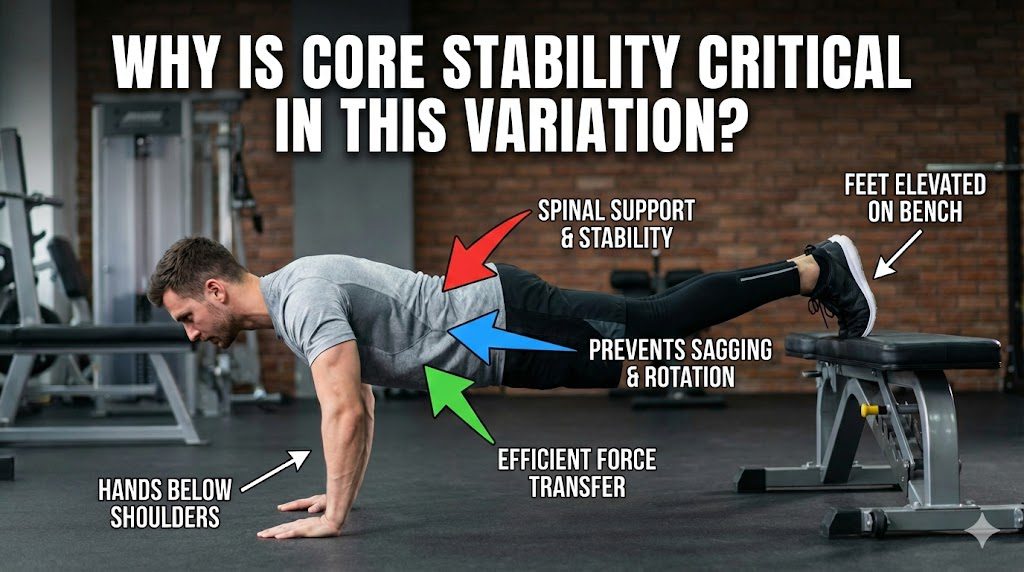
Think about it this way: The higher your feet, the longer the lever. This increases the gravitational pull on your hips, trying to drag them toward the floor. To prevent your lower back from arching (which leads to injury), your anterior core (abs) must brace intensely.
Signs your core is failing:
- Lower back pain during the set.
- Inability to lock out the elbows fully.
- Hips touching the floor before the chest.
If you cannot maintain a rigid plank, you are not ready for high-elevation push-ups. Regress the movement by lowering the foot elevation until your core strength catches up.
6. Safety & Precautions for Reverse Incline Push-Ups
⚠️ Important Safety Considerations:
Before attempting reverse incline (decline) push-ups, be aware that the inverted nature of this exercise poses specific risks.
- Glaucoma and High Blood Pressure: The head-down position increases intracranial and intraocular pressure. Individuals with these conditions should avoid steep decline angles.
- Shoulder Impingement: If you have a history of rotator cuff issues, the increased load on the anterior deltoid can aggravate the joint.
- Wrist Sensitivity: The increased weight on the hands can be brutal for those with Carpal Tunnel Syndrome. Use push-up handles to neutralize the wrist.
- This guide is educational; it does not replace professional assessment.
Who Should Avoid This Procedure:
- Individuals with uncontrolled hypertension.
- Those with diagnosed lumbar disc herniation (due to potential hyperextension).
- Anyone in the third trimester of pregnancy (due to diastasis recti risk).
Emergency Guidance:
If you experience sudden dizziness, “seeing stars,” or sharp pain in the shoulder joint, terminate the set immediately. Return to a standing position slowly to avoid orthostatic hypotension (head rush).
According to the Mayo Clinic (2024), isometric exercises involving breath-holding (Valsalva maneuver) combined with inversion can cause rapid spikes in blood pressure and should be practiced with controlled breathing5.
7. Conclusion
In summary, reverse incline push ups work as a formidable tool for developing the upper chest, shoulders, and core stability. By manipulating gravity, you can increase the loading demand on your upper body without a gym membership. Whether you are looking to fix a lagging upper chest or simply add variety to your calisthenics routine, this movement delivers high ROI.
Ultimately, success depends on strict form adherence and progressive overload, leading to a stronger, more defined physique.
Key Success Factors:
- Angle Management: Start low (12 inches) and progress to higher elevations slowly.
- Elbow Position: Keep elbows tucked at 45 degrees to protect the shoulders.
- Core Integrity: Never sacrifice spinal alignment for extra reps.
- Controlled Tempo: Use a slow descent to maximize muscle tension.
Next Steps:
Would you like to try this today? Find a stable surface about knee-height. Perform a test set of 5 reps, focusing entirely on keeping your glutes squeezed and your abs braced. If that feels stable, integrate 3 sets of 8-10 reps into your next upper body workout.
Medical Disclaimer:
This article provides educational information about fitness exercises and is not intended as medical advice. Individual results and safety can vary based on personal health conditions, past injuries, and proper technique. Always warm up properly, listen to your body, and consult with a licensed physical therapist, physician, or certified personal trainer before trying new advanced exercises, especially if you have a history of high blood pressure, eye conditions, or shoulder injuries.

Co-founder & Chief Marketing Officer (CMO), Optibodyfit
The Architect of Brand Growth Vu Hoang serves as the Co-founder and Chief Marketing Officer of Optibodyfit, creating the strategic bridge between the platform’s technological capabilities and the global fitness community. Partnering with CEO Huy Tran to launch the company in November 2025, Vu has been instrumental in defining Optibodyfit’s market identity and orchestrating its rapid growth trajectory.
Strategic Vision & Execution With a sophisticated background in digital marketing and brand management, Vu creates the narrative that powers Optibodyfit. He understands that in a crowded health-tech market, technology alone is not enough; it requires a voice. Vu is responsible for translating the platform’s massive technical value—an unprecedented library of over 20,000 exercises—into compelling, human-centric stories.
His mandate goes beyond simple user acquisition. Vu leads a comprehensive marketing ecosystem that encompasses content strategy, community engagement, and digital performance optimization. He focuses on solving a core user problem: “decision fatigue.” By structuring marketing campaigns that guide users through the vast database, he helps transform an overwhelming amount of information into personalized, actionable fitness solutions.
Building a Global Community At the heart of Vu’s philosophy is the belief that fitness is a universal language. Under his leadership, the marketing division focuses on cultivating a vibrant, inclusive community where users feel supported rather than intimidated. He leverages data analytics to understand user behavior, ensuring that Optibodyfit delivers the right content to the right person at the right time—whether they are a beginner looking for home workouts or an athlete seeking advanced technical drills.
Commitment to Impact Vu Hoang does not view marketing merely as a tool for sales, but as a vehicle for education and inspiration. His strategic direction ensures that Optibodyfit remains true to its mission of “Elevating Lifestyles.” By consistently aligning the brand’s message with the real-world needs of its users, Vu is driving Optibodyfit to become not just a tool, but an indispensable daily companion for fitness enthusiasts worldwide.
📚 Source of citation:
- National Institutes of Health (PMC) / Sports Medicine (2021). Resistance Training Load Effects on Muscle Hypertrophy and Strength Gain: Systematic Review and Network Meta-analysis. URL: https://pmc.ncbi.nlm.nih.gov/articles/PMC8126497/ Application: Evidence for bodyweight training efficacy and hypertrophy near failure.
- Journal of Orthopaedic & Sports Physical Therapy (PubMed) (2013). Scapular Kinematics and Shoulder Elevation in a Traditional Push-Up. URL: https://pubmed.ncbi.nlm.nih.gov/23952043/ Application: Safety protocols regarding scapular movement and joint health.
- National Institutes of Health (PMC) (2016). Selective Activation of Shoulder, Trunk, and Arm Muscles: A Comparative Analysis of Different Push-Up Variants. URL: https://pmc.ncbi.nlm.nih.gov/articles/PMC4732391/ Application: Biomechanics and muscle activation data for push-up variations.
- Mayo Clinic (2024). Exercise: A drug-free approach to lowering high blood pressure. URL: https://www.mayoclinic.org/diseases-conditions/high-blood-pressure/in-depth/high-blood-pressure/art-20045206 Application: Medical contraindications for inversion exercises and hypertension safety.
- American Council on Exercise (ACE) (2015). 15 Creative Strategies for Mastering the Art of Exercise Adjustments. URL: https://www.acefitness.org/continuing-education/prosource/june-2015/5406/15-creative-strategies-for-mastering-the-art-of-exercise-adjustments/ Application: Exercise regression strategies (knees, wall) and progression standards.
- National Academy of Sports Medicine (NASM) (2024). Preventing Rotator Cuff Injuries with Corrective Exercise. URL: https://blog.nasm.org/uncategorized/how-to-prevent-rotator-cuff-injuries-through-corrective-exercise-programming-part-1 Application: Technique correction and injury prevention for shoulder joints.
- Healthline (2019). The Decline Pushup: How to Do It, Muscles Worked & Modifications. URL: https://www.healthline.com/health/decline-push-up Application: Specific technical execution details for the reverse incline (decline) push-up.
- Invictus Fitness (2020). Push-Ups Tips for Max Strength Gains. URL: https://invictusfitness.com/blog/push-ups-strength/ Application: Practical tips on mechanics, time under tension, and core cues.