Do Seated Calf Raises Hurt Your Knees? (Causes, Fixes, and Safety Guide)
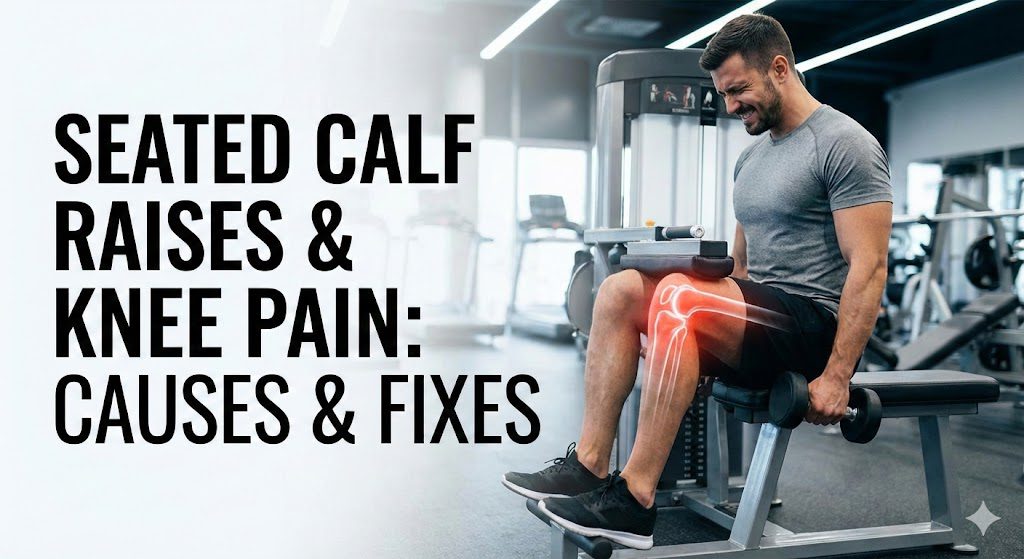
Seated calf raises do not inherently hurt your knees unless they are performed with improper form, incorrect machine setup, or excessive weight load. However, many gym-goers experience discomfort due to placing the knee pads directly on the patella or allowing the feet to rotate, which creates unnecessary shear force. Consequently, understanding the biomechanics of this exercise is crucial to isolating the soleus muscle without compromising joint health.
The primary reasons for knee pain during this movement often include positioning the knee pad too low, poor foot placement causing torque, and using momentum instead of controlled muscle contraction. Specifically, when the pad sits on the kneecap rather than the lower thigh, the compression can irritate the patellar tendon, leading to sharp pain or chronic inflammation.
To perform seated calf raises correctly, you must adjust the knee pad to rest on the distal quadriceps, align your toes forward, and control the eccentric phase of the lift. In addition, comparing the seated variation with standing calf raises reveals that the seated position is generally safer for the knee joint itself because the bent-knee angle disengages the gastrocnemius, reducing tension behind the knee.
Beyond technical errors, hidden causes such as limited ankle mobility or pre-existing patellar tendonitis can exacerbate pain, necessitating joint-friendly alternatives. Let’s explore the detailed causes, fixes, and safety guidelines to help you build bigger calves without wrecking your knees.
Do Seated Calf Raises Cause Knee Pain?
No, seated calf raises do not cause knee pain when performed correctly, but they can trigger injury due to user error, poor machine ergonomics, or pre-existing joint conditions. On the contrary, this exercise is designed to target the soleus muscle while the knee is in a stable, flexed position, theoretically making it safe for the joint structure.
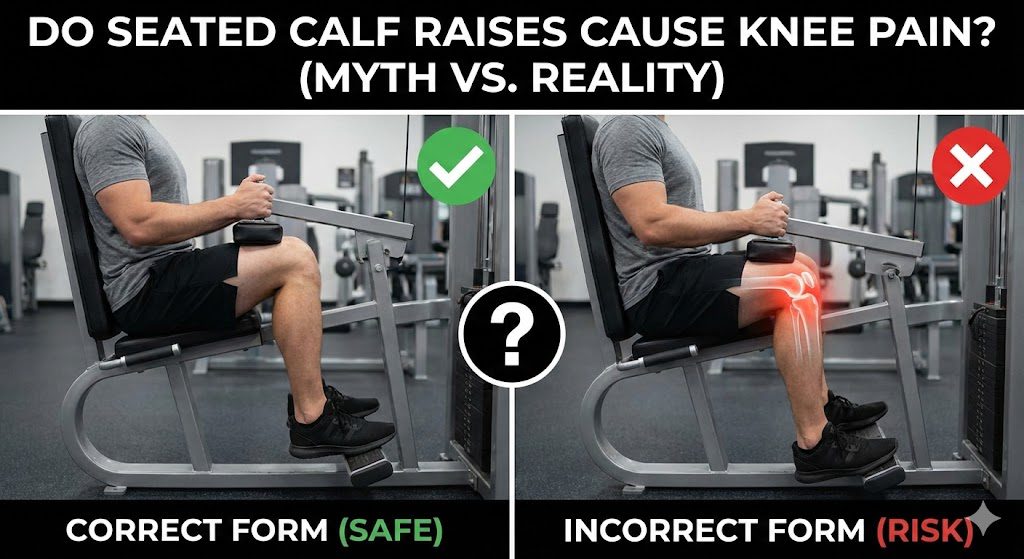
Important findings suggest that pain is rarely caused by the movement pattern itself but rather by external pressure.
- Safety Profile: The seated position takes the weight off the spine and hips, isolating the lower leg.
- Common Occurrence: Pain usually stems from the “crushing” force of the pad on the kneecap, not the hinge action of the knee joint.
According to biomechanical analysis from the Journal of Strength and Conditioning Research, the shear force on the knee is significantly minimized when the joint is flexed at 90 degrees, provided the external load is applied to the femur (thigh bone) and not the patella (kneecap).
Why Do My Knees Hurt When Doing Seated Calf Raises?
Your knees likely hurt doing seated calf raises because of incorrect knee pad positioning, misaligned foot placement, excessive weight load, or uncontrolled movement speed. Specifically, these mechanical failures shift the stress from the target muscle (soleus) directly onto the delicate structures of the knee joint and patellar tendon.
Here are the primary culprits behind the pain:
- Knee Pad Position: Placing the pads too far forward so they rest on the kneecap instead of the lower thigh (quadriceps) causes direct compression pain.
- Foot Placement: Positioning feet too far back causes the knee to slide forward, while placing them too far forward reduces range of motion; turning toes out excessively creates rotational torque.
- Weight Load: Using “ego lifting” weights forces the joint to grind and often leads to the knee shifting under the pad to compensate.
- Speed/Tempo: Bouncing the weight at the bottom of the movement utilizes the Achilles tendon’s elasticity but shocks the knee joint with sudden force.
How Do You Perform Seated Calf Raises Correctly to Avoid Pain?
You perform seated calf raises correctly by positioning the pads on the distal quadriceps, ensuring neutral foot alignment, and controlling the lowering phase to maximize muscle tension while protecting the joints. To begin with, setting up the machine specifically for your body proportions is the most critical step in injury prevention.
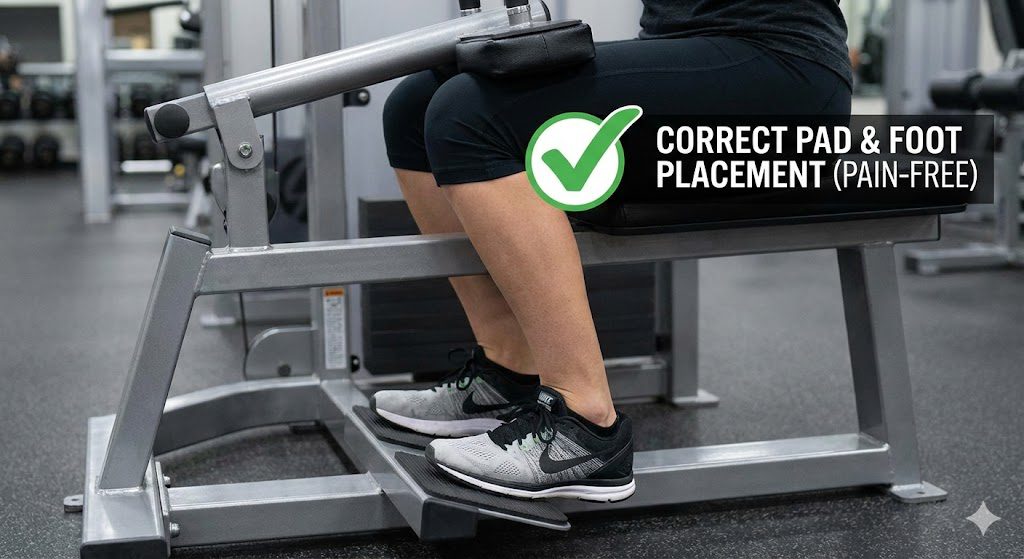
Mastering the setup eliminates the “grinding” sensation and ensures the load travels through the muscle belly.
Where Should the Knee Pad Sit During the Exercise?
The knee pad should sit firmly on the distal quadriceps, approximately 2-3 inches above the kneecap, to ensure the load is transferred through the femur rather than the patella. Crucially, this gap prevents the heavy pad from compressing the patellar tendon or the bursa sac located on top of the knee joint.
- Adjustment Tip: Slide your knees forward until the pad is resting on muscle, not bone.
- Check: If you feel pressure on the kneecap bone, you are positioned incorrectly.
What Is the Optimal Foot Position for Knee Safety?
The optimal foot position involves placing the balls of your feet securely on the platform edge with toes pointing straight forward or slightly out, keeping the knees tracking directly over the second toe. Furthermore, this alignment prevents tibial rotation, which is a leading cause of meniscus stress during leg exercises.
- Alignment: Ensure your ankles, knees, and hips form a straight line.
- Mistake to Avoid: Do not let your ankles roll outward (supination) at the top of the rep.
Seated vs. Standing Calf Raises: Which Is Safer for the Knees?
Seated calf raises are generally safer for the knee joint because the bent-knee position minimizes tension on the posterior knee capsule, whereas standing calf raises place significant compressive load on the knee while it is in a locked or semi-locked position. In comparison, the structural difference lies in muscle recruitment: the seated version targets the Soleus, while the standing version targets the Gastrocnemius.
Biomechanically, the two exercises affect the knee differently:
- Seated (Bent Knee): The Gastrocnemius crosses the knee joint. When the knee is bent, this muscle is slackened (active insufficiency), meaning it pulls less on the knee joint. This reduces strain for people with posterior knee pain.
- Standing (Straight Knee): The knee bears the full weight of the body plus the added load. If a lifter hyperextends (locks out) their knees, it can cause significant injury.
However, for those with patellofemoral pain (pain at the front of the knee), the pressure from the seated machine’s pad might be intolerable, making the standing variation—which uses shoulder pads—a better option regarding contact pain.
What Are the Hidden Causes and Alternatives for Knee Pain?
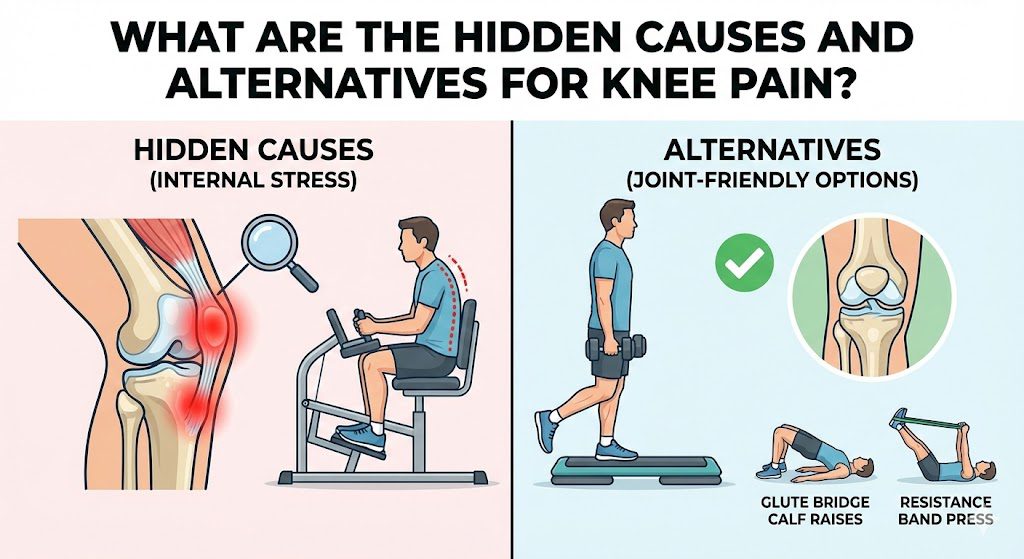
The hidden causes of knee pain often involve limited ankle mobility, patellar tendonitis flare-ups, or tibial nerve compression, which may require switching to joint-friendly alternatives like dumbbell seated raises. Furthermore, ignoring these underlying physiological issues and pushing through the pain can lead to chronic tendinopathy or permanent joint irritation.
Understanding these micro-factors allows for better programming and rehabilitation.
How Does Limited Ankle Mobility Affect Knee Stress?
Limited ankle mobility affects knee stress by forcing the knee to compensate for the lack of dorsiflexion, leading to internal rotation or shifting of the joint under heavy loads. Specifically, if your ankles cannot bend deeply enough at the bottom of the rep, your body naturally tries to find leverage by twisting the knee, creating dangerous torque.
- The Chain Reaction: Tight calves -> Stiff Ankles -> Unstable Knees.
Can Patellar Tendonitis Be Triggered by Seated Calf Raises?
Yes, patellar tendonitis can be triggered or exacerbated by seated calf raises due to the direct downward pressure of the pad on the quadriceps tendon insertion point and the sustained knee flexion under load. Moreover, “Jumper’s Knee” sufferers often find that the specific angle of the machine places tension exactly where their inflammation is most acute.
- Symptom: Sharp pain just below the kneecap while the weight is resting on the legs.
What Are the Best Joint-Friendly Alternatives to Seated Calf Raises?
The best joint-friendly alternatives include Dumbbell Seated Calf Raises, Smith Machine Seated Raises, and Squat Holds, which allow for customizable positioning without the restrictive mechanics of a fixed machine. For instance, using dumbbells on the knees allows you to adjust the weight placement precisely to avoid pain points.
- Dumbbell Seated Calf Raise: Sit on a bench, place dumbbells on your knees (use a towel for padding). This allows you to move the weight further up the thigh, completely avoiding the knee.
- Bridge Calf Raises: Performed on the floor, removing vertical gravity load from the knee joint entirely.
Does the “Shear Force” on the Machine Cause Chronic Injury?
The “shear force” on the machine can cause chronic injury if the machine’s pivot point does not align perfectly with your knee’s natural hinge, creating a mismatch in motion paths. Consequently, as you lift, the pad may try to push your lower leg backward while your knee is trying to extend, creating friction within the joint.
- Physics Factor: Fixed axis machines cannot accommodate every individual’s limb length perfectly, leading to micro-trauma over time if adjustments aren’t precise.
According to physical therapy guidelines, adapting the exercise to fit your anatomy is far more effective than forcing your anatomy to fit a machine. If the machine causes pain, the dumbbell variation is the clinically recommended substitute.

Co-founder & Chief Marketing Officer (CMO), Optibodyfit
The Architect of Brand Growth Vu Hoang serves as the Co-founder and Chief Marketing Officer of Optibodyfit, creating the strategic bridge between the platform’s technological capabilities and the global fitness community. Partnering with CEO Huy Tran to launch the company in November 2025, Vu has been instrumental in defining Optibodyfit’s market identity and orchestrating its rapid growth trajectory.
Strategic Vision & Execution With a sophisticated background in digital marketing and brand management, Vu creates the narrative that powers Optibodyfit. He understands that in a crowded health-tech market, technology alone is not enough; it requires a voice. Vu is responsible for translating the platform’s massive technical value—an unprecedented library of over 20,000 exercises—into compelling, human-centric stories.
His mandate goes beyond simple user acquisition. Vu leads a comprehensive marketing ecosystem that encompasses content strategy, community engagement, and digital performance optimization. He focuses on solving a core user problem: “decision fatigue.” By structuring marketing campaigns that guide users through the vast database, he helps transform an overwhelming amount of information into personalized, actionable fitness solutions.
Building a Global Community At the heart of Vu’s philosophy is the belief that fitness is a universal language. Under his leadership, the marketing division focuses on cultivating a vibrant, inclusive community where users feel supported rather than intimidated. He leverages data analytics to understand user behavior, ensuring that Optibodyfit delivers the right content to the right person at the right time—whether they are a beginner looking for home workouts or an athlete seeking advanced technical drills.
Commitment to Impact Vu Hoang does not view marketing merely as a tool for sales, but as a vehicle for education and inspiration. His strategic direction ensures that Optibodyfit remains true to its mission of “Elevating Lifestyles.” By consistently aligning the brand’s message with the real-world needs of its users, Vu is driving Optibodyfit to become not just a tool, but an indispensable daily companion for fitness enthusiasts worldwide.