Are Calf Raises Just Tippy Toes? Distinguishing Mechanics for Maximum Hypertrophy
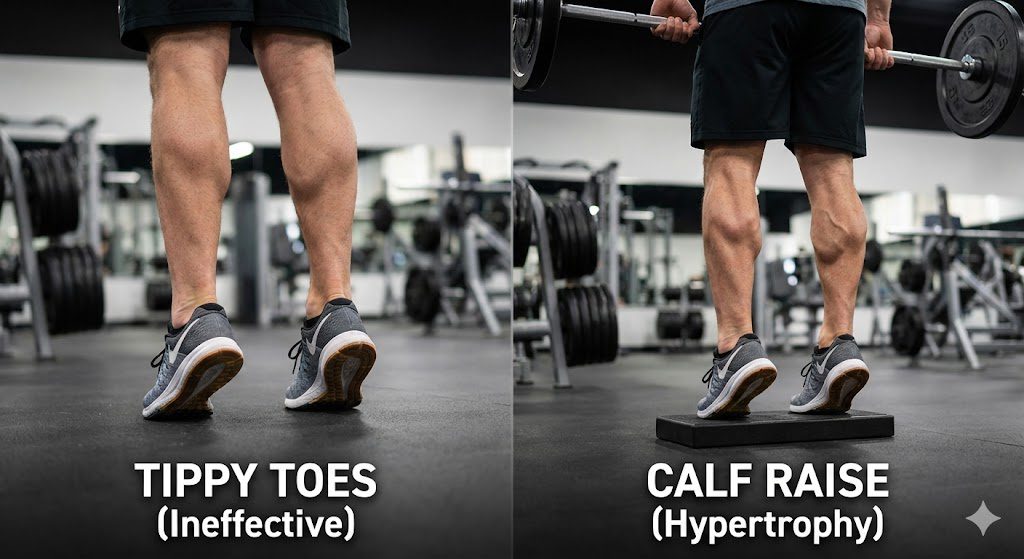
Are calf raises just tippy toes? The answer is no; while they share the motion of plantarflexion, a proper calf raise utilizes full range of motion, controlled eccentric loading, and targeted resistance to drive muscle hypertrophy, whereas “tippy toes” involves static isometric holds or limited range primarily for stability. Specifically, distinguishing these mechanics is the key factor that separates a casual movement from a serious muscle-building exercise. Crucially, understanding this distinction prevents lifters from wasting time on ineffective “bouncing” reps that rely on tendon elasticity rather than muscular contraction.
What is the difference between calf raises and everyday toe walking? This comparison lies in the application of load and the engagement of the Stretch-Shortening Cycle, where calf raises demand a deep stretch under weight, while toe walking relies on connective tissue efficiency. In contrast, everyday toe walking is a locomotor function designed for energy conservation, not tissue breakdown and growth.
What muscles do calf raises actually target? They specifically isolate the Triceps Surae group, comprising the Gastrocnemius and the Soleus, requiring distinct knee angles to fully activate. Furthermore, knowing which muscle you are targeting helps in selecting the right variation of the exercise.
What are the key components of a proper calf raise? To transform a tippy-toe motion into a mass-builder, you must master full range of motion (ROM) and apply progressive resistance. Finally, we will analyze why your calf raises are not growing your calves, addressing common errors like bouncing, knee angle mistakes, foot positioning, and ankle mobility limitations.
Is a Calf Raise the Same as Standing on Tippy Toes?
Is a calf raise the same as standing on tippy toes? Definitely No, because a calf raise requires a dynamic stretch under load, controlled tempo, and metabolic stress, whereas standing on tippy toes is often a static or low-load activity.
To elaborate, while both actions look visually similar at the top of the movement (peak contraction), the internal mechanics are vastly different. A “tippy toe” action usually happens on flat ground, meaning the heel never drops below the toes, eliminating the stretch phase. However, a hypertrophy-focused calf raise requires the heel to travel through a full arc of motion, creating micro-tears in the muscle fibers necessary for growth.
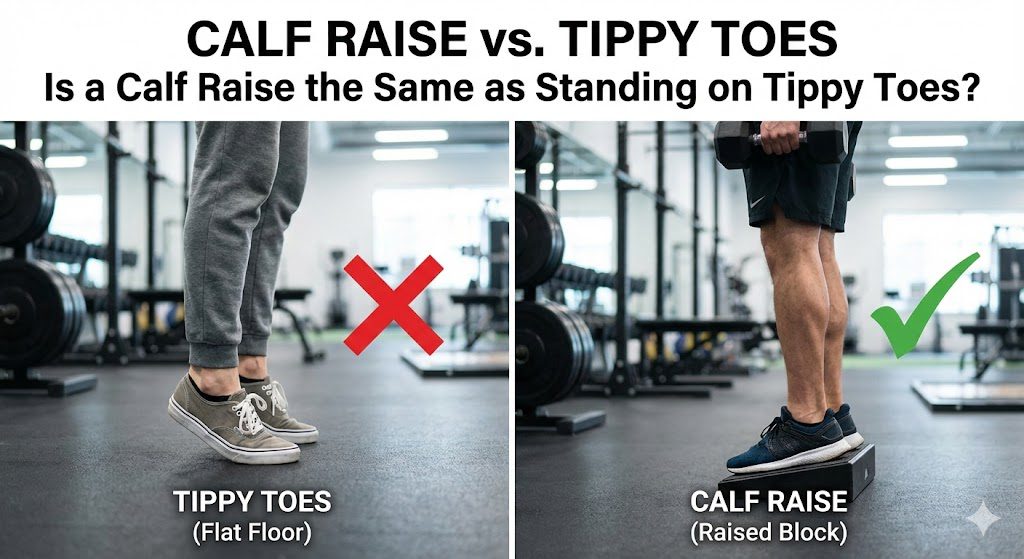
Specifically, the primary distinction is the intent and the stimulus. Standing on your toes activates the calves primarily for balance and stability (isometric endurance), often utilizing the Type I slow-twitch fibers. Conversely, a weighted calf raise forces the recruitment of Type II fast-twitch fibers (if heavy enough) and takes the muscle through an eccentric (lengthening) phase. Therefore, if you are just lifting your heels off the floor without a deficit or significant weight, you are indeed just “doing tippy toes” and likely won’t see significant muscle growth.
“According to biomechanical research published in the Journal of Strength and Conditioning Research, muscle hypertrophy is significantly greater when exercises are performed through a full range of motion compared to partial repetitions.”
What is the Difference Between Calf Raises and Everyday Toe Walking?
The difference between calf raises and everyday toe walking is that calf raises optimize hypertrophy through mechanical tension, whereas everyday toe walking prioritizes energy efficiency via tendon elasticity.
In other words, the human body is designed to walk efficiently, often using the Achilles tendon like a rubber band to propel us forward with minimal energy cost. On the other hand, building muscle requires inefficiency—forcing the muscle to work hard against resistance without relying on that rebound effect.
To better understand, let’s analyze the mechanical differences in the following table:
| Feature | Everyday Toe Walking / “Tippy Toes” | Hypertrophy Calf Raises |
| Range of Motion | Partial: Starts from neutral (flat foot) to plantarflexion. | Full: Starts from deep dorsiflexion (stretch) to full plantarflexion. |
| Primary Driver | Achilles Tendon: Uses elastic recoil (bouncing). | Muscular Contraction: Uses active shortening of muscle fibers. |
| Tempo | Fast/Bouncy: Minimizes muscle time under tension. | Controlled: Slow eccentric (3s) and explosive concentric. |
| Load | Bodyweight: Low intensity, high endurance. | Progressive Overload: Bodyweight + External Weight (Dumbbells/Machines). |
Moreover, looking at this comparison, it becomes clear why mail carriers or ballet dancers (who spend hours on their toes) have muscular calves due to sheer volume, but the average gym-goer cannot achieve the same result with a few sets of bodyweight “tippy toes.” Consequently, to mimic the results of training, one must abandon the mechanics of walking and adopt the mechanics of lifting.
What Muscles Do Calf Raises Actually Target?
Calf raises actually target the Triceps Surae muscle group, which is fundamentally composed of the Gastrocnemius (the visible diamond shape) and the Soleus (the deep, broad muscle), along with engagement of the Achilles Tendon.
Specifically, understanding the anatomy is crucial because “tippy toes” often fails to adequately stimulate the Soleus due to a lack of duration or load, and fails to stretch the Gastrocnemius. 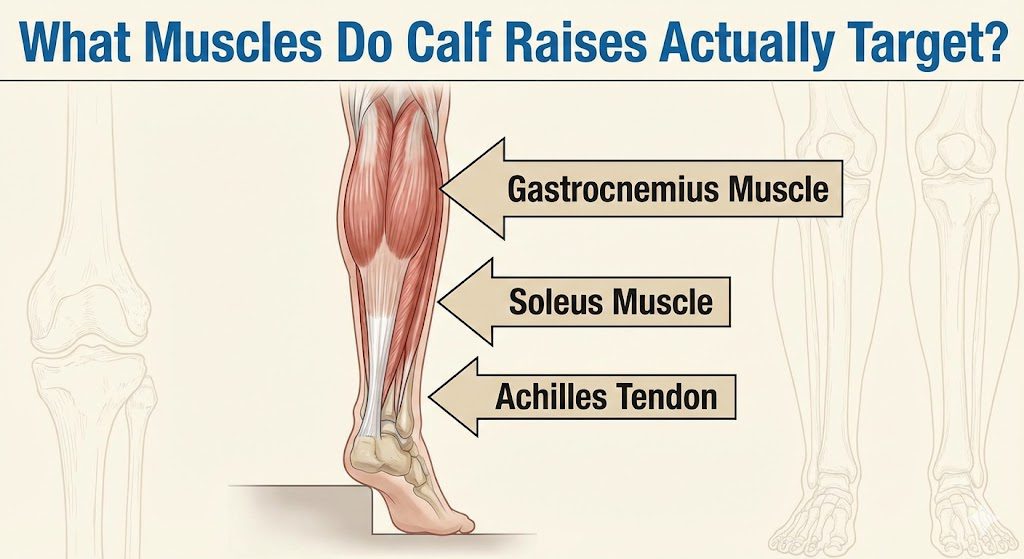
Detailed breakdown of the target muscles:
- The Gastrocnemius: This is the two-headed muscle responsible for the “upside-down heart” shape of the calves. It crosses the knee joint, meaning it is most active when the legs are straight. It is composed largely of fast-twitch fibers, making it responsive to heavy loads and explosive movements (once the stretch is mastered).
- The Soleus: Located underneath the Gastrocnemius, this muscle does not cross the knee joint. It is a workhorse, comprised mostly of slow-twitch fibers, and is essential for ankle stability. It is maximally targeted when the knee is bent (like in a Seated Calf Raise).
Furthermore, a proper calf raise ensures that both of these muscles are taken through their full functional length. Thus, simply standing on your toes engages these muscles merely to prevent you from falling forward, which is a low-threshold motor unit activity, completely different from the high-threshold recruitment needed for mass.
“Studies in Clinical Anatomy indicate that the Gastrocnemius is maximally activated during plantarflexion when the knee is fully extended, whereas knee flexion significantly reduces its contribution, shifting the load to the Soleus.”
What Are the Key Components of a Proper Calf Raise?
The key components of a proper calf raise that separate it from tippy-toeing are Full Range of Motion (ROM) and Progressive Resistance.
To start, mastering these two elements is non-negotiable if your goal is aesthetic improvement or strength gains. Let’s examine the technical execution of each component:
Why is the Full Range of Motion Critical?
Full Range of Motion is critical because the stretch phase (dorsiflexion) triggers stretch-mediated hypertrophy, which is the most potent stimulus for calf growth.
Specifically, “tippy toes” occur only in the top half of the movement (from neutral to extended). However, the most valuable part of a calf raise is the bottom half—where your heels drop below the level of the step.
- The Deficit: You must perform calf raises on a step or block. This allows the heel to travel downward, stretching the muscle fibers under load.
- The Pause: At the very bottom of the stretch, holding for 1-2 seconds eliminates the stretch reflex (the bounce), forcing the muscle to initiate the lift from a “dead stop.”
How Does Resistance Change the Exercise?
Resistance changes the exercise by shifting the stimulus from muscular endurance to mechanical tension, which is the primary driver of muscle growth.
In detail, your calves carry your body weight all day. They are incredibly resilient.
- Overloading: Doing 50 reps of bodyweight tippy toes is simply cardio for your calves. To force adaptation, you must add weight (dumbbells, smith machine, leg press) that limits you to a hypertrophy rep range (typically 8-15 reps, or up to 20 for Soleus).
- Time Under Tension: Resistance must be controlled. If you use heavy weight but bounce it, you are using momentum, not muscle.
Therefore, combining a deep stretch with a load that challenges you is the formula for success.
Why Are Your Calf Raises Not Growing Your Calves?
Your calf raises are not growing your calves likely because you are bouncing instead of contracting, using the wrong knee angle, adopting an unstable foot position, or suffering from limited ankle mobility.
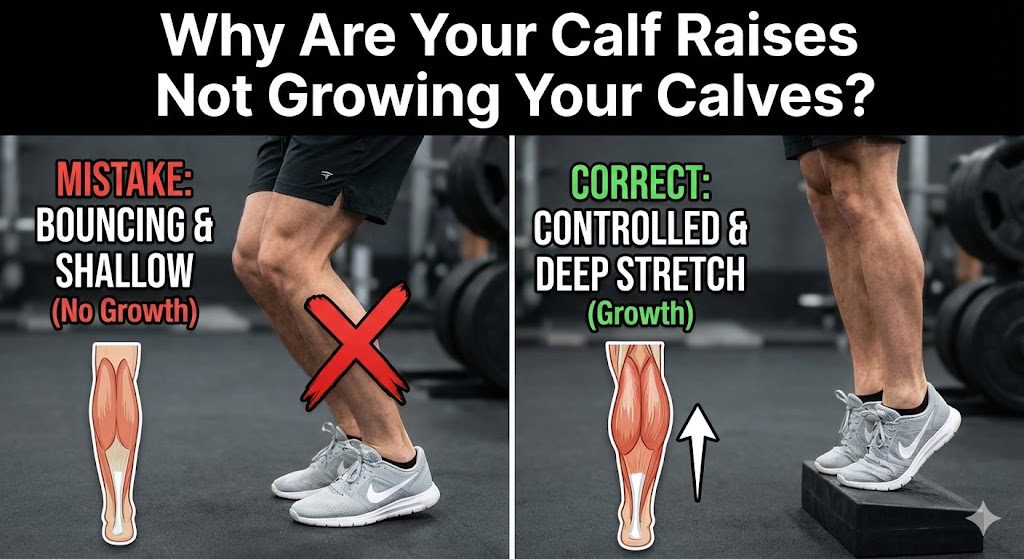
Below, we troubleshoot the four most common “tippy toe” mistakes that kill your gains:
Are You Bouncing or Contracting? (The Achilles Tendon Myth)
You are likely bouncing if you perform reps quickly, utilizing the Achilles tendon’s elasticity rather than the muscle’s contractile tissue.
Cụ thể, the Achilles tendon is the thickest, strongest tendon in the body. It acts like a spring. When you drop down quickly and bounce back up (like jumping rope), the tendon does 90% of the work.
- The Fix: Use a specific tempo: 3-1-1-1. Lower for 3 seconds, pause at the bottom for 1 second (to kill the bounce), lift for 1 second, and squeeze at the top for 1 second.
- The Result: This forces the Gastrocnemius and Soleus to move the weight, not the tendon.
Does Straight vs. Bent Knee Matter?
Straight vs. bent knee matters significantly because straight legs isolate the Gastrocnemius, while bent legs isolate the Soleus.
Specifically, many people do “tippy toes” with slightly soft knees, which puts the Gastrocnemius in a comprised position (active insufficiency).
- Standing Calf Raises: Keep knees locked (but not hyperextended) to maximize the visual “diamond” muscle size.
- Seated Calf Raises: The knees are bent at 90 degrees, rendering the Gastrocnemius mostly inactive and focusing entirely on the Soleus (width).
- The Mistake: Doing only seated calf raises and expecting the upper calf to grow is a physiological impossibility.
How Does Foot Position Affect Muscle Recruitment?
Foot position affects muscle recruitment marginally, but neutral alignment is generally superior for maximum force production and safety.
In detail, old-school bodybuilding myths suggest turning toes in (pigeon-toed) hits the outer head, and toes out (duck-footed) hits the inner head.
- The Reality: While EMG studies show slight shifts, the risk of placing torque on the knee and ankle joints often outweighs the benefits.
- The Recommendation: Keep toes straight forward or very slightly out. This allows for the strongest “tippy toe” push and the deepest stable stretch.
Can Ankle Mobility Limit Your Calf Raise Potential?
Ankle mobility can limit your calf raise potential because tight ankles prevent the deep dorsiflexion required for a full stretch.
Moreover, if your ankles are stiff, you physically cannot lower your heels far enough to get the benefit of the exercise. You are stuck doing partial reps—essentially just standing on tippy toes.
- The Check: If you feel a blockage in the front of your ankle before you feel a stretch in the calf, you have mobility restrictions.
- The Solution: Perform ankle mobility drills and foam rolling prior to training to unlock that crucial bottom range of motion.
“Physical therapy data suggests that increasing ankle dorsiflexion by just 5 degrees can increase the effective work performed by the calf muscles by over 20% during a repetition.”
In conclusion, a calf raise is only “just tippy toes” if you treat it that way. By controlling the descent, pausing at the bottom, and loading the movement heavy, you transform a simple foot movement into a powerful bodybuilding tool.

Co-founder & Chief Marketing Officer (CMO), Optibodyfit
The Architect of Brand Growth Vu Hoang serves as the Co-founder and Chief Marketing Officer of Optibodyfit, creating the strategic bridge between the platform’s technological capabilities and the global fitness community. Partnering with CEO Huy Tran to launch the company in November 2025, Vu has been instrumental in defining Optibodyfit’s market identity and orchestrating its rapid growth trajectory.
Strategic Vision & Execution With a sophisticated background in digital marketing and brand management, Vu creates the narrative that powers Optibodyfit. He understands that in a crowded health-tech market, technology alone is not enough; it requires a voice. Vu is responsible for translating the platform’s massive technical value—an unprecedented library of over 20,000 exercises—into compelling, human-centric stories.
His mandate goes beyond simple user acquisition. Vu leads a comprehensive marketing ecosystem that encompasses content strategy, community engagement, and digital performance optimization. He focuses on solving a core user problem: “decision fatigue.” By structuring marketing campaigns that guide users through the vast database, he helps transform an overwhelming amount of information into personalized, actionable fitness solutions.
Building a Global Community At the heart of Vu’s philosophy is the belief that fitness is a universal language. Under his leadership, the marketing division focuses on cultivating a vibrant, inclusive community where users feel supported rather than intimidated. He leverages data analytics to understand user behavior, ensuring that Optibodyfit delivers the right content to the right person at the right time—whether they are a beginner looking for home workouts or an athlete seeking advanced technical drills.
Commitment to Impact Vu Hoang does not view marketing merely as a tool for sales, but as a vehicle for education and inspiration. His strategic direction ensures that Optibodyfit remains true to its mission of “Elevating Lifestyles.” By consistently aligning the brand’s message with the real-world needs of its users, Vu is driving Optibodyfit to become not just a tool, but an indispensable daily companion for fitness enthusiasts worldwide.