Stop Knee Pain: Are Calf Raises Bad for Your Joints? (Safe Form Guide)
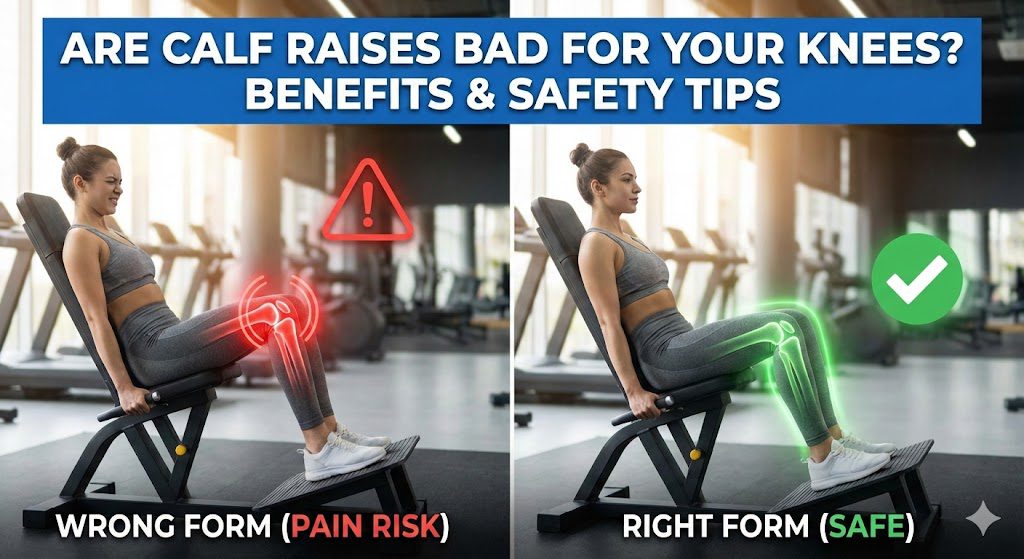
No, calf raises are not inherently bad for your knees; in fact, they are essential for knee joint stability when performed with correct form, although improper technique such as locking the knees can cause injury. However, many individuals experience discomfort due to muscle imbalances, hyperextension, or excessive loading, which shifts stress from the muscles to the joint capsule. Fortunately, by adopting safety modifications and choosing the right variations like seated raises, you can build strong calves without compromising joint health. Let’s explore the biomechanics, common mistakes, and safe protocols to protect your knees while training.
Are Calf Raises Bad for Your Knees?
No, calf raises are not bad for your knees provided you avoid locking the joint, maintain proper alignment, and do not exceed your mobility limits. On the contrary, they are beneficial because strong calf muscles act as shock absorbers for the knee joint, stabilize the femur, and reduce the risk of ACL injuries during dynamic movements.
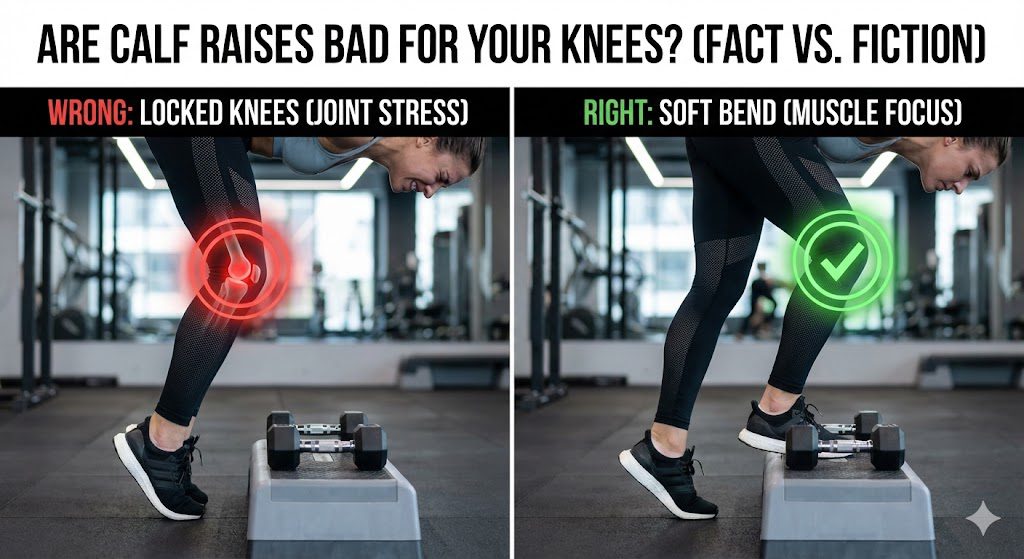
Specifically, the “bad” reputation of calf raises stems largely from user error rather than the exercise itself. When performed correctly, the movement occurs almost entirely at the ankle joint (plantarflexion), while the knee remains isometrically stable. However, if the knees are allowed to snap back into hyperextension at the top of the movement, the shear force is transferred directly to the posterior capsule and ligaments, leading to chronic pain or acute injury.
According to a study published in the Journal of Orthopaedic & Sports Physical Therapy, increasing calf strength significantly reduces patellofemoral joint loading during running and walking, indicating a protective effect on the knee.
What Is the Function of Calf Muscles in Knee Health?
The function of calf muscles in knee health is primarily dynamic stabilization, as the Gastrocnemius crosses the knee joint to assist in flexion, while the Soleus manages tibial alignment. To clarify, these muscles work together to control the forward motion of the shin bone (tibia) during movement, preventing excessive strain on the knee ligaments.
Specifically, the calf complex is unique because of its dual attachment points. The large Gastrocnemius muscle originates above the knee on the femur, meaning it has a direct mechanical influence on knee stability. When this muscle contracts, it pulls against the femur, helping to keep the joint centered. The Soleus, while originating below the knee, plays a critical role in preventing the knee from collapsing inward (valgus collapse) during squats or lunges.
How Do Weak Calves Contribute to Knee Pain?
Weak calves contribute to knee pain by failing to absorb ground reaction forces, leading to increased impact on the knee joint and forcing the quadriceps to overcompensate. Consequently, this “kinetic chain” breakdown results in conditions like Patellar Tendonitis or general anterior knee pain.
Moreover, when the calves are weak or tight, ankle mobility is often restricted (lack of dorsiflexion). To compensate for this lack of movement at the ankle, the body often forces movement at the knee or hip, creating unnatural torque. Strengthening the calves ensures that force is dissipated properly through the muscles rather than hammering the skeletal structure of the knee.
What Are the Common Causes of Knee Pain During Calf Raises?
There are three common causes of knee pain during calf raises: hyperextension of the knee joint, improper foot alignment (internal/external rotation), and using excessive weight beyond muscle control. Following this, understanding these mechanical errors is the first step toward correcting them and eliminating pain.
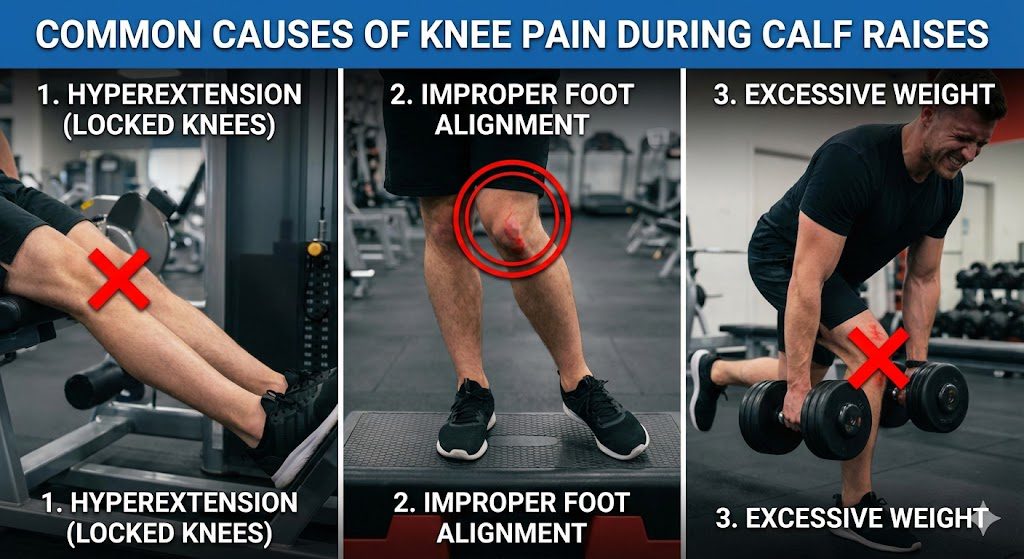
Specifically, most gym-goers unknowingly compromise their joint integrity by prioritizing weight over range of motion. The knee is a hinge joint designed primarily for flexion and extension, not for absorbing the grinding force of rotation or the shearing force of locking out under a heavy load.
Why Does Locking Your Knees Cause Pain?
Locking your knees causes pain because it shifts the load from the Gastrocnemius muscle directly onto the posterior knee capsule and the popliteal ligaments. In other words, instead of the muscle supporting the weight, your delicate joint structures are being crushed between the bones.
Furthermore, repetitive locking out creates a “bone-on-bone” compression effect. Over time, this can lead to inflammation, hyperextension injuries (recurvatum), and wear on the meniscus. The goal of the exercise is to keep tension on the muscle belly; locking out releases that tension, reducing the exercise’s effectiveness while maximizing injury risk.
How Does Improper Foot Alignment Affect the Joint?
Improper foot alignment affects the joint by creating rotational torque at the knee, straining the collateral ligaments (MCL/LCL) and causing uneven meniscus wear. Specifically, excessive turning in or out of the toes forces the knee to twist against resistance.
Additionally, while bodybuilders often rotate feet to target different “heads” of the calf, this technique requires exceptional hip and ankle mobility. For the average person, forcing the feet outward while the knees track forward creates a mismatch in the hinge mechanism. If your feet turn out, your knees must track in the exact same direction; otherwise, you are grinding the joint surfaces together with every rep.
How Can You Perform Calf Raises Safely to Avoid Injury?
To perform calf raises safely, you must maintain a “soft bend” in the knees, control the eccentric (lowering) phase, and align your toes directly forward. This approach ensures that the tension remains on the muscle fibers while the knee joint functions purely as a stabilizer without bearing compressive load.
Specifically, the “Perfect Rep” requires mental focus. You should feel a deep stretch at the bottom without bouncing, and a strong peak contraction at the top without snapping the knees back. By removing momentum, you reduce the shear forces that typically irritate the knee.
What Is the Correct Posture for Standing Calf Raises?
The correct posture for standing calf raises involves keeping the spine neutral, engaging the core, and maintaining a micro-bend in the knees throughout the entire range of motion. Crucially, this “soft knee” position acts as a safety buffer.
To implement this:
- Stand tall with feet hip-width apart.
- Unlock your knees slightly (do not stand stiff-legged).
- Keep this angle constant; do not straighten the leg further as you rise.
- Drive up through the ball of the big toe to prevent ankle rolling.
What Modifications Exist for People with Bad Knees?
Modifications for people with bad knees include limiting the range of motion (partial reps), using bodyweight only, or switching to double-leg variations to distribute the load. Therefore, these adjustments allow for muscle stimulation without aggravating existing inflammation.
For example, if full dorsiflexion (heels all the way down) causes pain behind the knee, stop just before the point of discomfort. Isometric holds—holding the top position for 5-10 seconds—are another excellent modification, as they strengthen the tendon and muscle without the grinding friction of repetitive joint movement.
Which Calf Raise Variations Are Best for Knee Issues?
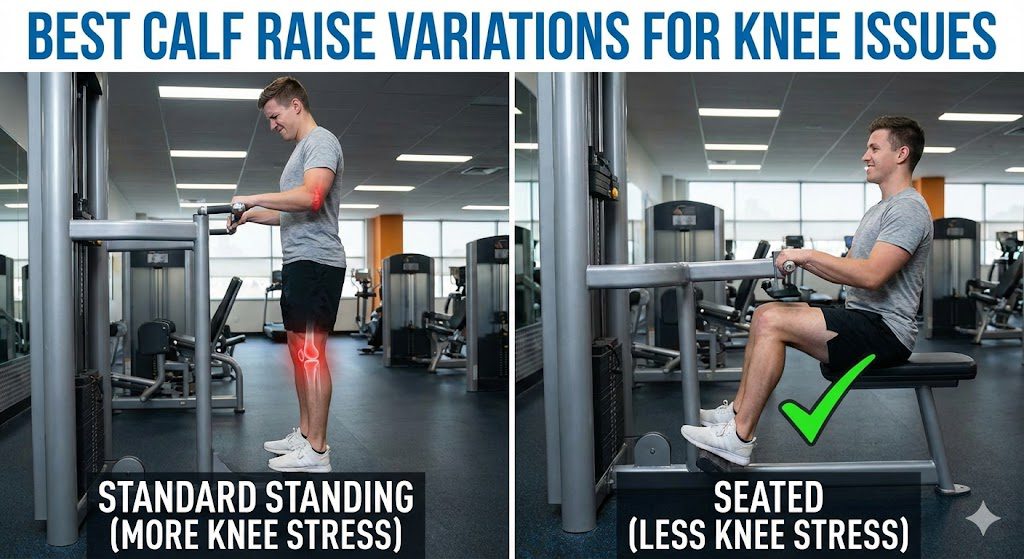
The best calf raise variations for knee issues are Seated Calf Raises, Tibialis Raises, and Donkey Calf Raises, as these exercises minimize axial loading on the spine and knees. In comparison, Standing Calf Raises place the highest compressive load on the knee joint and should be approached with caution.
Specifically, selecting the right variation depends on the specific nature of your knee pain. If the pain comes from compression (weight bearing), seated options are superior. If the pain comes from instability, exercises that co-contract the surrounding muscles are more effective.
What Is the Difference Between Standing and Seated Calf Raises for Knee Safety?
Seated Calf Raises constitute the safest option because the bent-knee position disengages the Gastrocnemius, shifting the focus to the Soleus, thereby removing tension from the knee joint. Conversely, Standing Calf Raises engage the Gastrocnemius heavily, which crosses the knee and can aggravate tension.
To elaborate, when the knee is bent at 90 degrees (as in the seated machine), the Gastrocnemius is put into “active insufficiency”—it is too slack to contribute significantly. This means the Soleus does all the work. Since the Soleus does not cross the knee joint, you can train it intensely without pulling on the femoral condyles or irritating the knee capsule.
How Do Tibialis Raises Complement Calf Raises for Knee Balance?
Tibialis raises complement calf raises by strengthening the Tibialis Anterior (shin muscle), which acts as the antagonist to the calf, ensuring structural balance and improving knee deceleration. Resultingly, this reduces the risk of “runner’s knee” and shin splints.
Furthermore, the knee is sandwiched between the ankle and the hip. If the muscles on the front of the shin are weak, the calf muscles can become chronically tight and dominant, pulling the knee out of alignment. Strengthening the Tibialis Anterior helps to “pull back” against strong calves, creating a balanced tension that keeps the knee joint centered and healthy.
Can Calf Raises Aggravate Specific Conditions Like a Baker’s Cyst or Meniscus Tear?
Yes, calf raises can aggravate conditions like a Baker’s Cyst or Meniscus Tear due to fluid compression and posterior shearing forces during deep flexion or extension. Therefore, individuals with these specific diagnoses should avoid deep stretching under load.
Specifically, a Baker’s cyst is a fluid-filled sac behind the knee. The repetitive pumping action of a calf raise can compress this cyst, causing sharp pain or bursting. Similarly, for a posterior meniscus tear, the pressure applied when the knee is fully extended (at the top of a standing raise) can pinch the torn cartilage. In these cases, isometric exercises or rehabilitation-specific movements prescribed by a physical therapist are necessary.
What Alternative Exercises Strengthen Calves Without Knee Strain?
Alternative exercises to strengthen calves without knee strain include Sled Pushes, Resistance Band Plantarflexion, and Isometrics, which allow for controlled loading without vertical gravity compression. Ultimately, these exercises build hypertrophy and endurance safely.
For instance:
- Sled Pushes: The angle of the body allows you to drive through the calves without the weight resting directly on the knee joint stack.
- Resistance Bands: Sitting on the floor with legs straight and pressing against a band isolates the calf muscles with zero gravity load on the knee.
- Farmer’s Walks: Walking on toes while carrying weights builds isometric strength in the calves while the knees remain dynamically stable but not repetitively grinding.
According to the American Council on Exercise (ACE), incorporating low-impact variations like seated raises is highly recommended for individuals recovering from lower-body joint injuries while maintaining muscular fitness.

Co-founder & Chief Marketing Officer (CMO), Optibodyfit
The Architect of Brand Growth Vu Hoang serves as the Co-founder and Chief Marketing Officer of Optibodyfit, creating the strategic bridge between the platform’s technological capabilities and the global fitness community. Partnering with CEO Huy Tran to launch the company in November 2025, Vu has been instrumental in defining Optibodyfit’s market identity and orchestrating its rapid growth trajectory.
Strategic Vision & Execution With a sophisticated background in digital marketing and brand management, Vu creates the narrative that powers Optibodyfit. He understands that in a crowded health-tech market, technology alone is not enough; it requires a voice. Vu is responsible for translating the platform’s massive technical value—an unprecedented library of over 20,000 exercises—into compelling, human-centric stories.
His mandate goes beyond simple user acquisition. Vu leads a comprehensive marketing ecosystem that encompasses content strategy, community engagement, and digital performance optimization. He focuses on solving a core user problem: “decision fatigue.” By structuring marketing campaigns that guide users through the vast database, he helps transform an overwhelming amount of information into personalized, actionable fitness solutions.
Building a Global Community At the heart of Vu’s philosophy is the belief that fitness is a universal language. Under his leadership, the marketing division focuses on cultivating a vibrant, inclusive community where users feel supported rather than intimidated. He leverages data analytics to understand user behavior, ensuring that Optibodyfit delivers the right content to the right person at the right time—whether they are a beginner looking for home workouts or an athlete seeking advanced technical drills.
Commitment to Impact Vu Hoang does not view marketing merely as a tool for sales, but as a vehicle for education and inspiration. His strategic direction ensures that Optibodyfit remains true to its mission of “Elevating Lifestyles.” By consistently aligning the brand’s message with the real-world needs of its users, Vu is driving Optibodyfit to become not just a tool, but an indispensable daily companion for fitness enthusiasts worldwide.