What Muscles Do Renegade Rows Work? The Ultimate Anatomy Guide
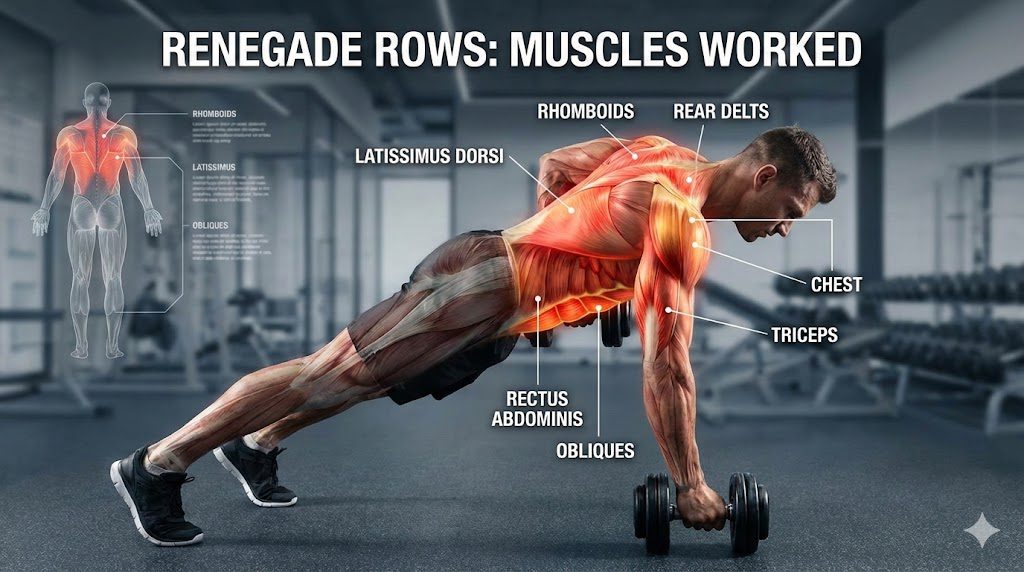
Renegade Rows primarily work the Latissimus Dorsi and Rhomboids in the back, while simultaneously engaging the Rectus Abdominis and Obliques for core stability. Specifically, this compound movement acts as a hybrid exercise, merging the pulling benefits of a row with the anti-rotational tension of a plank. Furthermore, by requiring unilateral strength, it effectively targets stabilizer muscles like the Rear Delts and Serratus Anterior to correct left-to-right muscle imbalances.
The Renegade Row is a powerhouse exercise that targets both primary back muscles and secondary core stabilizers, highlighting how form directly impacts muscle activation. Moreover, understanding the biomechanics helps lifters optimize the movement for either hypertrophy or stability, depending on their specific training goals.
To master this movement, it is crucial to understand the differences between Kettlebell and Dumbbell variations, address common wrist pain issues, and explore beginner alternatives if the full version is too demanding. Finally, we will analyze whether this functional movement can truly replace the standard dumbbell row in a mass-building program.
What Is the Renegade Row Exercise?
The Renegade Row is a compound, full-body exercise that combines a high plank position with a single-arm dumbbell row to target the upper body and core simultaneously. To understand this movement, it essentially forces the body to resist gravity and rotation while executing a dynamic pull, creating a high-tension environment for multiple muscle groups.

Specifically, the exercise requires the lifter to hold a push-up position with dumbbells in hand. While one arm pushes into the floor to maintain stability, the other arm performs a rowing motion. This dual-action nature classifies it as a multi-joint movement that builds functional strength, improves anti-rotational core stability, and enhances muscular coordination between the upper back and the abdominal wall.
What Are the Primary Back Muscles Worked in Renegade Rows?
There are three primary muscle groups worked in Renegade Rows: the Latissimus Dorsi (Lats), the Rhomboids, and the Middle Trapezius, which are responsible for the pulling action. Here is a breakdown of how these prime movers function during the concentric phase of the lift to build a thicker, wider back.
The Latissimus Dorsi is the largest muscle in the back and takes the majority of the load during the rowing motion, contributing to back width. Simultaneously, the Rhomboids and Middle Trapezius work together to retract the scapula (shoulder blade) at the top of the movement. This retraction is vital for upper back thickness and posture correction. By focusing on driving the elbow back and squeezing the shoulder blades together, you maximize the recruitment of these specific tissues.
What Secondary and Core Muscles Does the Renegade Row Target?
Secondary targets of the Renegade Row include the Obliques, Rectus Abdominis, Transverse Abdominis, and Serratus Anterior, which function primarily as stabilizers throughout the set. Beyond the back, the isometric demand of this exercise lights up the entire anterior chain to prevent the hips from sagging or twisting.
Do Renegade Rows Work the Rear Delts?
Yes, Renegade Rows work the Rear Delts, but they function primarily as synergists (assisting muscles) rather than prime movers during the rowing phase. In this context, the posterior deltoid assists in extending the arm behind the body. While they do not receive the same load as the lats, the stabilization required to keep the shoulder joint centered engages the rear delts significantly, contributing to overall shoulder health and stability.
Does the Push-Up Position Engage the Chest and Triceps?
Yes, the push-up position isometrically engages the Pectoralis Major and Triceps Brachii of the supporting arm to maintain a rigid torso height. Furthermore, the non-rowing arm must press actively into the floor to prevent the chest from collapsing. This static contraction builds endurance in the “push” muscles (Chest, Triceps, Anterior Delts) even though the primary movement is a “pull,” making it a true antagonist-agonist pairing.
How Does Form Affect Muscle Activation?
Form dictates whether you primarily target the Lats and Core or unintentionally shift the load to the hips and lower back due to poor stabilization. Specifically, the strictness of your hip position changes the intended stimulus of the exercise completely.
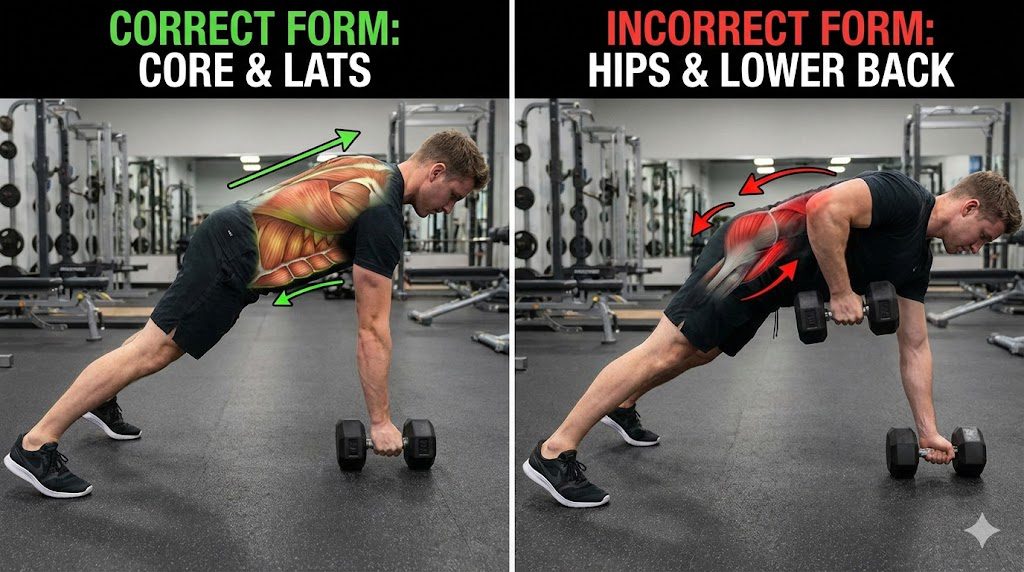
If you allow your hips to twist (rotate) as you row the weight up, you reduce the anti-rotational demand on the Obliques and shorten the range of motion for the Lats, diminishing the exercise’s effectiveness. Conversely, maintaining a rigid, square torso forces the core to work at maximum capacity to fight rotation. Good form ensures the tension remains on the back muscles for hypertrophy and the abs for stability, rather than relying on momentum or leverage to lift the weight.
“According to a study published in the Journal of Strength and Conditioning Research, maintaining a neutral spine during plank-based movements increases abdominal muscle activation by up to 20% compared to compromised postures.”
How Can You Optimize Renegade Rows for Hypertrophy vs. Stability?
Optimizing Renegade Rows depends on the load: use heavier weights with controlled rest for Hypertrophy, or lighter weights with longer hold times for Core Stability. In other words, there is a functional trade-off between building muscle size and building endurance that you must navigate.
To focus on Hypertrophy (Muscle Growth), widen your foot stance slightly to increase stability, allowing you to lift a heavier dumbbell. This shifts the focus toward overloading the Lats and Rhomboids. On the other hand, to prioritize Stability, use a lighter weight, keep your feet closer together, and perform the row slowly (tempo training). This increases “Time Under Tension” for the core, forcing the stabilizers to work harder to prevent the body from tipping over.
What Is the Difference Between Kettlebell and Dumbbell Renegade Rows?
Kettlebell Renegade Rows offer a greater stability challenge due to the narrower base of support and elevated handle, whereas Dumbbell Renegade Rows provide more wrist stability and balance. However, the choice of equipment significantly alters the difficulty curve and grip requirements.
Using Hex Dumbbells is generally safer for beginners because they do not roll, providing a stable platform for the push-up position. In contrast, Kettlebells have a smaller surface area touching the floor and a higher center of gravity. This requires intense grip strength and wrist alignment to prevent the bell from tipping sideways. While the Kettlebell variation is superior for athletic proprioception and wrist strength, the Dumbbell variation allows for heavier loading, making it better for raw strength development.
Why Do Renegade Rows Cause Wrist Pain for Some Lifters?
Wrist pain occurs due to the high compression force placed on the carpal bones and the extension angle required to support body weight on the handles. This happens because the wrist is forced to bear half the body’s weight in a potentially compromised position.
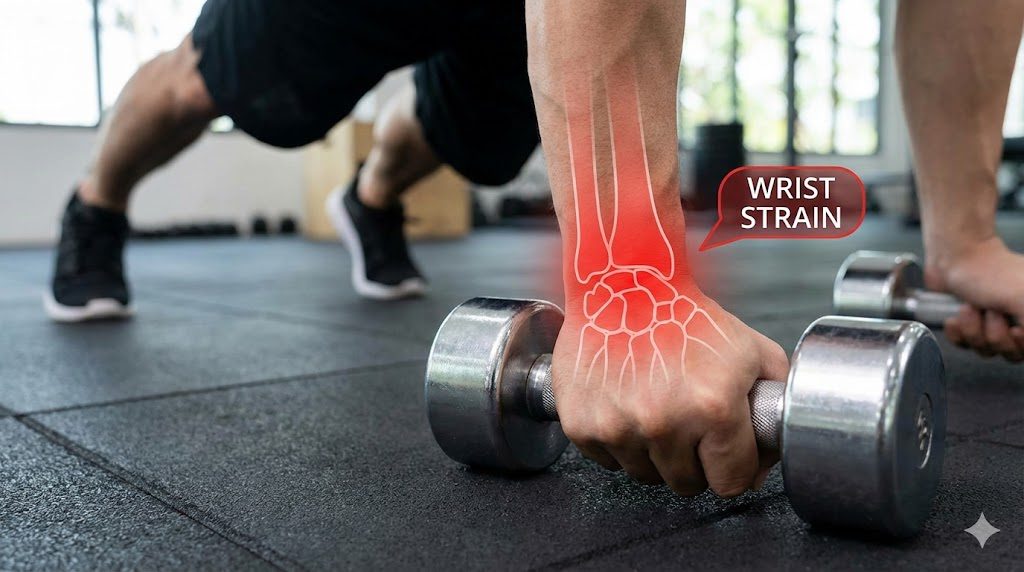
Specifically, holding a dumbbell places the wrist in varying degrees of extension. If the lifter lacks wrist mobility or grip strength, the joint can collapse, causing strain on the tendons and nerves. To mitigate this, lifters can ensure they keep their wrists neutral (straight like a punch) rather than letting them bend back. Alternatively, using dumbbells with thicker handles or gripping the floor with fists (if not using weights for the support hand) can alleviate the pressure on the carpal tunnel area.
What Are the Best Renegade Row Alternatives for Beginners?
The best alternatives for beginners include the Kneeling Renegade Row, the Elevated Plank Row, and the Bird-Dog Row to build foundational strength safely. For those starting out, these regressions allow you to master the anti-rotation mechanics without the overwhelming demand of a full plank.
The Kneeling Renegade Row reduces the total weight the core must support, allowing the lifter to focus entirely on the rowing motion and back engagement. Similarly, the Elevated Plank Row (placing hands on a bench) reduces the leverage against gravity, making the core hold easier. These variations are critical stepping stones that ensure the correct muscles—lats and core—are firing before progressing to the full, toes-on-the-ground version.
Do Renegade Rows Replace the Standard Dumbbell Row?
No, Renegade Rows do not replace the standard Dumbbell Row for maximal back hypertrophy because the stability requirement limits the amount of absolute load you can lift. Therefore, they should be viewed as complementary exercises rather than direct substitutes in a bodybuilding program.
The Standard Dumbbell Row allows for bracing (using a bench for support), which removes the stability factor and allows you to pull the heaviest weight possible to overload the lats. However, the Renegade Row is superior for functional integration, teaching the upper body and lower body to work together. Tying it all together, use standard rows to build muscle mass, and use Renegade Rows to build athletic core strength and total-body coordination.

Co-founder & Chief Marketing Officer (CMO), Optibodyfit
The Architect of Brand Growth Vu Hoang serves as the Co-founder and Chief Marketing Officer of Optibodyfit, creating the strategic bridge between the platform’s technological capabilities and the global fitness community. Partnering with CEO Huy Tran to launch the company in November 2025, Vu has been instrumental in defining Optibodyfit’s market identity and orchestrating its rapid growth trajectory.
Strategic Vision & Execution With a sophisticated background in digital marketing and brand management, Vu creates the narrative that powers Optibodyfit. He understands that in a crowded health-tech market, technology alone is not enough; it requires a voice. Vu is responsible for translating the platform’s massive technical value—an unprecedented library of over 20,000 exercises—into compelling, human-centric stories.
His mandate goes beyond simple user acquisition. Vu leads a comprehensive marketing ecosystem that encompasses content strategy, community engagement, and digital performance optimization. He focuses on solving a core user problem: “decision fatigue.” By structuring marketing campaigns that guide users through the vast database, he helps transform an overwhelming amount of information into personalized, actionable fitness solutions.
Building a Global Community At the heart of Vu’s philosophy is the belief that fitness is a universal language. Under his leadership, the marketing division focuses on cultivating a vibrant, inclusive community where users feel supported rather than intimidated. He leverages data analytics to understand user behavior, ensuring that Optibodyfit delivers the right content to the right person at the right time—whether they are a beginner looking for home workouts or an athlete seeking advanced technical drills.
Commitment to Impact Vu Hoang does not view marketing merely as a tool for sales, but as a vehicle for education and inspiration. His strategic direction ensures that Optibodyfit remains true to its mission of “Elevating Lifestyles.” By consistently aligning the brand’s message with the real-world needs of its users, Vu is driving Optibodyfit to become not just a tool, but an indispensable daily companion for fitness enthusiasts worldwide.