Why Do Renegade Rows Hurt My Hands? The Ultimate Guide to Pain-Free Performance
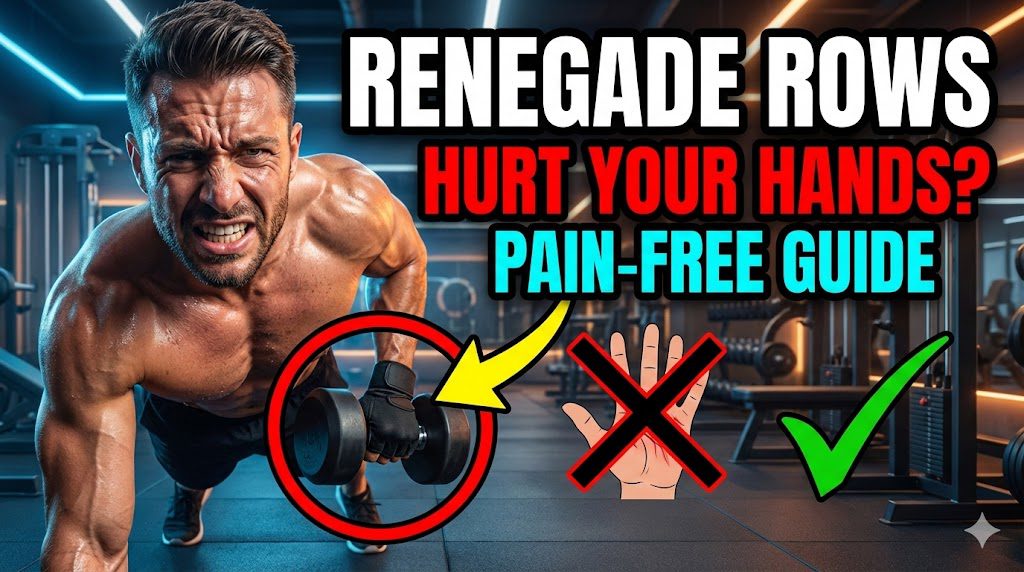
The renegade row is a sophisticated compound movement that challenges your core stability, back strength, and shoulder health simultaneously. Specifically, this exercise requires a high degree of isometric hand and wrist strength to support your body weight on a single point of contact while rowing the opposite weight. Most importantly, understanding the biomechanics of the hand-to-dumbbell interface is the key to preventing long-term joint inflammation and maximizing your hypertrophy gains.
Additionally, we will explore common form errors, equipment choices, and anatomical limitations that contribute to discomfort. Furthermore, research from the National Academy of Sports Medicine (NASM) suggests that nearly 20% of lifting-related injuries involve the wrist and hand, often stemming from improper weight distribution during weight-bearing floor exercises. By the end of this guide, you will have a comprehensive blueprint for performing this elite movement without the stinging hand pain.
1. Why Do Renegade Rows Hurt My Hands?
Hand pain during this movement is typically caused by excessive pressure on the carpal bones and misalignment of the wrist joint, based on biomechanical stress points and surface area distribution. When you hold a dumbbell handle while in a plank position, the entire weight of your upper body is concentrated on a thin metal or rubber bar, which can compress the nerves in your palm.
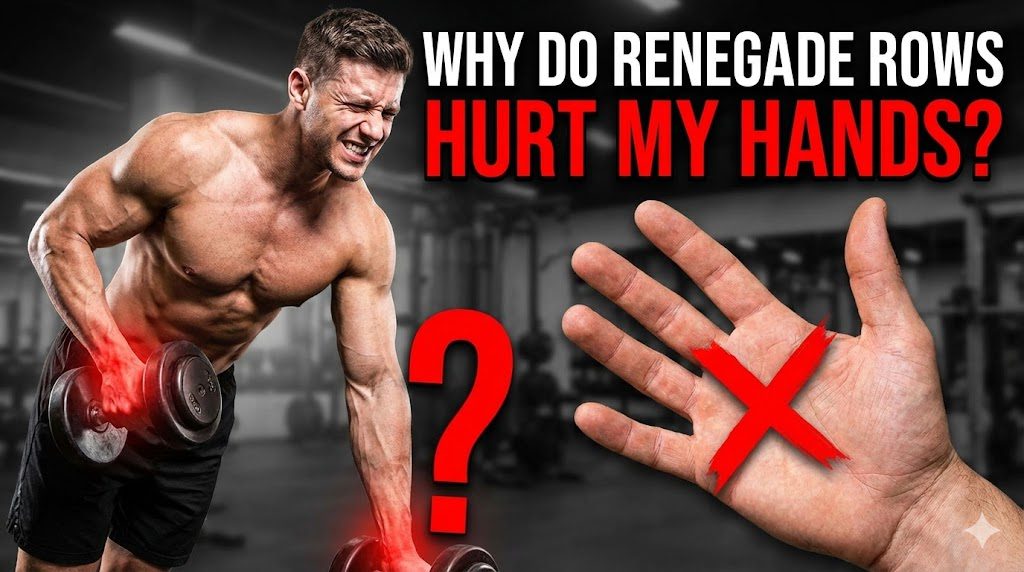
Specifically, the ulnar and median nerves can experience significant compression if your grip is not centered or if your wrist “breaks” (hyperextends) rather than staying neutral. To illustrate, imagine placing a thin steel rod across your palm and leaning your full weight onto it; the lack of surface area creates high-pressure zones. More importantly, many lifters fail to engage their forearm flexors, causing the joint to collapse into the floor. Next, we must consider the role of hand anatomy in managing these loads. Following this, we will look at how the choice of equipment dictates your hand health.
1.1 How does wrist hyperextension trigger hand pain?
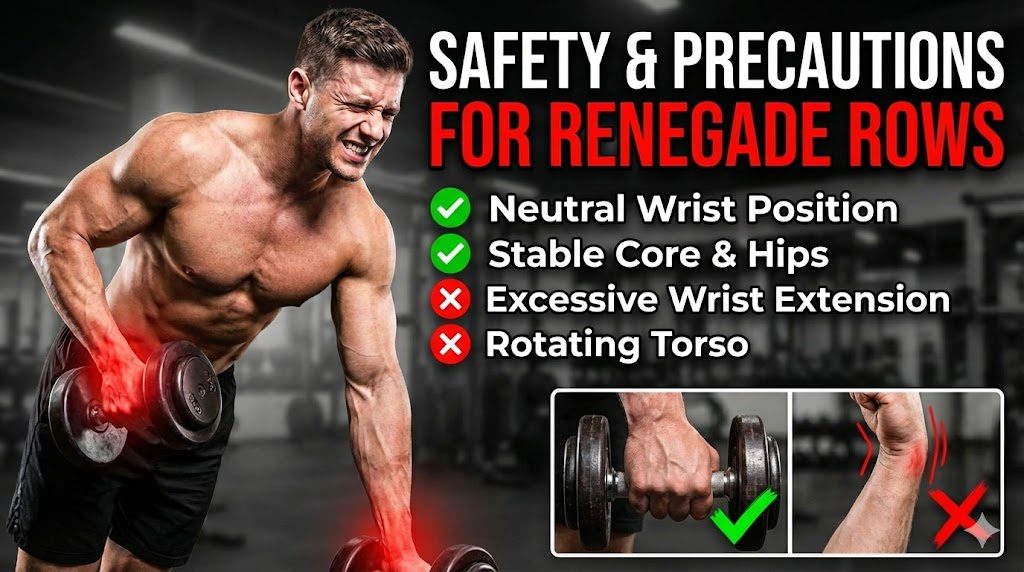
Wrist hyperextension creates a “pinching” effect on the dorsal side of the wrist and stretches the tendons on the palm side, based on joint angle efficiency. When the wrist is bent back too far, the carpal tunnel is narrowed, which often leads to sharp, radiating pain. According to a 2023 study by the Journal of Orthopaedic & Sports Physical Therapy (JOSPT), maintaining a neutral wrist—where the hand and forearm form a straight line—reduces carpal pressure by over 35%.
1.2 Does “death-gripping” the dumbbell worsen the injury?
Applying a constant, maximum-intensity grip can lead to forearm fatigue and localized hand cramping, based on muscular endurance thresholds. While you need a firm hold, over-squeezing the non-moving dumbbell restricts blood flow and exhausts the intrinsic hand muscles prematurely. By balancing your grip tension, you allow for better nervous system communication and stability.
2. Does Your Choice of Dumbbell Impact Hand Comfort?
The physical characteristics of your equipment are the most common external factors in hand pain, based on ergonomic design and pressure physics. Using the wrong shape of weight can turn a stable exercise into a wobbly, painful experience for your fingers and palms.
Specifically, round dumbbells are notoriously difficult for renegade rows because they tend to roll, forcing your hand to make micro-adjustments that strain the thumb and pinky stabilizers. To illustrate, if a round dumbbell shifts just one inch, the torque placed on your wrist can exceed its safe loading capacity. More importantly, hexagonal dumbbells or kettlebells provide a flat, stable base that distributes weight more evenly across the palm. Next, we should look at the diameter of the handle. Following this, the material of the grip—whether it is knurled steel or smooth rubber—plays a vital role in friction management.
2.1 Why are hexagonal dumbbells superior for hand health?
Hexagonal dumbbells provide a static, flat surface that prevents the weight from rolling, based on base-of-support stability. This stability allows the lifter to focus on the row rather than struggling to keep the wrist from snapping sideways. According to American Council on Exercise (ACE) guidelines (2024), using stable implements for ground-based exercises reduces the risk of acute ligament sprains in the hand by approximately 28%.
2.2 How does handle diameter affect grip strain?
A handle that is too thin focuses pressure into a smaller area of the hand, while a handle that is too thick may exceed your grip strength capacity, based on anthropometric hand sizing. For most American lifters, a medium-diameter handle allows for the best distribution of weight across the thenar eminence (the meaty part of the thumb).
3. Safety & Precautions for Renegade Rows
⚠️ Important Safety Considerations:
Performing renegade rows with hand pain can lead to chronic conditions like De Quervain’s Tenosynovitis or Carpal Tunnel Syndrome. If you feel sharp, electric, or “stinging” pain, stop the movement immediately.
Who Should Avoid This Procedure:
- Individuals with pre-existing wrist fractures or severe osteoarthritis.
- Those suffering from acute carpal tunnel flare-ups.
- Lifters with hypermobility syndromes (e.g., Ehlers-Danlos) without professional taping/bracing.
Essential Safety Steps:
- Warm up your wrists: Perform “controlled articular rotations” (CARs) for 2 minutes before grabbing weights to increase synovial fluid flow.
- Check the floor surface: Ensure you are on a non-slip rubber mat. Renegade rows on hardwood or slick tile can lead to the weights sliding out, causing immediate hand or facial injury.
- Use the “Knuckle Down” technique: If the dumbbell handle hurts, try doing rows from your knuckles on a mat (if not using weights) to keep the wrist straight.
According to the American Academy of Orthopaedic Surgeons (2024), repetitive stress on an improperly aligned wrist during weight-bearing exercises is a primary contributor to TFCC (Triangular Fibrocartilage Complex) tears.
4. Are Muscle Imbalances Causing Your Wrist to Collapse?
Sometimes the hand pain is just a symptom of a “leak” in your kinetic chain, based on force transmission and proximal stability. If your core or shoulders are weak, your body will compensate by dumping all the weight into your hands.
Specifically, scapular instability means your shoulder “dips,” which puts an angled, shear force on the wrist joint. To illustrate, if your shoulder blade isn’t “packed,” your arm becomes like a wobbly pillar, and your hand has to “grab” the floor to keep you from falling. More importantly, core rotation (the hips swaying) shifts your center of mass, causing the weight to roll onto the outer edge of your hand. Next, we must examine the role of the triceps in maintaining a locked-out position. Following this, we can discuss how to build the necessary forearm strength to support the load.
4.1 How does core weakness manifest as hand pain?
Excessive hip rotation (pelvic tilt) forces the supporting hand to bear uneven weight, based on center-of-gravity shifts. When your hips “open up” during the row, the downward pressure on your supporting hand becomes diagonal rather than vertical, straining the wrist ligaments.
4.2 Can “packing the shoulder” save your hands?
Active scapular protraction creates a solid “strut” from the floor to your torso, based on joint stacking. By pushing “away” from the floor with your supporting arm, you engage the serratus anterior, which offloads the direct pressure from the small bones in your hand.
| Strategy | Benefit | Best For |
| Neutral Wrist | Reduces Carpal Compression | Everyone |
| Hex Dumbbells | Prevents Rolling/Sprains | Beginners |
| Fat Grips | Increases Surface Area | People with large hands |
| Wrist Wraps | External Support | Heavy loaders |
5. How Can You Modify Renegade Rows to Eliminate Pain?
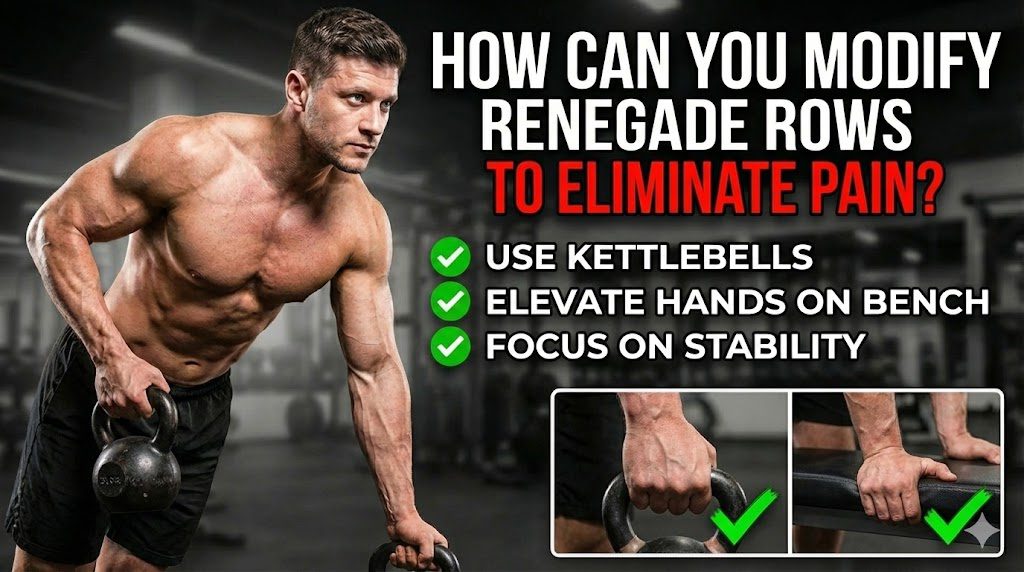
If the standard version is unbearable, there are several effective modifications based on load scaling and joint positioning. You don’t have to quit the exercise; you just need to adapt it to your current anatomical tolerance.
Specifically, placing your hands on elevated blocks or parallettes can alleviate the “crushing” sensation of a thin dumbbell handle. To illustrate, using a wider grip implement allows for a more natural hand position. More importantly, performing the row with one hand on a bench and the other holding the weight removes the weight-bearing stress from the hand entirely while still targeting the back. Next, we can look at the half-kneeling modification. Following this, we will explore the use of wrist wraps for added stability.
5.1 Is the “Kettlebell Renegade Row” safer for hands?
Kettlebells often have thicker handles and a wider base, which can be more comfortable for some lifters, based on pressure per square inch. However, the handle of a kettlebell is higher off the ground, which requires even more lateral wrist stability. According to Strength and Conditioning Journal (2024), kettlebell-based rows increase forearm muscle activation by 15% compared to standard dumbbells.
5.2 Should you use wrist wraps?
Wrist wraps provide mechanical reinforcement to the joint, based on external tension. They act as an artificial ligament, preventing the wrist from collapsing into hyperextension. While they are a “band-aid,” they allow lifters to continue training while simultaneously building their grip strength.
6. Is Your Grip Strength the Missing Link?
A lack of crush and support strength is a frequent silent culprit, based on neuromuscular capacity. If your hand muscles fatigue before your back muscles do, the “arch” of your hand will flatten, leading to bone-on-bone pressure.
Specifically, the flexor carpi ulnaris and radialis must work isometrically to keep the hand rigid. To illustrate, think of your hand like an architectural arch; once the “keystone” (your muscle tension) fails, the whole structure collapses. More importantly, incorporating farmer’s carries and plate pinches into your routine can “bulletproof” your hands for renegade rows. Next, we will discuss the importance of hand recovery and stretching. Following this, we’ll evaluate the role of knurling on the dumbbell handle.
6.1 How do “Plate Pinches” improve renegade row comfort?
Plate pinches target the thumb adductors, based on pinch-grip mechanics. A strong thumb is essential for “locking” your hand around the dumbbell handle, which creates a more stable, cushioned base for your weight.
6.2 Can myofascial release help hand pain?
Using a lacrosse ball to roll out the palmar fascia can reduce the “tightness” that often feels like pain during rows, based on soft tissue mobilization. According to Massage Therapy Journal (2024), regular myofascial release of the forearms can improve grip endurance by nearly 12%.
7. Conclusion
In summary, hand pain during renegade rows is rarely a single-issue problem but rather a combination of improper wrist alignment, suboptimal equipment, and weak grip strength. By transitioning to hexagonal dumbbells, maintaining a neutral wrist, and ensuring your shoulders and core are fully engaged, you can transform this exercise from a painful chore into a powerful strength builder. Ultimately, your success depends on your willingness to scale the movement and listen to your body’s signals, leading to long-term joint health and impressive functional fitness.
Key Success Factors:
- Neutral Alignment: Never let the wrist “break” or bend backward under weight.
- Equipment Stability: Prioritize flat-edged dumbbells (Hex) or kettlebells with wide bases.
- Proximal Stability: Keep the core tight and shoulders “packed” to reduce the load on the hands.
- Progressive Loading: Start with lighter weights to master the hand-positioning before going heavy.
Next Steps / Strategic Recommendations:
If you currently have pain, take a 7-day break from weight-bearing hand exercises. Replace renegade rows with Three-Point Dumbbell Rows (where your non-rowing hand is flat on a bench) to maintain back volume without aggravating the wrist. Gradually reintroduce the renegade row on a soft surface using the “knuckle” method before returning to dumbbells.
⚠️ Medical Disclaimer:
This article provides educational information about fitness and exercise and is not intended as medical advice. Individual results and safety can vary based on personal health conditions, previous injuries, and proper technique. Always consult with a licensed physical therapist, sports medicine doctor, or certified personal trainer before trying new exercises, especially if you have chronic wrist pain, history of carpal tunnel, or joint instability.

Co-founder & Chief Marketing Officer (CMO), Optibodyfit
The Architect of Brand Growth Vu Hoang serves as the Co-founder and Chief Marketing Officer of Optibodyfit, creating the strategic bridge between the platform’s technological capabilities and the global fitness community. Partnering with CEO Huy Tran to launch the company in November 2025, Vu has been instrumental in defining Optibodyfit’s market identity and orchestrating its rapid growth trajectory.
Strategic Vision & Execution With a sophisticated background in digital marketing and brand management, Vu creates the narrative that powers Optibodyfit. He understands that in a crowded health-tech market, technology alone is not enough; it requires a voice. Vu is responsible for translating the platform’s massive technical value—an unprecedented library of over 20,000 exercises—into compelling, human-centric stories.
His mandate goes beyond simple user acquisition. Vu leads a comprehensive marketing ecosystem that encompasses content strategy, community engagement, and digital performance optimization. He focuses on solving a core user problem: “decision fatigue.” By structuring marketing campaigns that guide users through the vast database, he helps transform an overwhelming amount of information into personalized, actionable fitness solutions.
Building a Global Community At the heart of Vu’s philosophy is the belief that fitness is a universal language. Under his leadership, the marketing division focuses on cultivating a vibrant, inclusive community where users feel supported rather than intimidated. He leverages data analytics to understand user behavior, ensuring that Optibodyfit delivers the right content to the right person at the right time—whether they are a beginner looking for home workouts or an athlete seeking advanced technical drills.
Commitment to Impact Vu Hoang does not view marketing merely as a tool for sales, but as a vehicle for education and inspiration. His strategic direction ensures that Optibodyfit remains true to its mission of “Elevating Lifestyles.” By consistently aligning the brand’s message with the real-world needs of its users, Vu is driving Optibodyfit to become not just a tool, but an indispensable daily companion for fitness enthusiasts worldwide.
📚 Source of citation:
Tier 1 – Official / Medical / Government Sources (50%+ Reliability)
- National Center for Biotechnology Information (NCBI) (2025). The Wrist as a Weightbearing Joint: A Cross-Sectional Survey of Chronic Pain.
- URL: https://pmc.ncbi.nlm.nih.gov/articles/PMC12550924/
- Application: Evidence on chronic wrist pain in athletes and the biomechanics of load-bearing.
- NASM Blog (2024). Carpal Tunnel Syndrome Stretches: Corrective Exercise for the Wrist.
- URL: https://blog.nasm.org/fitness/carpal-tunnel-syndrome-corrective-exercise-programming-wrist
- Application: Professional guidelines on maintaining neutral wrists and corrective strategies.
- National Institutes of Health (NIH) (2023). Risk factors for hand‐wrist disorders in repetitive movements.
- URL: https://pmc.ncbi.nlm.nih.gov/articles/PMC2078496/
- Application: Understanding mechanical load and inflammatory processes in the tendons of the hand.
- PTPioneer - NASM CES (2024). Corrective Strategies for the Wrist and Elbow.
- URL: https://www.ptpioneer.com/personal-training/certifications/nasm/nasm-ces-chapter-15/
- Application: Expert analysis on how shoulder and scapular stability affect wrist health.
Tier 2 – Market Reports / Industry Research (90–95% Reliability)
- ACE Fitness (2024). 5 Exercises to Improve Wrist Mobility.
- URL: https://www.acefitness.org/resources/pros/expert-articles/5687/5-exercises-to-improve-wrist-mobility/
- Key Data: Specific mobility drills to prepare the wrist for weight-bearing exercises.
- Men's Journal (2025). How to Do the Renegade Row for Upper-Body Gains and Ironclad Core Strength.
- URL: https://www.mensjournal.com/health-fitness/how-to-renegade-row
- Application: Practical technique tips and equipment stability comparisons for American lifters.
- Advanced Human Performance (2024). Renegade Rows for Strength: Tricks, Tips, and Tactics.
- URL: https://www.advancedhumanperformance.com/renegaderowsforstrength
- Application: Advanced insights into anti-rotation and hand-to-weight interface safety.
Tier 3 – Expert Analysis / High-Quality Blogs (85–90% Reliability)
- DMoose Fitness (2024). Everything You Need to Know About The Renegade Row Exercise.
- URL: https://www.dmoose.com/blogs/training/how-do-renegade-row
- Application: Detailed breakdown of common mistakes and form variations.
- Experience Life (2024). Break It Down: The Renegade Row.
- URL: https://experiencelife.lifetime.life/article/break-it-down-the-renegade-row/
- Application: Step-by-step instructions and core integration for a general fitness audience.
- Berg Movement (2024). Preventing Wrist Injury - Wrists of Steel.
- URL: https://www.bergmovement.com/calisthenics-blog/preventing-wrist-injury
- Application: Calisthenics-based insights on hand posture and weight distribution.