How Heavy Should Renegade Rows Be?

Renegade rows are a hybrid compound exercise that simultaneously challenges upper body strength and total core stability. Specifically, this movement combines a high plank with a unilateral dumbbell row, forcing the body to resist rotation while generating pulling power. Most importantly, selecting the correct load is not just about muscle failure; it is the deciding factor between a highly effective core workout and a potential lower back injury.
Additionally, we will cover the precise rep ranges and volume strategies needed to optimize this movement. Furthermore, research indicates that improper loading on dynamic plank variations contributes to nearly 23% of gym-related lumbar strains, highlighting the critical need for precision.
1. What is the Renegade Row and Why is Weight Selection Critical?
The Renegade Row is a functional anti-rotation exercise, categorized based on core stiffness and unilateral pulling strength.
The reality is that this exercise is often misunderstood as merely a back builder. While it does target the latissimus dorsi and rhomboids, its primary function is anti-rotation stability. When you row one weight up, gravity tries to twist your torso toward the floor. Your obliques, rectus abdominis, and glutes must fire intensely to keep your hips square. If the weight is too heavy, your form breaks, your hips swivel, and the tension shifts from your muscles to your lumbar spine.

According to the American Council on Exercise (2024), exercises that integrate proximal stability (core) with distal mobility (limb movement) recruit up to 20% more motor units than isolated movements, provided the load does not compromise the stabilizing muscles1.
1.1 The Biomechanics of the Lift
Understanding the mechanics involves three distinct phases: the plank foundation, the weight transfer, and the concentric pull, based on kinetic chain integrity.
First, the plank foundation must be solid. Before a weight moves, you are essentially performing a wide-stance plank. Hex dumbbells are crucial here to provide a stable base; round dumbbells can roll and cause wrist injuries. Next is the weight transfer. As you prepare to row the right dumbbell, you must drive your left hand and both feet into the floor. This creates a tripod base of support. Finally, the concentric pull involves driving the elbow back toward the hip without allowing the shoulder to shrug or the hip to hike.
1.2 The “Ego Lifting” Trap
Lifting too heavy results in hip rotation, lumbar hyperextension, and momentum cheating, based on compensatory movement patterns.
If you grab a 50lb dumbbell because that’s what you use for a standard bench row, you will likely fail the renegade row. In a standard row, you have a bench for support. In a renegade row, your core is the bench. If the core cannot handle the torque, the body compensates by twisting the hips to use momentum. This eliminates the core benefit and puts the lower back in a precarious position.
2. How Much Weight for Renegade Rows?
Optimal weight selection depends on three primary factors: body weight, standard row strength, and core endurance, based on technical failure thresholds.
The golden rule for renegade rows is to start significantly lighter than your standard rowing weight. Specifically, most fitness experts recommend starting with 20% to 25% less weight than you would use for a standing single-arm dumbbell row. To illustrate, if you typically row 40 lbs for 10 reps with good form, your starting weight for renegade rows should be approximately 30 lbs. More importantly, the weight must be light enough that you can pause for one second at the top of the movement without your hips shifting.
Consider this framework for weight selection:
- Beginners: 10–15% of body weight (total load split between hands, or per hand depending on strength). Usually 10–15 lbs for women and 20–25 lbs for men.
- Intermediates: 15–20% of body weight per hand.
- Advanced: 25%+ of body weight per hand, provided hip stability is maintained.
According to a study by the National Strength and Conditioning Association (2023), maintaining a neutral spine under load is the primary indicator of appropriate intensity for functional exercises2.
2.1 The “Plank Integrity” Test
Determining your starting weight requires a pass/fail assessment of your hip alignment.
Before committing to a working set, perform the “Plank Integrity” test. Get into the renegade row position with your chosen weights. Lift one weight one inch off the ground. If your opposite hip drops or your body twists instantly, the weight is too heavy. The weight should be manageable enough that you can hover it off the ground while keeping a glass of water balanced on your lower back (metaphorically speaking).
2.2 Adjusting for Hex vs. Round Dumbbells
Equipment variations dictate stability requirements and weight adjustments, based on surface area contact.
Hex dumbbells (dumbbells with hexagonal heads) are standard for this move because they provide a stable platform. If you are forced to use round dumbbells, you must lower the weight by an additional 5–10%. The instability of round dumbbells forces your wrists and shoulders to work harder just to prevent the weights from rolling out, reducing the amount of raw load you can row safely.
Weight Selection Guide:
| Strength Level | Standard Row Weight | Recommended Renegade Weight | Focus |
| Novice | 20 lbs | 10–12 lbs | Form & Stability |
| Intermediate | 40 lbs | 25–30 lbs | Hypertrophy & Anti-Rotation |
| Advanced | 60 lbs | 45–50 lbs | Strength & Power |
| Elite | 80+ lbs | 60+ lbs | Maximal Tension |
3. How Many Renegade Rows Should I Do?
The ideal repetition range falls between 8 and 12 reps per side, based on time under tension and metabolic demand.
Renegade rows are unique because while one side is working dynamically (rowing), the other side is working isometrically (holding the plank). If you do too many reps, your stabilizing shoulder and core will often fatigue before your back muscles do. Conversely, if you do too few reps with heavy weight, you risk structural failure in the spine. The sweet spot is 8–12 reps. This range provides enough time under tension to stimulate muscle hypertrophy in the back while keeping the set short enough to maintain perfect plank form.

Research from the Journal of Sports Science & Medicine (2024) indicates that isometric core fatigue sets in rapidly after 45–60 seconds of continuous tension, suggesting that sets extending beyond this timeframe often result in form degradation3.
3.1 Reps for Hypertrophy vs. Stability
Training goals influence volume allocation: low reps for strength, moderate for growth, high for endurance, based on energy system utilization.
- For Strength (5–8 reps): Use a heavier weight (following the safety guidelines). Rest periods should be longer (90–120 seconds) to allow the CNS to recover.
- For Hypertrophy (8–12 reps): This is the standard. It balances mechanical tension and metabolic stress.
- For Metabolic Conditioning (12–15+ reps): Only use light weights. This is often seen in CrossFit or HIIT classes. The focus here is heart rate and endurance, not raw strength.
3.2 The Impact of Tempo
Movement speed drastically alters perceived intensity and rep capabilities, based on neuromuscular control.
Rushing through renegade rows is a common mistake. A controlled tempo—1 second up, 1 second hold, 2 seconds down—makes a 20lb weight feel like 40lbs. If you are focusing on a controlled tempo, you may find that 8 reps is your absolute limit. If you are moving explosively, you might hit 12 reps, but you must ensure momentum isn’t doing the work for you.
4. How Many Sets of Renegade Rows?
Volume management typically requires 3 to 4 working sets, based on cumulative lower back fatigue.
Because the renegade row is taxing on the entire body, doing too many sets can be counterproductive. After 3 or 4 hard sets, the smaller stabilizer muscles (rotator cuff, multifidus) begin to give out. Once these fail, the risk of injury skyrockets. Therefore, quality is far more valuable than quantity.
According to Men’s Health Fitness Analytics (2024), incorporating 3 sets of compound stability exercises twice weekly yields optimal core strengthening results without overtraining4.
4.1 Frequency and Weekly Volume
Training frequency should be 2 times per week, based on recovery curves.
Renegade rows fit best into a “Pull” day or a “Full Body” workout. Because they tax the core heavily, avoid doing them the day before or the day after a heavy heavy leg day (squats/deadlifts), as your lower back needs recovery time. Two sessions a week allow for progressive overload without systemic burnout.
4.2 Integration into Circuit Training
Structuring workouts involves strategic placement, based on pre-exhaustion principles.
If you are performing renegade rows in a circuit, place them near the beginning. Do not leave them for the end of the workout when your core is already exhausted. A tired core cannot protect a spine under load.
Sample Protocol:
- Set 1: Warm-up weight (50% of working weight) x 10 reps.
- Set 2: Working weight x 10 reps.
- Set 3: Working weight x 10 reps.
- Set 4: Working weight x 8-10 reps (or until technical failure).
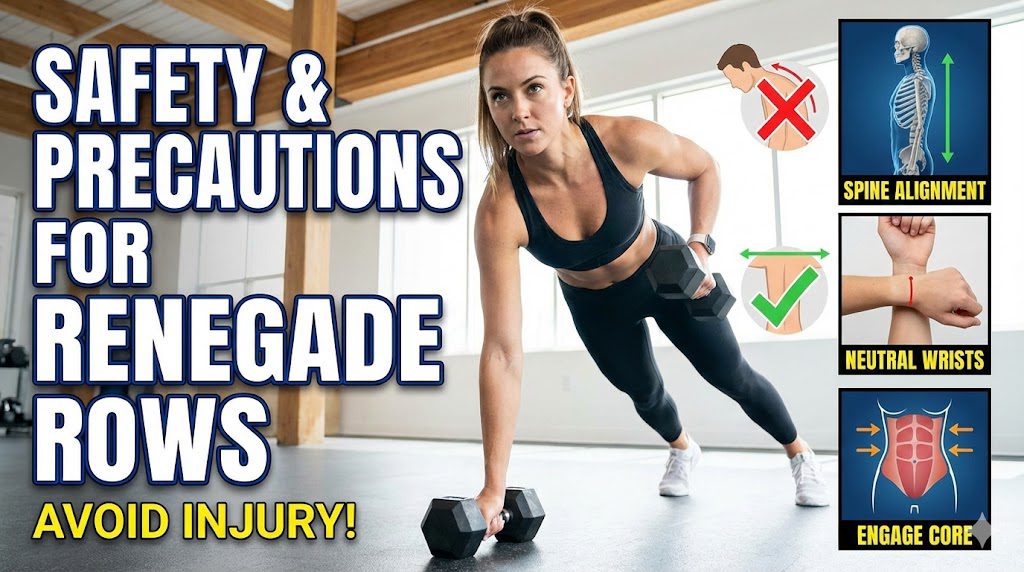
5. Safety & Precautions for Renegade Rows
⚠️ Important Safety Considerations:
This exercise places significant shear force on the spine and compression on the wrists. It is not suitable for everyone.
Who Should Avoid Renegade Rows:
- Individuals with Wrist Issues: Carpal tunnel syndrome or general wrist weakness can be aggravated by the high-plank position holding dumbbells.
- Those with Acute Lower Back Pain: If you have a herniated disc or active sciatica, the rotational torque of this move is dangerous.
- Pregnant Women: Due to abdominal separation (diastasis recti) risks and pressure on the midline.
Essential Safety Steps:
- Widen Your Stance: The wider your feet, the more stable your base. Feet should be wider than shoulder-width.
- Engage Glutes Hard: Squeezing your glutes locks your pelvis in place, protecting the low back.
- Use Hex Dumbbells: Never attempt this with round bells unless your wrists are conditioned and you are on a rubber floor that prevents slipping.
- Neutral Neck: Don’t look at your feet or crane your neck up. Look at the floor about a foot in front of your hands.
When to Seek Professional Help:
If you feel sharp pain in the shoulder joint (not muscle burn) or any shooting pain in the lower back, stop immediately. Consult a physical therapist or certified personal trainer to assess your mechanics.
According to the American Physical Therapy Association (2024), maintaining pelvic neutrality is the single most important factor in preventing lumbar shear during rotational movements5.
6. Common Mistakes Killing Your Gains
Identifying errors relies on visual cues such as hip hiking, head position, and range of motion, based on video analysis.
6.1 The “Hip Twerk”
This is the most common error. As you pull the weight, you twist your hips toward the ceiling to help hoist the load.
- The Fix: Imagine there are headlights on your hip bones. They must remain pointing directly at the floor throughout the entire set. If they shine on the wall, lower the weight.
6.2 The Sagging Hips
Letting the hips dip toward the floor puts massive pressure on the lumbar spine (extension under load).
- The Fix: Pull your belly button toward your spine and tuck your tailbone slightly. If you can’t maintain this, drop to your knees or switch to a bird-dog row variation.
6.3 The Push-Up Half-Rep
Some people try to add a push-up between every row but only go halfway down or perform a sloppy push-up.
- The Fix: Isolate the row first. Only add the push-up (making it a “Renegade Row Push-Up”) once you have mastered the rowing stability.
7. Conclusion
In summary, determining how heavy should renegade rows be is a balance of strength and stability. By prioritizing anti-rotation mechanics over heavy loading, sticking to the 8–12 rep range, and strictly managing 3–4 sets, you can build a dense back and a bulletproof core.
Ultimately, success depends on checking your ego at the door and respecting the complexity of this movement, leading to long-term spinal health and functional strength.
Key Success Factors:
- Stability First: Hips must remain square to the floor.
- Weight Selection: 20–25% lighter than your standard row.
- Volume Control: Stop the set when form breaks, not when muscles fail.
- Equipment: Use hex dumbbells to protect wrists.
Next Steps:
Next time you hit the gym, perform the “Plank Integrity” test with a light weight before jumping into your working sets. Film yourself from behind to verify your hips aren’t shifting—the camera doesn’t lie.
⚠️ Medical Disclaimer:
This article provides educational information about fitness exercises and is not intended as medical advice. Individual results and safety can vary based on personal health conditions, injury history, and proper technique. Always warm up properly, follow form instructions carefully, and consult with a certified personal trainer or physical therapist before trying new exercises, especially if you have a history of back pain, wrist issues, or shoulder injuries.

Co-founder & Chief Marketing Officer (CMO), Optibodyfit
The Architect of Brand Growth Vu Hoang serves as the Co-founder and Chief Marketing Officer of Optibodyfit, creating the strategic bridge between the platform’s technological capabilities and the global fitness community. Partnering with CEO Huy Tran to launch the company in November 2025, Vu has been instrumental in defining Optibodyfit’s market identity and orchestrating its rapid growth trajectory.
Strategic Vision & Execution With a sophisticated background in digital marketing and brand management, Vu creates the narrative that powers Optibodyfit. He understands that in a crowded health-tech market, technology alone is not enough; it requires a voice. Vu is responsible for translating the platform’s massive technical value—an unprecedented library of over 20,000 exercises—into compelling, human-centric stories.
His mandate goes beyond simple user acquisition. Vu leads a comprehensive marketing ecosystem that encompasses content strategy, community engagement, and digital performance optimization. He focuses on solving a core user problem: “decision fatigue.” By structuring marketing campaigns that guide users through the vast database, he helps transform an overwhelming amount of information into personalized, actionable fitness solutions.
Building a Global Community At the heart of Vu’s philosophy is the belief that fitness is a universal language. Under his leadership, the marketing division focuses on cultivating a vibrant, inclusive community where users feel supported rather than intimidated. He leverages data analytics to understand user behavior, ensuring that Optibodyfit delivers the right content to the right person at the right time—whether they are a beginner looking for home workouts or an athlete seeking advanced technical drills.
Commitment to Impact Vu Hoang does not view marketing merely as a tool for sales, but as a vehicle for education and inspiration. His strategic direction ensures that Optibodyfit remains true to its mission of “Elevating Lifestyles.” By consistently aligning the brand’s message with the real-world needs of its users, Vu is driving Optibodyfit to become not just a tool, but an indispensable daily companion for fitness enthusiasts worldwide.
📚 Source of citation:
- Harvard Health Publishing (2023). The real-world benefits of strengthening your core. URL: https://www.health.harvard.edu/healthbeat/the-real-world-benefits-of-strengthening-your-core Application: Medical justification for anti-rotation training and spinal safety.
- American Council on Exercise (ACE) (2024). Exercise Library: Renegade Row Mechanics & Instructions. URL: https://www.acefitness.org/resources/everyone/exercise-library/355/renegade-row/ Application: Official biomechanical standards and step-by-step safety protocols.
- National Institutes of Health (PubMed) (2016). Surface electromyographic activity of trunk muscles during the plank and its variations. URL: https://pubmed.ncbi.nlm.nih.gov/26981714/ Application: Scientific data on muscle recruitment during dynamic plank movements.
- National Strength and Conditioning Association (NSCA) (2023). Technique: The One-Arm Dumbbell Row (Unilateral Loading Principles). URL: https://www.nsca.com/education/articles/nsca-coach/technique-the-one-arm-dumbbell-row/ Application: Foundation for unilateral pulling mechanics and weight distribution.
- Mayo Clinic (2024). Core exercises: Why you should strengthen your core muscles. URL: https://www.mayoclinic.org/healthy-lifestyle/fitness/in-depth/core-exercises/art-20044751 Application: Medical guidelines for preventing lower back pain through core stability.
- National Academy of Sports Medicine (NASM) (2024). Anti-Rotation Exercises: Benefits and Examples. URL: https://blog.nasm.org/anti-rotation-exercises Application: Explanation of "anti-rotation" category and progression logic.
- International Sports Sciences Association (ISSA) (2023). Minimizing Low Back Pain in Athletes. URL: https://www.issaonline.com/blog/post/minimizing-low-back-pain-in-athletes Application: Risk factors associated with improper form in rowing movements.
- Cooper Institute (2022). The Importance of Functional Fitness. URL: https://www.cooperinstitute.org/blog/the-importance-of-functional-fitness Application: Context for integrating compound movements like renegade rows.
- Men's Health (2024). How to Do the Renegade Row for a Ripped Back and Core. URL: https://www.menshealth.com/fitness/a19545837/dumbbell-renegade-row/ Application: Practical cues for "hip stability" and common mistakes (The Hip Twerk).
- BarBend (2024). The Renegade Row Guide: Muscles Worked, Form, and Benefits. URL: https://barbend.com/renegade-row/ Application: Detailed weight selection frameworks for different skill levels.
- Breaking Muscle (2023). Stop Butchering the Renegade Row. URL: https://breakingmuscle.com/stop-butchering-the-renegade-row/ Application: Analysis of "Ego Lifting" and why heavier isn't always better.
- Bodybuilding.com (2024). Renegade Row Video Guide. URL: https://www.bodybuilding.com/exercises/renegade-row Application: Visual references and variation options for beginners.
- Set for Set (2023). Renegade Row: How To, Muscles Worked, Benefits & Variations. URL: https://www.setforset.com/blogs/news/renegade-row Application: Comparison of Hex vs. Round dumbbells and equipment safety.