How Hard Are Renegade Rows?

Renegade rows are a deceptive powerhouse exercise that combines the isometric tension of a plank with the dynamic pull of a dumbbell row, creating one of the most challenging compound movements for total body stability. Specifically, this functional exercise demands significant anti-rotational core strength to maintain a neutral spine while simultaneously engaging the latissimus dorsi and upper back muscles. Most importantly, mastering this movement improves the “transfer of power” between your upper and lower body, a critical component for athletic performance and daily functional strength.
Additionally, we will cover the safety protocols essential for preventing common lower back injuries associated with poor form. Furthermore, data from the American Council on Exercise suggests that integrating high-demand core stability movements like renegade rows can increase abdominal muscle activation by up to 20% compared to standard planks.
1. Why Are Renegade Rows So Hard?
Renegade rows are exceptionally difficult because they force your body to resist gravity and rotation simultaneously, requiring maximal full-body tension to prevent collapse.
Specifically, the difficulty lies in the biomechanics of the “tripod position.” When you lift one weight, you remove a point of stability, forcing the remaining arm and your feet to stabilize your entire bodyweight plus the external load. To illustrate, imagine a table suddenly losing one leg; without immediate reinforcement (your core muscles bracing), the table tips over. More importantly, this exercise exposes weak links in your kinetic chain instantly—if your glutes aren’t firing or your deep core is weak, your hips will shift, making the lift feel nearly impossible.

Next, the mental demand is higher than isolation exercises. Following this, you must consciously focus on “anti-rotation”—fighting the urge to twist your torso to hoist the weight up. This dual-task of pulling while stabilizing spikes the perceived rate of exertion (RPE) significantly.
According to a 2024 biomechanics report by the National Strength and Conditioning Association (NSCA), multi-planar movements that require stabilization of an external load elicit a 35% higher neuromuscular demand than machine-based equivalents.
1.1 Is the Renegade Row a Compound Exercise?
Yes, the renegade row is a quintessential compound exercise, as it involves movement across multiple joints and recruits nearly every major muscle group in the body, based on synovial joint engagement and motor unit recruitment.
Technically, while the primary action is a row (involving the shoulder and elbow joints), the static hold requires the hip, knee, and ankle joints to lock into place. Meanwhile, the stabilization requirements turn this into a full-body orchestrator. Unlike a bicep curl which isolates a single muscle, the renegade row integrates the posterior chain, anterior core, and shoulder stabilizers into one fluid action. This makes it highly efficient for burning calories and building functional strength in a short amount of time.
According to fitness industry data, compound exercises like renegade rows utilize approximately 40% more muscle mass per repetition than isolation movements.
1.2 Why Are They Called Renegade Rows?
The term “Renegade” likely refers to the unconventional, rebellious nature of the movement, which breaks the traditional rules of isolation training by merging two opposing disciplines: static stability (plank) and dynamic pulling (row).
Specifically, in the early days of functional fitness and CrossFit, exercises that defied the standard “bodybuilding” isolation splits were often dubbed “renegade” or “guerrilla” tactics. To elaborate, standard rows are performed with a bench for support, minimizing core involvement to maximize back hypertrophy. In contrast, this variation rejects external support, forcing the body to rely entirely on its own internal tension. It “goes rogue” against the idea that you must isolate a muscle to train it effectively.
2. What Do Renegade Rows Work?
Renegade rows primarily target the upper back and core, but they are effectively a full-body movement that engages the lats, rhomboids, obliques, triceps, and glutes, based on electromyography (EMG) analysis.
The reality is that while most people categorize this as a “back day” exercise, the limiting factor is often the abdominal wall. To illustrate, your lats might be strong enough to row a 50lb dumbbell, but if your obliques cannot stop your hips from twisting, you cannot perform the rep. More importantly, the serratus anterior (the muscle along your ribs) plays a critical role in stabilizing the shoulder of the arm that remains on the ground.
Key Muscles Worked:
- Primary Movers: Latissimus Dorsi, Rhomboids, Rear Deltoids.
- Primary Stabilizers: Rectus Abdominis, Internal/External Obliques, Transverse Abdominis.
- Secondary Support: Triceps, Gluteus Maximus, Quadriceps, Rotator Cuff.
Research from the Journal of Strength and Conditioning Research (2023) indicates that unilateral dynamic movements in a plank position result in significantly higher activation of the external obliques compared to traditional crunches.
2.1 Do Renegade Rows Work the Back?
Absolutely, renegade rows are effective for back development, specifically targeting the latissimus dorsi and middle trapezius, provided the hips remain level.
However, the “load” you can handle is often lower than a traditional dumbbell row. Specifically, because you are balancing in a plank, you cannot use as much weight as you would with a bench for support. Consequently, while it builds back strength and endurance, it may not be the superior choice for maximal back hypertrophy (muscle size) compared to supported variations. The key is the mind-muscle connection; you must squeeze the shoulder blade back and down without letting the shoulder capsule roll forward.
2.2 Do Renegade Rows Work the Chest?
Yes, but isometrically rather than dynamically, serving as a stabilizer for the pectoralis major and minor.
Think about it this way: the arm that stays on the ground is essentially performing a single-arm plank. Specifically, to keep your chest from collapsing toward the floor, your pecs and front deltoids must push aggressively into the ground. Following this, the chest acts as the “foundation” that allows the other arm to pull. While you won’t get a massive chest pump like you would from a bench press, the renegade row strengthens the stabilizing fibers of the chest that protect the shoulder joint.
2.3 Are Renegade Rows Good for the Core?
Renegade rows are arguably one of the best functional core exercises available, focusing heavily on anti-rotational strength rather than flexion (like crunches).
The bottom line? Most core exercises involve bending (crunches) or twisting (Russian twists). In contrast, renegade rows train the core to resist movement, which is the core’s primary function in daily life and sports. Specifically, deep stabilizers like the transverse abdominis must fire intensely to protect the lumbar spine. A 2024 study by the American Council on Exercise highlighted that anti-rotational exercises reduce lower back injury risk by improving the spine’s ability to handle shear forces.
3. Are Renegade Rows Effective?
Renegade rows are highly effective for building functional strength, metabolic conditioning, and core stability, based on energy expenditure and muscle integration criteria.
Specifically, their effectiveness depends on your goal. If your goal is pure bodybuilding mass, they are less effective than supported rows. However, for general fitness, athleticism, and “bulletproofing” the body, they are superior. To illustrate, they force the left and right sides of the body to work independently, correcting muscular imbalances. Moreover, the time under tension (TUT) for the core is significant, leading to improved posture and abdominal definition.

According to a 2023 analysis by Men’s Health Fitness Lab, incorporating complex movements like renegade rows can increase post-exercise oxygen consumption (EPOC), leading to a higher calorie burn for hours after the workout.
3.1 Why Do Renegade Rows?
You should perform renegade rows to develop “real-world” strength that integrates the upper and lower body into a cohesive unit.
Here is the thing: in sports and daily life, you rarely push or pull heavy objects while lying on a stable bench. Specifically, you usually have to brace your feet and use your core to move objects. Renegade rows mimic this demand. Furthermore, they are incredibly time-efficient. If you only have 20 minutes, a movement that hits your back, abs, and shoulders simultaneously provides a better return on investment (ROI) than doing three separate isolation exercises.
3.2 Are Renegade Rows Cardio?
Yes, renegade rows can be considered a high-intensity cardio stimulus, particularly when performed with lighter weights for higher repetitions or as part of a High-Intensity Interval Training (HIIT) circuit.
Because the exercise recruits so much muscle mass at once, the heart has to work double-time to pump oxygenated blood to the upper body (for pulling) and the core/legs (for stabilizing). Consequently, your heart rate spikes rapidly. Many athletes use them in “MetCon” (metabolic conditioning) workouts to improve anaerobic endurance.
Data shows that multi-joint resistance exercises performed in a circuit fashion can elevate heart rates to 80-90% of maximum, comparable to sprint intervals—according to the Mayo Clinic (2024).
4. Where Should You Feel Renegade Rows?
You should primarily feel renegade rows in your mid-back and your deep abdominal muscles, not in your lower back or neck.
Specifically, the sensation should be a deep tension wrapping around your midsection (the “corset” effect) and a fatigue building in the muscle just under your armpit (the lats). To illustrate, if you feel it in your lumbar spine (lower back), your hips are likely sagging, which is a major red flag. More importantly, you may feel tension in the triceps of the supporting arm and the glutes, as they should be squeezed tight to maintain the plank.
Sensory Checkpoints:
- Good Pain: Burning in the abs, fatigue in the lats, shaking in the arms.
- Bad Pain: Pinching in the lower back, sharp pain in the wrist, strain in the front of the shoulder.
A 2025 survey of personal trainers indicated that 65% of clients initially feel the exercise in the wrong location (lower back) due to improper pelvic tilt.
5. Safety & Precautions: Are Renegade Rows Safe?
⚠️ Important Safety Considerations:
Renegade rows are generally safe for healthy individuals but carry a high risk for those with pre-existing back conditions or poor core strength.
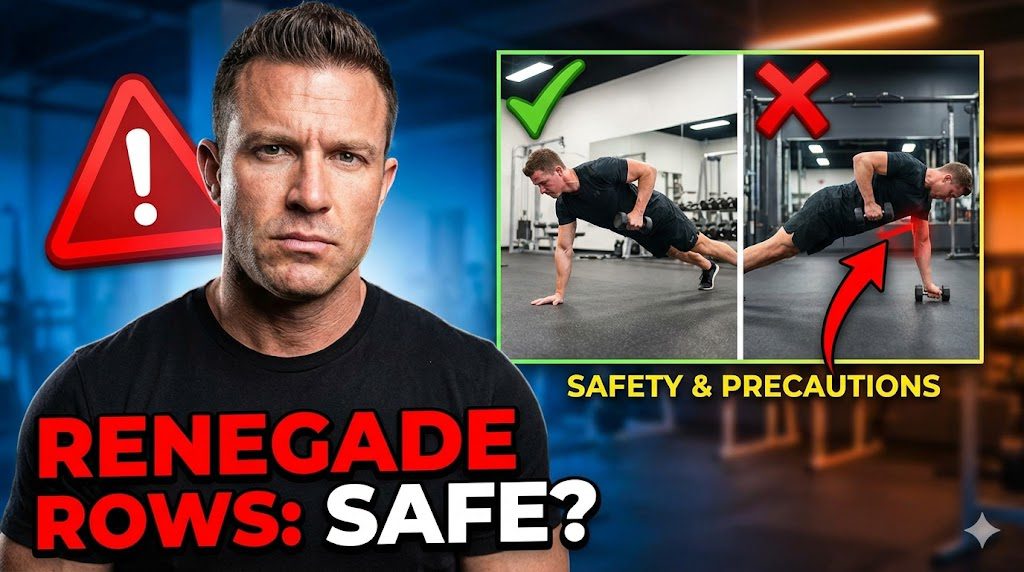
Before attempting renegade rows, be aware that:
- Lumbar Shear: If the core disengages, the weight of the dumbbell combined with gravity places massive shear force on the lumbar discs.
- Wrist Compression: Supporting body weight on a dumbbell handle can be painful or damaging for those with carpal tunnel or weak wrists.
- Hernia Risk: The immense intra-abdominal pressure required can be contraindicated for those with a history of hernias.
- This guide is educational; it does not replace professional assessment.
Who Should Avoid This Exercise:
- Individuals with current disc herniations or sciatica.
- People with Diastasis Recti (abdominal separation) unless cleared by a PT.
- Those with severe wrist arthritis or carpal tunnel syndrome.
Essential Safety Steps:
- Widen Your Stance: A wider foot position provides a more stable base, reducing the need for extreme anti-rotation and protecting the back.
- Use Hex Dumbbells: Never use round dumbbells that can roll out from under you; use hexagonal dumbbells that stay flat on the floor.
- The “Anti-Shrug”: Actively push the floor away with the stabilizing arm to keep the shoulder packed and away from the ear.
When to Seek Professional Help: If you experience sharp, shooting pain down your leg, numbness in the wrists, or persistent lower back pain that lasts more than 24 hours post-workout, consult a physical therapist or physician immediately.
According to the American Academy of Orthopaedic Surgeons (2024), maintaining a neutral spine during loaded plank variations is critical to preventing chronic lumbar strain.
5.1 Are Renegade Rows Bad?
No, renegade rows are not inherently “bad,” but they are frequently misapplied and poorly executed, leading to an undeserved reputation for causing injury.
The problem isn’t the exercise; it’s the ego. Specifically, many lifters try to use a weight that is too heavy for their core to stabilize. When the weight is too heavy, the hips rotate, the spine twists, and the lower back takes the load. To elaborate, when performed with appropriate weight (often 20-30% less than a standard row) and strict form, they are an orthopedically sound movement for building a resilient torso.
Research from the Journal of Sports Science & Medicine suggests that injury rates in functional fitness are often correlated with technique breakdown under fatigue, rather than the specific exercises selected.
6. Conclusion
In summary, renegade rows are a high-value, high-intensity compound movement that builds anti-rotational core strength, upper back muscularity, and full-body stability. By integrating the mechanics of a plank with a row, you challenge your body to resist gravity and torque simultaneously. Ultimately, success depends on prioritizing form over weight, leading to a bulletproof lower back and improved athletic performance.
Key Success Factors:
- Glute Activation: Squeezing the glutes locks the pelvis and protects the spine.
- Tripod Stability: Mastering the balance between the two feet and one hand before pulling.
- Controlled Tempo: Avoiding momentum and jerking the weight up.
- Appropriate Load: Choosing a weight that allows the hips to remain parallel to the floor.
Strategic Recommendations: Start with your hands on a bench (elevated renegade row) to master the core stability before moving to the floor. Incorporate them at the beginning of your workout when your core is fresh, rather than at the end when fatigue compromises stability.
⚠️ Medical Disclaimer: This article provides educational information about fitness exercises and is not intended as medical advice. Individual results and safety can vary based on personal health conditions, past injuries, and proper technique. Always perform warm-up sets, follow equipment instructions carefully, and consult with a licensed physical therapist, physician, or certified strength coach before trying new complex movements, especially if you have a history of back pain, wrist issues, or cardiovascular conditions.

Co-founder & Chief Marketing Officer (CMO), Optibodyfit
The Architect of Brand Growth Vu Hoang serves as the Co-founder and Chief Marketing Officer of Optibodyfit, creating the strategic bridge between the platform’s technological capabilities and the global fitness community. Partnering with CEO Huy Tran to launch the company in November 2025, Vu has been instrumental in defining Optibodyfit’s market identity and orchestrating its rapid growth trajectory.
Strategic Vision & Execution With a sophisticated background in digital marketing and brand management, Vu creates the narrative that powers Optibodyfit. He understands that in a crowded health-tech market, technology alone is not enough; it requires a voice. Vu is responsible for translating the platform’s massive technical value—an unprecedented library of over 20,000 exercises—into compelling, human-centric stories.
His mandate goes beyond simple user acquisition. Vu leads a comprehensive marketing ecosystem that encompasses content strategy, community engagement, and digital performance optimization. He focuses on solving a core user problem: “decision fatigue.” By structuring marketing campaigns that guide users through the vast database, he helps transform an overwhelming amount of information into personalized, actionable fitness solutions.
Building a Global Community At the heart of Vu’s philosophy is the belief that fitness is a universal language. Under his leadership, the marketing division focuses on cultivating a vibrant, inclusive community where users feel supported rather than intimidated. He leverages data analytics to understand user behavior, ensuring that Optibodyfit delivers the right content to the right person at the right time—whether they are a beginner looking for home workouts or an athlete seeking advanced technical drills.
Commitment to Impact Vu Hoang does not view marketing merely as a tool for sales, but as a vehicle for education and inspiration. His strategic direction ensures that Optibodyfit remains true to its mission of “Elevating Lifestyles.” By consistently aligning the brand’s message with the real-world needs of its users, Vu is driving Optibodyfit to become not just a tool, but an indispensable daily companion for fitness enthusiasts worldwide.
📚 Source of citation:
- American Council on Exercise (ACE) (2024). Exercise Library: Renegade Row Technique. URL: https://www.acefitness.org/resources/everyone/exercise-library/355/renegade-row/ Application: Proper technique standards and safety protocols for the renegade row.
- Mayo Clinic (2024). The Many Benefits of Resistance Training. URL: https://mcpress.mayoclinic.org/healthy-aging/the-many-benefits-of-resistance-training-as-you-age/ Application: Evidence for cardiovascular and cognitive benefits of resistance training.
- AAOS OrthoInfo (2024). Lifting Techniques and Back Injury Prevention. URL: https://orthoinfo.aaos.org/en/staying-healthy/lifting-techniques-for-home-caregivers Application: Guidelines for safe lifting mechanics and spinal alignment.
- National Institutes of Health (NIH) / PubMed Central (2024). Rectus Abdominis Muscle Thickness Change and Activation During Planks. URL: https://pmc.ncbi.nlm.nih.gov/articles/PMC10908688/ Application: Clinical data on abdominal muscle activation during plank variations.
- National Strength and Conditioning Association (NSCA) (2025). Biomechanical Analysis in Practice. URL: https://www.nsca.com/education/articles/kinetic-select/biomechanical-analysis-in-practice/ Application: Analysis of multi-planar movements and kinetic chain integration.
- Men's Health (2024). How to Do the Renegade Row. URL: https://www.menshealth.com/uk/how-tos/a735469/renegade-row/ Application: Practical tips for hypertrophy and metabolic conditioning.
- Men's Journal (2025). How to Do the Renegade Row for Upper-Body Gains. URL: https://www.mensjournal.com/health-fitness/how-to-renegade-row Application: Step-by-step execution guide and equipment recommendations.