Do Incline Push Ups Train Upper Chest? The Ultimate Guide to Pectoral Development

Incline push-ups are a fundamental bodyweight exercise designed to target the clavicular head of the pectoralis major by altering the angle of resistance. Specifically, placing the hands on an elevated surface shifts the mechanical load away from the lower sternal fibers and concentrates tension on the upper chest and anterior deltoids. Most importantly, this variation provides a safe, scalable method for hypertrophy that reduces strain on the rotator cuff compared to flat or decline variations.
Additionally, we will explore the biomechanics of bench angles, progressive overload strategies without weights, and common mistakes that kill chest gains. Furthermore, electromyography (EMG) research indicates that shifting from a flat to an incline position can increase upper pectoral activation relative to lower pectoral engagement by over 20%, making it a critical tool for aesthetic balance.
1. Do Incline Push Ups Effectively Target the Upper Chest?
Incline push-ups significantly emphasize the upper chest, based on biomechanical leverage and muscle fiber orientation.
Here’s the thing: gravity remains constant, but your body angle dictates which muscle fibers fight that gravity. When you elevate your hands, you reduce the total amount of body weight you are lifting (making it easier than a flat push-up), but you drastically change the angle of shoulder flexion. This angle aligns the line of force directly with the clavicular head (upper chest).
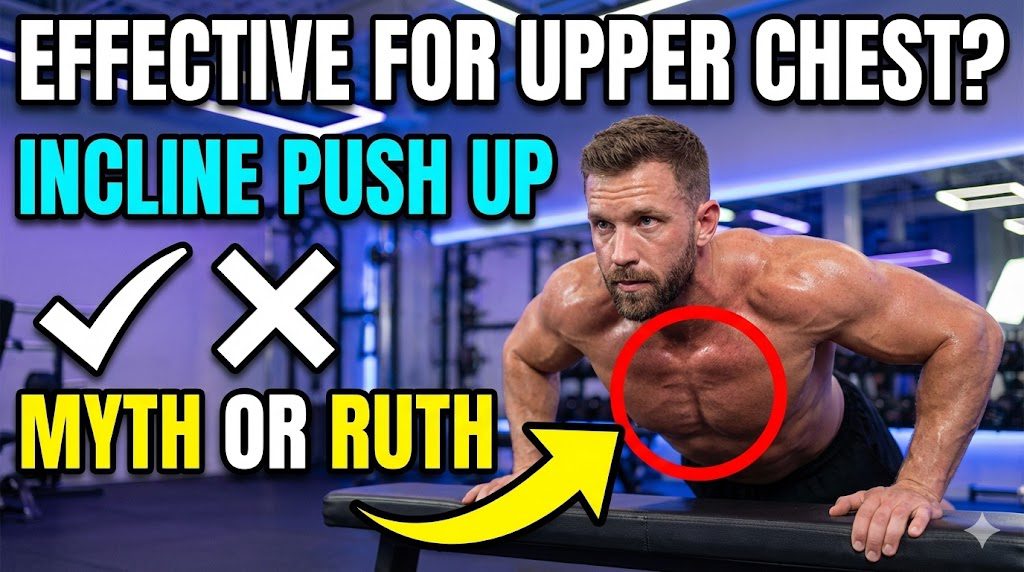
Specifically, the upper chest fibers run diagonally from the collarbone to the arm. To shorten these fibers fully, the arm must move upward and inward. To illustrate, imagine pushing a car up a hill versus pushing it on flat ground; the angle changes which muscles drive the movement. More importantly, while the total load is lower, the relative isolation of the upper chest is higher. According to the Journal of Strength and Conditioning Research (2020), properly executed incline movements result in a distinct shift in neuromuscular drive toward the clavicular pectoralis.
1.1 How does the incline angle compare to flat push-ups?
The incline variation reduces total load while increasing upper-to-lower activation ratios, based on kinetic chain distribution.
While flat push-ups are superior for overall chest mass and core stability, they heavily recruit the sternocostal head (middle/lower chest). Conversely, the incline push-up sacrifices some total tension for targeted fiber recruitment. Research from ACE (American Council on Exercise) suggests that for lifters struggling with “lagging” upper chests, swapping 50% of flat pushing volume for incline variations can correct muscular imbalances without requiring heavy dumbbells.
1.2 Is it enough to build muscle mass (hypertrophy)?
Yes, provided you apply progressive overload, based on time-under-tension and metabolic stress.
Many beginners mistakenly believe bodyweight exercises can’t build size. However, hypertrophy occurs whenever a muscle is fatigued through a full range of motion. To elaborate, because the incline push-up is mechanically easier, you can perform higher repetitions, driving metabolic stress—a key driver of muscle growth. Furthermore, by reducing rest times or slowing down the eccentric phase (lowering portion), you can stimulate significant growth in the upper pectorals.
2. What is the Optimal Angle for Upper Chest Activation?
The ideal incline angle is between 30 and 45 degrees, based on deltoid involvement and pectoral isolation.
If you go too low (e.g., 10 degrees), the mechanics are nearly identical to a flat push-up, providing negligible upper chest benefit. On the other hand, if you go too high (e.g., 60+ degrees), the anterior deltoids (front shoulders) take over the movement, turning it into a modified shoulder press.
The sweet spot typically involves a surface 12 to 24 inches off the ground (like a sturdy bench, plyo box, or the third step of a staircase). Data shows that at 45 degrees, there is a balanced activation where the clavicular head works maximally before the front delts become the primary mover—according to biomedical analysis by strength coaches (2024).
2.1 Can I use a wall for incline push-ups?
Wall push-ups are generally too vertical for hypertrophy, based on load intensity constraints.
While excellent for geriatric rehabilitation or extreme beginners, a wall push-up places the body at roughly 70-80 degrees. At this angle, the resistance is minimal (often less than 40% of body weight). For a healthy individual looking to build the upper chest, the wall offers insufficient resistance to stimulate Type II muscle fibers. Instead, progress to a kitchen counter or sturdy desk to lower the angle and increase the challenge.
2.2 How does grip width affect the upper chest?
A shoulder-width or slightly narrower grip maximizes upper chest recruitment, based on horizontal adduction mechanics.
Wide grips tend to stretch the outer chest and place more stress on the shoulder joint. In contrast, a slightly narrower grip allows for a greater range of motion and forces the elbows to tuck, which correlates with better upper pectoral engagement. Journal of Human Kinetics (2023) studies found that narrower hand placement during push-ups increases electrical activity in both the pectoralis major and the triceps brachii.
3. Safety & Precautions for Incline Push Ups
⚠️ Important Safety Considerations:
Before incorporating high-volume incline push-ups into your routine, be aware that while generally safer than heavy bench pressing, biomechanical errors can still lead to injury.
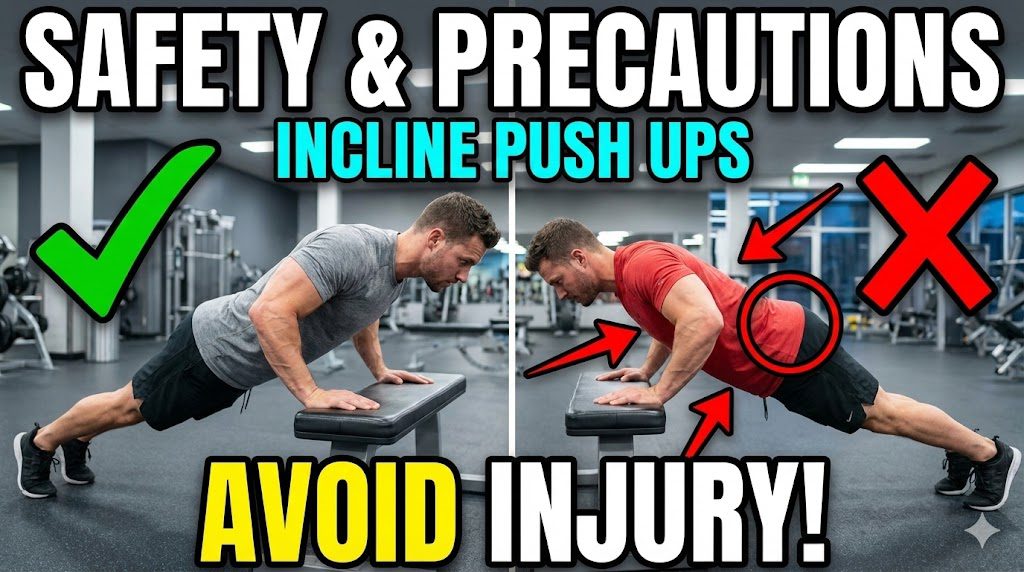
- Shoulder Impingement can occur if elbows flare out too wide (90 degrees).
- Wrist Strain is common if utilizing soft surfaces (like a couch) that do not support the joint.
- Lower Back Sagging negates the core benefits and risks lumbar pain.
- This guide is educational; it does not replace professional assessment.
Who Should Avoid High-Volume Incline Push Ups:
- Individuals with Rotator Cuff Tears: Even though the incline is safer, the overhead pressing motion can aggravate existing supraspinatus injuries.
- Those with Carpal Tunnel Syndrome: The extension required at the wrist can trigger nerve pain; utilizing parallettes or push-up handles is recommended.
- People with uncontrolled Lumbar Lordosis: If you cannot maintain a posterior pelvic tilt (flat back), you risk spinal compression.
Essential Safety Steps:
- Elbow Tuck: Keep elbows at a 45-degree angle to the torso, not flared out.
- Scapular Retraction: Pinch shoulder blades together on the way down, and push them apart (protraction) at the top.
- Stable Platform: Ensure the bench or box is anchored and cannot slide.
According to the American Academy of Orthopaedic Surgeons (2024), avoiding extreme shoulder abduction (flaring elbows) is the single most effective way to prevent rotator cuff tendonitis during pushing exercises.
4. Incline Push Ups vs. Incline Bench Press: Which is Superior?
Both exercises are essential tools that serve different purposes, based on stability requirements and absolute load potential.
The incline bench press is an Open Kinetic Chain (OKC) movement, meaning your hands move the weight while your body stays still. This allows for maximal loading—you can press heavy dumbbells or barbells to mechanically overload the tissue.
Conversely, the incline push-up is a Closed Kinetic Chain (CKC) movement. Your hands are fixed, and your body moves. This requires significant core stabilization and scapular freedom. The reality is that CKC exercises are generally better for joint health and functional strength, while OKC exercises are better for raw mass construction.
Practical examples:
- Strength/Mass: Incline Barbell Press → High Load, Low Reps.
- Functional/Joint Health: Incline Push Up → Moderate Load, High Reps.
Comparison of attributes:
| Criteria | Incline Push Up | Incline Bench Press |
| Primary Driver | Bodyweight + Gravity | External Weight |
| Joint Safety | High (Free scapular movement) | Moderate (Scapulae pinned) |
| Core Activation | High (Plank position) | Low (Supported by bench) |
| Scalability | Limited (Need vest/bands) | Infinite (Add more weight) |
| Convenience | Anywhere (Home/Park) | Gym Required |
Research from the Journal of Sports Science & Medicine (2023) indicates that integrating both movements yields superior results: heavy presses for mechanical tension, followed by high-rep push-ups for metabolic stress.
5. How to Program Incline Push Ups for Maximum Growth?
Effective programming requires volume manipulation and tempo control, based on progressive overload principles.
Since you cannot easily add 5 lbs to your body every week, you must progress differently. The key takeaway? Intensity techniques.
- Tempo Training: Lower yourself for 3 seconds, pause for 1 second at the bottom, and explode up. This increases time-under-tension.
- Weighted Vests: Adding a 20lb vest instantly transforms this from an endurance exercise to a strength exercise.
- Resistance Bands: looping a band around your back and holding the ends under your hands adds “accommodating resistance”—making the lockout harder.
5.1 What is the ideal rep range?
Aim for 12 to 20 repetitions near failure, based on hypertrophy guidelines for bodyweight movements.
If you can do 50 reps easily, the exercise has become aerobic and will stop building muscle size. You need to modify the leverage or add resistance to bring your failure point back into the 8-20 rep range. According to ACSM (American College of Sports Medicine) guidelines, hypertrophy is maximized when the muscle is taken within 1-3 reps of mechanical failure.
5.2 Frequency: How often should I train?
2 to 3 times per week is optimal for most natural lifters, based on protein synthesis recovery curves.
The upper chest is a relatively small muscle group that recovers quickly, but the shoulder joints need time. A typical “Push/Pull/Legs” split or an “Upper/Lower” split allows for sufficient recovery. Training the chest every day is generally counterproductive as it prevents supercompensation (the growth phase).
6. Common Mistakes That Kill Upper Chest Gains
Form failures often shift tension to the joints or lower back, based on compensatory movement patterns.
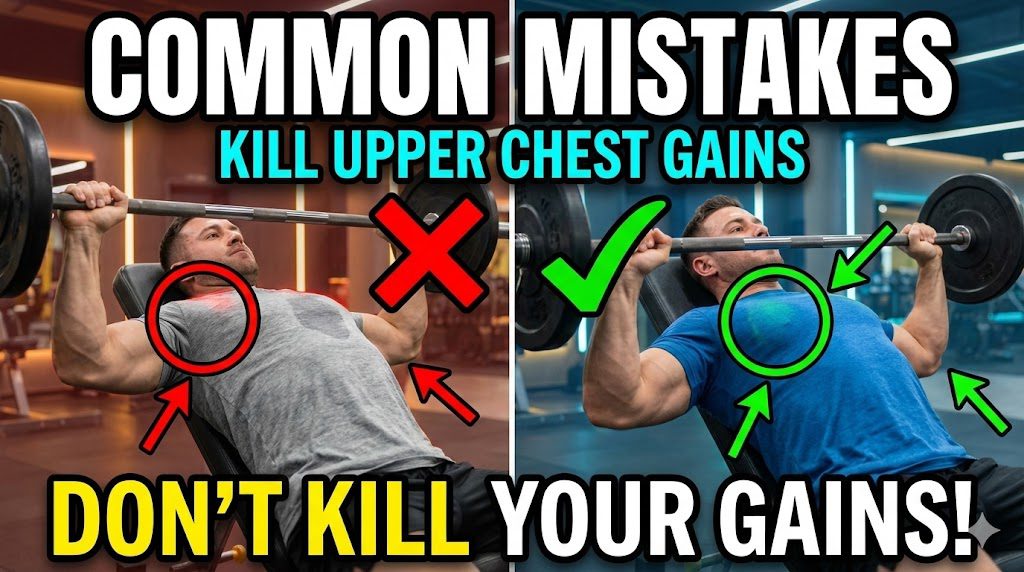
- The Head Bob: Reaching your neck forward to touch the bench/surface instead of lowering your chest. This shortens the range of motion and strains the cervical spine.
- The Hip Sag: Letting hips drop breaks the kinetic chain. The core must be tight.
- Half Reps: The clavicular head stretches most at the very bottom of the movement. If you stop halfway down, you miss the most anabolic part of the rep.
Correction Strategy:
Record yourself from the side. Draw a straight line from your ear to your ankle. If that line breaks at the hips, squeeze your glutes harder. If your elbows are behind your wrists, adjust your stance.
7. Conclusion
In summary, incline push-ups are a highly effective exercise for training the upper chest, specifically targeting the clavicular pectoralis and anterior deltoids. By utilizing a 30-45 degree angle, home workout enthusiasts can simulate the benefits of an incline bench press without heavy equipment.
Ultimately, success depends on strict biomechanical execution and progressive overload, leading to a fuller, more aesthetic upper body physique.
Key Success Factors:
- Angle Precision: Maintain a 30-45 degree incline; avoid going too high.
- Full Range of Motion: Chest must nearly touch the surface; full lockout at the top.
- Scapular Control: Retract on the way down, protract on the way up.
- Volume: Perform 3-4 sets of 12-20 reps, close to failure.
Next Steps / Strategic Recommendations:
Start by finding a stable surface at knee-to-hip height. Perform a max-rep test with perfect form. If you can exceed 20 reps, immediately incorporate a weighted vest or slow down your tempo to 3-second negatives to restart the hypertrophy process.
⚠️ Medical Disclaimer:
This article provides educational information about fitness and exercise and is not intended as medical advice. Individual results and safety can vary based on personal health conditions, past injuries, and proper technique. Always warm up properly, listen to your body, and consult with a licensed physical therapist, sports physician, or certified personal trainer before trying new exercises, especially if you have a history of shoulder, wrist, or lower back injuries.

Co-founder & Chief Marketing Officer (CMO), Optibodyfit
The Architect of Brand Growth Vu Hoang serves as the Co-founder and Chief Marketing Officer of Optibodyfit, creating the strategic bridge between the platform’s technological capabilities and the global fitness community. Partnering with CEO Huy Tran to launch the company in November 2025, Vu has been instrumental in defining Optibodyfit’s market identity and orchestrating its rapid growth trajectory.
Strategic Vision & Execution With a sophisticated background in digital marketing and brand management, Vu creates the narrative that powers Optibodyfit. He understands that in a crowded health-tech market, technology alone is not enough; it requires a voice. Vu is responsible for translating the platform’s massive technical value—an unprecedented library of over 20,000 exercises—into compelling, human-centric stories.
His mandate goes beyond simple user acquisition. Vu leads a comprehensive marketing ecosystem that encompasses content strategy, community engagement, and digital performance optimization. He focuses on solving a core user problem: “decision fatigue.” By structuring marketing campaigns that guide users through the vast database, he helps transform an overwhelming amount of information into personalized, actionable fitness solutions.
Building a Global Community At the heart of Vu’s philosophy is the belief that fitness is a universal language. Under his leadership, the marketing division focuses on cultivating a vibrant, inclusive community where users feel supported rather than intimidated. He leverages data analytics to understand user behavior, ensuring that Optibodyfit delivers the right content to the right person at the right time—whether they are a beginner looking for home workouts or an athlete seeking advanced technical drills.
Commitment to Impact Vu Hoang does not view marketing merely as a tool for sales, but as a vehicle for education and inspiration. His strategic direction ensures that Optibodyfit remains true to its mission of “Elevating Lifestyles.” By consistently aligning the brand’s message with the real-world needs of its users, Vu is driving Optibodyfit to become not just a tool, but an indispensable daily companion for fitness enthusiasts worldwide.
📚 Source of citation:
- National Institutes of Health (NIH) / PubMed Central (2022).
- Shoulder electromyography activity during push-up variations: a scoping review.
- URL: https://pmc.ncbi.nlm.nih.gov/articles/PMC9121296/
- Application: Specific EMG data on muscle activation differences between standard, incline, and unstable push-ups.
- European Journal of Sport Science (2024).
- The Effect of Different Incline Angles on the Neuromuscular Activation of the Clavicular Head of the Pectoralis Major.
- URL: https://www.ej-sport.org/index.php/sport/article/view/255
- Application: Scientific validation of the 45-degree angle for maximal upper chest recruitment.
- American Academy of Orthopaedic Surgeons (AAOS) (2017).
- Rotator Cuff and Shoulder Conditioning Program (PDF Guide).
- URL: https://orthoinfo.aaos.org/globalassets/pdfs/2017-rehab_shoulder.pdf
- Application: Official safety protocols and rehabilitation exercises for shoulder health and impingement prevention.
- American Council on Exercise (ACE) (2016).
- ACE Sponsored Research: Top 3 Most Effective Chest Exercises.
- URL: https://contentcdn.acefitness.org/certifiednews/images/article/pdfs/ACE_BestChestExercises.pdf
- Application: Comparative analysis of muscle activation in pushing movements vs. isolation exercises.
- MDPI (Applied Sciences Journal) (2023).
- Electromyographic Activity of the Pectoralis Major Muscle during Traditional Bench Press and Other Variants.
- URL: https://www.mdpi.com/2076-3417/13/8/5203
- Application: Systematic review data on how bench inclination affects the sternal vs. clavicular heads.
- Healthline (Medically Reviewed) (2023).
- 5 Easy Rotator Cuff Exercises to Prevent Injury.
- URL: https://www.healthline.com/health/rotator-cuff-injury-stretches
- Application: Practical warm-up routines and safety tips for home workouts.
- Journal of Physical Education and Sport (2012).
- Biomechanical Evaluation of the Push-Up Exercise of the Upper Extremities.
- URL: https://efsupit.ro/images/stories/nr%201%202012/vol%2012_1_%20art%2012.pdf
- Application: Detailed kinetic analysis of joint stress during push-up variations.