Reverse Bear Crawl
Benefit Reverse Bear Crawl?
-
-
Improves shoulder stability and strength
-
Engages the deltoids, rotator cuff, and scapular stabilizers under load.
-
-
Enhances core activation
-
Requires continuous engagement of the rectus abdominis, obliques, and deep core muscles to maintain posture.
-
-
Builds coordination and motor control
-
Moving backward challenges proprioception and cross-body coordination.
-
-
Increases hip and leg strength
-
Activates hip flexors, quadriceps, glutes, and calves during controlled movement.
-
-
Boosts mobility and joint health
-
Promotes active range of motion in shoulders, hips, and ankles.
-
-
Improves cardiovascular conditioning
-
When performed continuously, it elevates heart rate and supports endurance.
-
-
Enhances athletic performance
-
Transfers well to sports requiring crawling, agility, and total-body control.
-
-
Low equipment, full-body exercise
-
Requires no equipment and can be done in small spaces, making it highly practical.
-
-
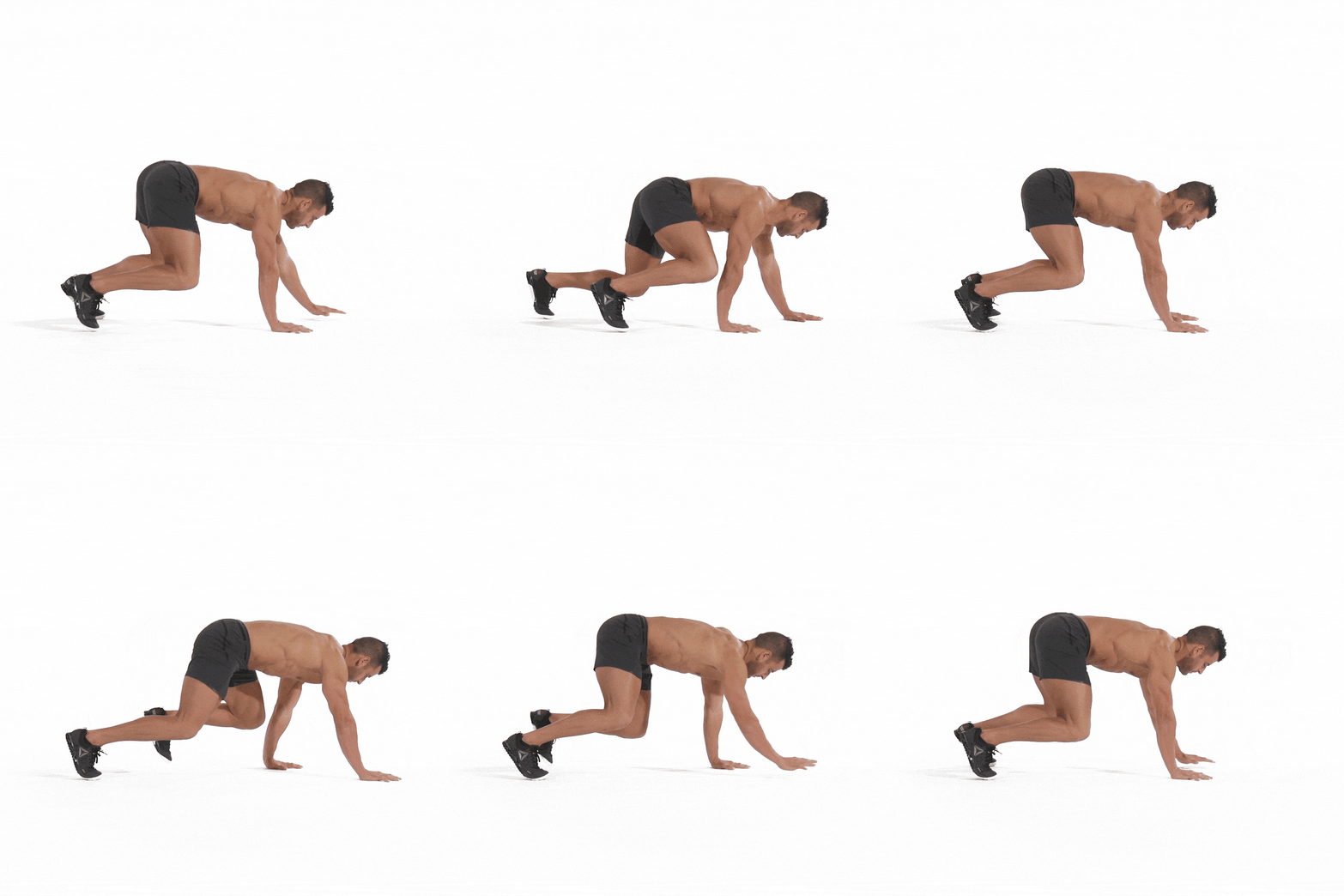
How to Perform Reverse Bear Crawl?
-
Start in a tabletop position
-
Place hands under shoulders and knees under hips, spine neutral.
-
-
Lift knees off the ground
-
Raise knees 2–5 cm, keeping your back flat and core tight.
-
-
Engage your core and shoulders
-
Brace your abs and press firmly through your hands.
-
-
Move backward with opposite limbs
-
Step right hand and left foot back together, then switch sides.
-
-
Keep hips low and controlled
-
Avoid lifting hips too high or letting them drop.
-
-
Maintain steady breathing
-
Inhale through the nose, exhale with control.
-
-
Continue for distance or time
-
Perform for 10–30 seconds or 5–10 controlled steps.
-
-
Finish with control
-
Lower knees gently to the floor and relax.
-
Training Recommendations Of Reverse Bear Crawl
Related Exercises
Bear Crawl Shoulder Taps
Improves core stability: The Bear Crawl with Shoulder Tap activates the rectus abdominis, transverse abdominis, and obliques to resist trunk rotation. Research from McGill University, Department of Kinesiology (2010) found that anti-rotation exercises significantly enhance spinal stability and reduce lower-back injury risk. Enhances shoulder strength and stability: Supporting body weight on one arm while tapping the opposite shoulder increases activation of the deltoids and rotator cuff muscles. A study by University of Wisconsin–La Crosse, Exercise Science Department (2014) showed that closed-chain shoulder exercises improve joint stability and neuromuscular control. Develops cross-body coordination: The contralateral movement pattern (right hand supports while left hand taps) improves neuromuscular coordination. Harvard University, Department of Neurobiology (2016) reported that cross-lateral movements enhance communication between brain hemispheres, improving motor control. Builds total-body functional strength: This exercise simultaneously engages the upper body, core, and lower body. According to National Strength and Conditioning Association (NSCA), 2018, integrated bodyweight movements are effective for developing functional strength applicable to daily and athletic activities. Improves balance and proprioception: Shifting weight during the shoulder tap challenges balance and body awareness. Research from University of Queensland, School of Human Movement Studies (2012) found that unstable, multi-joint exercises significantly improve proprioceptive ability. Increases metabolic demand: Maintaining a crawling position with added shoulder taps elevates heart rate and energy expenditure. A study by American Council on Exercise (ACE), 2015 showed that compound bodyweight exercises produce higher metabolic cost than isolated movements.
Weighted Bear Crawl
Full-body strength development: Adding weight increases loading on the shoulders, chest, arms, core, hips, and legs simultaneously, improving total-body muscular strength. Core stability and anti-rotation control: The weighted bear crawl strongly activates the deep core (transverse abdominis, obliques, spinal stabilizers) to resist rotation and spinal collapse. Shoulder stability and durability: Weight-bearing in a crawling position strengthens the rotator cuff, scapular stabilizers, and serratus anterior, supporting healthier shoulders. Improved hip mobility and coordination: The contralateral movement pattern enhances hip flexion/extension control and coordination between upper and lower body. Enhanced muscular endurance: Sustained crawling under load builds local muscular endurance in the shoulders, arms, and core. Functional movement carryover: Mimics real-world locomotion and athletic demands, improving transfer to sports and daily activities. Increased metabolic demand: The added load raises heart rate and energy expenditure, supporting conditioning and fat loss goals. Grip and forearm strength (if using external load): Weighted vests, chains, or sled resistance increase grip and forearm engagement. Joint-friendly strength option: Provides a closed-chain, low-impact alternative to heavy axial loading while still delivering high training stimulus.
Lateral Bear Crawl
Improves core stability Activates deep core muscles (transverse abdominis, obliques) to maintain a neutral spine during lateral movement. Enhances shoulder strength and stability Requires isometric shoulder loading, strengthening the deltoids, rotator cuff, and scapular stabilizers. Develops full-body coordination Demands synchronized movement between upper and lower limbs, improving neuromuscular control. Increases hip mobility and strength Lateral stepping challenges hip abductors and adductors, supporting better pelvic control. Boosts functional movement patterns Mimics real-life lateral locomotion, which is useful for sports and daily activities. Improves balance and proprioception Constant weight shifting enhances body awareness and postural control. Promotes muscular endurance Sustained crawling builds endurance in the arms, legs, and core simultaneously. Low-impact but high-intensity conditioning Elevates heart rate without excessive joint stress, making it suitable for many training levels.
Bear Plank (Bear Hold)
1. Improves Core Stability and Strength The Bear Plank forces you to brace your deep core muscles (transverse abdominis, obliques) to keep your back flat and hips stable, enhancing full-body stability more than a traditional static plank. 2. Enhances Shoulder and Upper-Body Endurance Maintaining the “bear” position recruits the shoulders, serratus anterior, and upper back muscles to resist collapse, building endurance and resilience for pushing/pulling movements. 3. Strengthens Hip and Glute Control Because your knees hover off the floor, your hips and glutes must stabilize your pelvis — this improves coordination and can reduce lower-back strain. 4. Builds Better Movement Mechanics The Bear Plank mimics quadruped stability — a foundational movement pattern — helping translate core control into walking, running, lifting, and athletic tasks. 5. Low Impact, Scalable, and Accessible It’s a joint-friendly exercise that can be scaled — from holding still to adding arm/leg lifts — making it suitable for beginners through advanced trainees. Why These Matter People do Bear Planks for the following reasons: Core Stability & Posture: Strong core muscles from Bear Holds help maintain neutral spine alignment during daily tasks and heavy lifts, reducing injury risk. Shoulder Health: Holding the scapulae (shoulder blades) stable in the Bear Hold strengthens key stabilizers, which can improve overhead performance and posture. Hip Control: Teaching the hips to stay level without sagging improves movement quality and supports lower-back health. Functional Strength Transfer: The dynamic stability carries over to real-world movements where the trunk must support and transfer force between upper and lower body.
Forward Bear Crawl
The forward bear crawl improves full-body strength, core stability, shoulder mobility and stability, coordination, and cardiovascular fitness. This exercise is widely used in athletic training and rehabilitation because it simultaneously challenges multiple muscle groups and the nervous system. People perform the forward bear crawl for the following reasons: Full-body strength: The movement requires the arms, shoulders, hips, and legs to support and propel body weight continuously; research from McGill University, Department of Kinesiology (2015) found that quadrupedal locomotion strongly activates both upper- and lower-body musculature. Core stability: The spine must remain neutral throughout the movement; a study by the University of Waterloo, Department of Health Sciences (2017) showed that bear crawl exercises produce high activation of the transverse abdominis and oblique muscles, which are essential for trunk stability. Shoulder stability and mobility: The shoulders function as weight-bearing joints during the crawl; findings from the University of Queensland, School of Human Movement Studies (2016) indicate that closed-chain exercises like the bear crawl improve scapular control and joint integrity. Coordination and motor control: The contralateral hand–foot movement pattern enhances neuromuscular coordination; research conducted by the University of Tokyo, Department of Sports Sciences (2018) demonstrated improved interlimb coordination from crawling-based movement patterns. Cardiovascular fitness: Continuous whole-body engagement elevates heart rate and oxygen demand; a study from the University of British Columbia, Exercise Physiology Laboratory (2019) reported that sustained bear crawl drills reach intensities sufficient to develop both aerobic and anaerobic capacity.